Home / Commercial roofing / Inspections
Roof inspections and infrared surveys that tell you what to spend
Before you repair, restore or replace, find out where the roof is wet, where it's sound and what it will need over the next five years.
Inspection types
Pick the inspection that answers your question
A leak, a purchase, a storm and a reserve study each call for a different level of detail. We'll recommend the lightest inspection that gives you a reliable answer.
Condition inspection
A section-by-section roof walk covering the field, seams, flashings, drains, penetrations, walls and edges, with photos and a written priority list. The starting point for most decisions.
Infrared moisture survey
An evening thermal scan that finds wet insulation hidden under the membrane, verified with core cuts and mapped on a roof plan.
Drone roof report
Overhead imagery of large, tall or hard-to-reach roofs. Useful for boards, insurers and multi-building communities, and for documenting a roof without walking every square foot.
Core cuts
Small samples cut through the roof to the deck. They show how many roofs are on the building, what the insulation is, whether it's wet and what the deck is.
Pre-purchase
Know the roof's real condition and remaining life before you close, so the price, the lender and your first-year budget reflect it.
Post-storm
Dated photos, measurements and test cuts after hail or high wind, while the storm date is fresh. See after a hailstorm.
Warranty inspection
A documented inspection before a manufacturer warranty expires, so covered defects are reported while they're still covered.
Leak investigation
For leaks that keep coming back. We find the entry point and the wet area around it instead of patching the spot above the stain.
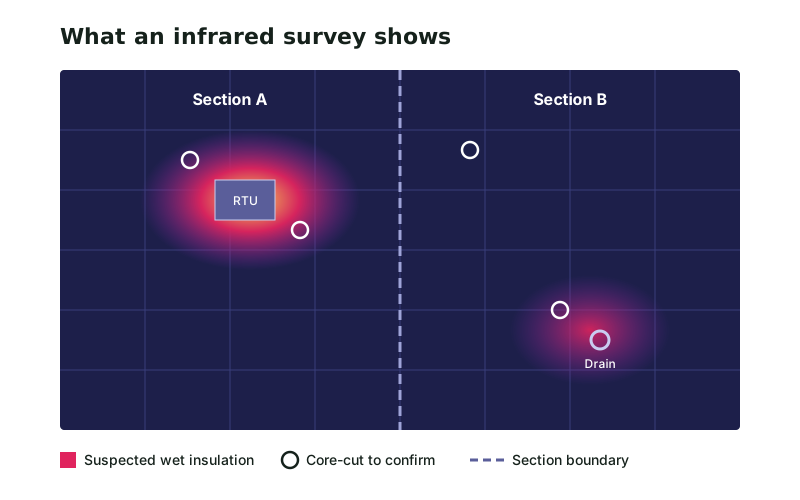
Why wet insulation changes the decision
Water that gets past a membrane soaks into the insulation below and stays there. Wet insulation loses its insulating value, adds weight, rusts fasteners and decks, and is the main reason a roof that looks fine from above has to be replaced.
If only a few areas are wet, those can be cut out and replaced, and the rest of the roof repaired or restored. If most of it is wet, replacement is the honest answer. Either way, you'll be spending based on data instead of guesses.
A visual inspection can't tell you this. A membrane over saturated insulation often looks the same as one over dry insulation, which is why the survey matters most when the decision is expensive.
How an infrared moisture survey works
The method is simple physics. During the day, sun warms the whole roof. After sunset, the roof gives that heat back to the night sky. Dry insulation holds little heat and cools quickly. Wet insulation holds much more, so it stays warm for hours after the dry areas have cooled. A thermal camera sees that difference as warm patches on the roof surface, often in shapes that follow how water spreads: outward from a curb, a drain or a seam. The industry reference for this method is ASTM C1153, the standard practice for locating wet roof insulation with infrared imaging.
The conditions have to be right
An infrared survey only works on the right evening, which is why we schedule it with the weather rather than the calendar:
- A sunny day first, so the roof absorbs enough heat to show a difference after dark.
- A dry roof surface, with no rain, snow, frost or standing water. Surface moisture cools by evaporation and hides what's underneath.
- Clear skies and light wind in the evening. Clouds slow cooling, and wind cools the surface evenly and washes out the pattern.
- Scanning after sunset, once dry areas have cooled and the wet areas stand out.
Along the Front Range, late spring through early fall offers the most usable evenings. Winter surveys are possible on clear, dry days after the snow is gone, but they're harder to schedule.
Core cuts verify what the camera sees
A warm spot isn't proof of water. Extra layers of material, patches, flashings, rooftop units and differences in surface color can all show up warm. So we mark the suspect areas that night and come back in daylight to verify them with core cuts and moisture readings, along with cuts in areas that read dry for comparison. Each core is logged, with the layers, insulation type and thickness, deck type and whether it's wet, then patched watertight the same day.
Where infrared has limits
Infrared works best on roofs where the membrane sits directly on absorbent insulation. Heavy ballast or gravel surfaces, some highly reflective membranes and some insulation types give weaker signals. When a roof isn't a good candidate, we tell you before scheduling and rely on a grid of core cuts and moisture-meter readings instead. More background: infrared roof moisture surveys.
What the report includes
Whether you order a condition inspection or a full survey, the report is written for the people who have to approve the money: owners, boards, asset managers and lenders.
- Roof plan with sections, drains, penetrations, rooftop equipment and wet areas marked, with the approximate area of wet insulation in each section.
- Thermal images paired with daylight photos of the same spot, so anyone can see what the camera saw.
- Core-cut log: location, roof layers, insulation, deck and moisture condition at each cut.
- Condition by section, with photos of every finding and its cause where we can tell.
- Recommended action by section: repair, remove and replace wet areas, restore, recover or replace.
- Prioritized repair list with pricing, plus remaining-life estimates and budget ranges for larger work.
Using the results for capital planning and reserve studies
Without data, roofs get budgeted by age. That's how a roof with years left gets replaced early, and how a roof that looked fine fails the year after the reserve study said it had a decade. Survey data replaces the guess with remaining life by section, the cost of extending that life, and the year each section will need major work.
For owners and asset managers, that means a capital plan you can sequence: fix the wet areas now, restore what's sound, and schedule replacement for the year it's actually due. Our estimating is led by a CPA and licensed general contractor, so the numbers come laid out the way finance teams read them.
For associations, give the survey to your reserve specialist. Building-by-building condition and remaining-life estimates make the study more accurate and help the board phase replacements across several years. See HOA reserve planning and our guide to roof reserve planning.
Keep the survey current. A survey right after a new roof is installed gives you a dry baseline. After that, re-survey before major decisions, after significant hail, and as the roof ages, and pair it with twice-yearly S.M.a.R.T. maintenance in between.
Inspection and survey FAQs
What does a roof inspection or IR survey cost?
It depends on roof size, the number of buildings and roof levels, access, whether you need an infrared survey and core cuts, and the type of report. We quote a fixed price before scheduling so you know the cost up front.
When is the best time for an infrared survey in Colorado?
Late spring through early fall, on a clear, calm evening after a sunny day with a dry roof. We watch the forecast and schedule for the first good evening rather than a fixed date.
Will core cuts cause leaks or affect our warranty?
Each core is patched watertight the same day using materials compatible with your roof. If the roof is under a manufacturer warranty, we check its requirements first and coordinate when the manufacturer requires it.
Do you need access to the inside of the building?
Usually only roof access through a hatch, ladder or stair. For leak investigations, seeing where water shows up inside helps us trace it, so we may ask to see the ceiling or upper floor.
Can you inspect a building we're buying?
Yes. Tell us your closing and due-diligence dates when you reach out, and we'll recommend whether a condition inspection is enough or a survey with core cuts is worth it.
Should we inspect before or after a hailstorm claim?
Both, ideally. A recent inspection documents the roof's condition before a storm, which makes storm damage easier to prove. After a storm, call us before the adjuster's visit so damage is documented and we can meet them on the roof.