
Home / Resources / Maintenance and your warranty
Keeping your commercial roof warranty valid
A manufacturer warranty on a commercial roof comes with homework. Most make the owner responsible for maintaining the roof and proving it. Here's what warranties usually ask of you and what they leave out. You'll also see how to build the records that keep a claim from being turned down.
What's the difference between a manufacturer and a workmanship warranty?
A new commercial roof usually comes with two separate warranties, and it helps to know which one covers what:
- The manufacturer warranty comes from the company that made the membrane or system. Some cover only the materials. Others cover the whole roof system, labor included. That coverage applies when an applicator the manufacturer has approved installs the roof to its specification, and the manufacturer inspects it.
- The workmanship warranty comes from the contractor and covers installation errors. Truman provides a workmanship warranty on replacements.
As an approved applicator, Truman can offer extended manufacturer warranties on commercial projects. Terms differ by manufacturer, system and project, so your warranty document is the only reliable guide. Keep a copy where you can find it.
What do manufacturers usually ask of owners?
Read the "owner responsibilities" or "conditions" section of your warranty. The details vary, but most include some version of these:
- Regular maintenance and inspections. Periodic inspections, cleared drains and repairs of damage the manufacturer isn't responsible for.
- Records. Proof that the maintenance happened, usually dated reports, photos and invoices.
- Prompt written notice of leaks. Most warranties set a deadline for telling the manufacturer, often counted from when you discover the leak.
- Authorized repairs. Repairs to the roof made by a contractor the manufacturer authorizes, with compatible materials.
- Approval before changes. You notify the manufacturer, or get its approval, before new equipment, penetrations, solar arrays or other alterations go on the roof.
- Access. Letting the manufacturer inspect the roof when a claim is made.
When a claim is filed, the manufacturer may ask for proof that these conditions were met. A warranty with no maintenance history behind it is much harder to use.
What do warranties commonly exclude?
Warranties cover defects in what the manufacturer made, and in some cases how it was installed. They generally don't cover damage from outside causes. Common exclusions include:
- Lack of maintenance, such as clogged drains that let water back up against flashings
- Damage by other trades, including punctures, cuts and new penetrations by HVAC, solar, telecom or sign crews
- Unauthorized repairs or alterations, especially with materials that don't match the roof
- Foot traffic and dropped tools away from walkway pads
- Chemicals and grease, such as kitchen exhaust on single-ply membranes
- Building movement or structural problems outside the roof system
- Weather beyond stated limits. Some warranties cover hail up to a stated size or wind up to a stated speed when the roof is built to their specification. Know what yours says before hail season.
Hail and wind damage beyond the warranty's limits is usually a matter for your property insurance, not the manufacturer. Policies vary, so check yours and talk with your agent. Our guide to the first 72 hours after a hailstorm covers what to do when a storm hits.
What maintenance routine protects your coverage?
These six steps cover what most warranties ask of you:
Inspect twice a year and after storms
NRCA recommends inspecting low-slope roofs at least twice a year and after severe weather. On the Front Range, that means spring, after snow and before hail season, and fall, after hail and before freeze-thaw.
Keep drains and gutters clear
Water backing up from a clogged drain is the kind of damage warranties often treat as a maintenance failure rather than a defect.
Control who goes on the roof
Keep a sign-in log, require other trades to stay on walkway pads, and ask them to report anything they cut, dropped or moved.
Report leaks in writing, quickly
Follow the notice steps in the warranty, keep a copy of the notice and note the date.
Use an authorized contractor for repairs
Before any repair, confirm the contractor is authorized by your roof's manufacturer and uses compatible materials.
Keep everything in one file
Reports, photos, invoices, notices and correspondence, organized by date.
Our spring and fall roof maintenance checklist lists what each routine visit should cover.
What should happen before other trades work on your roof?
Many warranty problems start with someone who isn't a roofer. A new rooftop unit, a solar array, a cell antenna or a sign mount can mean new curbs, penetrations and fasteners through the membrane. Before the work starts:
- Check what the warranty requires for alterations, and notify or get approval from the manufacturer if it's needed.
- Have the roofing details, such as new curbs, pipe flashings and patches, done by an authorized roofer.
- Photograph the area before and after, and add the work to the roof file.
Curbs and penetrations around equipment are frequent leak points. See leaks around rooftop HVAC curbs.
What should you do when a warrantied roof leaks?
Act fast, and follow the steps your warranty sets out:
- Protect the interior first. Move equipment, catch the water and photograph it.
- Notify the manufacturer in writing as the warranty requires, and keep a copy.
- Call an authorized contractor. If you need a temporary repair to stop water, make sure it uses compatible materials and gets documented.
- Don't let an unauthorized crew patch it. A quick fix with the wrong materials can give the manufacturer a reason to deny the claim.
If water is coming in, call us first at (720) 296-0000 or report a leak. We'll tell you if the leak looks like a warranty item. When the manufacturer needs to be involved, we'll coordinate with them.
What should you do before the warranty expires?
Schedule a documented inspection before the warranty ends, so you can report covered defects while they're still covered. Selling the building? Ask the manufacturer whether the warranty can be transferred to the new owner and what that requires. Many transfers need their approval, and sometimes an inspection.
What should you ask before you sign for a new roof?
The best time to understand a warranty is before the roof goes on. Ask your contractor, and read the sample warranty:
- Does it cover materials only, or the whole system, labor included?
- What maintenance does it require, and what records will the manufacturer want to see?
- Are hail and wind covered, and up to what stated limits?
- Who is allowed to make repairs, and how are leaks reported?
- Can it be transferred if the building is sold?
Longer manufacturer warranties usually require a specific assembly, an approved applicator and documented maintenance. So the answers shape the roof you choose as much as the warranty you get.
How does our maintenance program build the record?
Our S.M.a.R.T. maintenance program (Service, Maintenance and Repair with Truman) builds the proof a manufacturer asks for as you go. Every visit adds a dated report, photos and a repair log. Visits happen twice a year, as NRCA recommends, plus checks after severe weather.
- Level 1, Clear & Check: drain and gutter cleaning, a visual inspection and a written report. Often right for newer roofs under warranty.
- Level 2, Clear & Repair: Level 1, plus debris removal and small general repairs during the visit.
- Level 3, Survey & Repair: Level 2, plus a full inspection, a roof survey and medium general repairs.
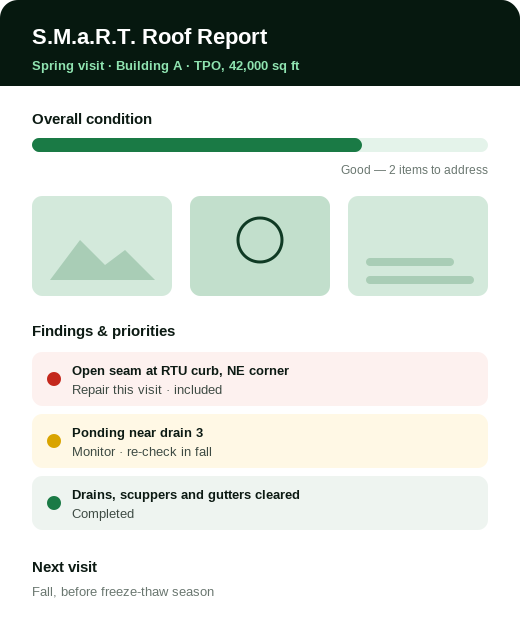
Before we work on a warrantied roof, we check what the warranty requires. That way a repair doesn't put your coverage at risk. Send us your warranty and we'll match the program to it. We maintain TPO, EPDM, built-up, metal and spray foam roofs across the Denver metro, from DTC office buildings to HOA communities. That includes commercial roofing in Centennial, where we're based. Request a maintenance quote to get started.
Roof warranty maintenance FAQs
Does our warranty require maintenance?
Most commercial roof warranties make the owner responsible for maintaining the roof. Check the conditions section of your warranty, or send it to us and we'll tell you what it asks for.
Can any roofer repair a warrantied roof?
Usually not. Many manufacturers require you to use a contractor they authorize, with compatible materials. Confirm before anyone works on the roof.
Does a manufacturer roof warranty cover hail?
Some cover hail up to a stated size when the roof is built to their specification; many exclude it. Damage beyond those limits is generally a property insurance question, so check your policy and talk with your agent.
What records should we keep?
The warranty itself, the original installation documents, every inspection report, photos, repair invoices, leak notices and correspondence with the manufacturer, organized by date.
Can the warranty transfer if we sell the building?
Sometimes. Many manufacturers allow a transfer with their approval and may require an inspection first. Ask the manufacturer before closing.