
Home / Resources / Roof maintenance checklist
A commercial roof maintenance checklist for spring and fall
Good commercial roof maintenance comes down to two visits a year, done in the right order, with a written record each time. Here's what to check in spring, what to check in fall, and what your staff can watch for in between.
Why does commercial roof maintenance run on two seasons?
Most low-slope leaks start small: a drain plugged with leaves, a seam opened by freeze-thaw, a pitch pan that dried out in the sun. Caught on a scheduled visit, each one is a small repair. Missed, water reaches the insulation, and wet insulation is what turns a repair into an early re-roof.
The National Roofing Contractors Association (NRCA) recommends inspecting low-slope roofs at least twice a year. It also recommends a check after severe weather. Along the Front Range, those two visits do different jobs:
- Spring repairs what winter did and gets the roof ready before hail season starts in mid-April.
- Fall finds what hail, wind and summer sun did and fixes it before freeze-thaw makes it worse.
Add a check after any hailstorm, chinook wind event or heavy wet snow. The checklists below follow the order a roofer works in. You start with drainage, then the field, then the details where most leaks begin.
What should you sort out before anyone goes up?
A roof walk isn't a job for building staff without fall protection and training. Roof edges, unguarded skylights, open hatches and slick membranes are real fall hazards. What staff can do is make the visit go smoothly:
- Know who holds roof hatch keys and ladder access, and keep a sign-in log for everyone who goes on the roof.
- Collect leak reports from tenants or residents since the last visit, with dates and locations.
- Note any rooftop work by HVAC, solar, telecom or sign contractors. Other trades often leave screws, cuts and debris behind.
- Pull the roof warranty, if there is one, so the maintenance matches what it requires.
What should the spring checklist cover?
Spring work repairs what winter did and gets the roof ready for hail. Book your spring visit between March and May, once snow is off the roof, and work through these items in order.
Drainage
- Clear roof drains, strainers, scuppers, gutters and downspouts of winter debris.
- Check that strainers and clamping rings are in place and overflow drains or scuppers are open.
- Look for ponding where snow sat or drifted, especially against parapets and behind rooftop units. Our guide to ponding water on flat roofs explains when it needs a fix.
- Confirm downspouts discharge away from the building and aren't crushed or disconnected.
Field and seams
- Walk the roof section by section, checking the membrane or surface for splits, punctures, blisters and wrinkles.
- Probe seams and laps for openings, especially where water froze and thawed in them.
- Note soft spots underfoot, which can mean wet insulation below.
- On gravel roofs, look for bare spots where wind or snow removal moved the stone.
- Note damage from snow shovels or ice removal.
Flashings, walls and edges
- Check base flashings at walls, curbs and parapets for loose, split or sagging material.
- Look at coping and edge metal for loose sections, open joints and missing fasteners after winter winds.
- Check counterflashing and termination bars, plus any sealant they rely on.
- Check expansion joints and the transitions between roof levels.
Penetrations, equipment and skylights
- Inspect pipe boots, pitch pans, vents and conduit supports. Refill or replace dried pitch pans.
- Check rooftop unit curbs and access panels, and look for condensate lines draining onto the roof. See leaks around rooftop HVAC curbs.
- Walk the service paths around equipment, where technicians' boots, tools and dropped screws puncture membranes, and check that walkway pads are still in place.
- Look for cracked skylight domes and gaps at skylight curbs.
Baseline photos and deferred repairs
Photograph each section in spring, before hail season. If a storm hits in June, dated photos from April make it much easier to show what changed. See what to do after a hailstorm for the steps that follow.
Spring is also the time to finish repairs that waited out the winter. A small opening gets bigger once heavy rain, hail and stronger sun arrive, and crews book up quickly once storm season starts.
What should the fall checklist cover?
Fall work finds what hail, wind and summer sun did and fixes it before freeze-thaw. Book your fall visit between September and November, before the first lasting snow.
Storm and sun damage
- Look for hail impacts on single-ply membranes: punctures, fractures and bruising. Check granular surfaces for granule loss, and metal panels, edge metal and vents for dents.
- Check for wind damage: lifted perimeter sheets, loose flashing and displaced ballast at corners.
- Reseal or repair sealant-dependent details that summer UV at altitude dried out.
- On spray foam roofs, check the coating for wear and hail fractures so recoating stays on schedule.
- Recheck every repair made earlier in the year to confirm it held through summer heat and storms.
Drainage before it freezes
- Clear leaves, seed pods and debris from drains, scuppers and gutters before they freeze in place.
- Check heat tape and its power supply where the building uses it.
- Make sure low spots that ponded in summer are noted, since they'll hold ice in winter. More on drains, scuppers and crickets.
Ready for snow
- Check snow guards on metal roofs above entrances, walkways and parking.
- Mark skylights, roof hatches and drains so they can be found under snow.
- Secure loose equipment panels and anything chinook winds could move.
- Confirm walkway pads are in place along service routes to rooftop equipment.
Our guide to preparing a commercial roof for winter covers snow removal plans and snow load warning signs.
Bigger decisions
The fall visit lands just before budget season, which makes it the right time to talk about larger work. Do some sections keep needing repairs, or does the report show widespread wear? Then ask for a repair-versus-replace comparison. That way your board or owner can plan for it instead of reacting to it.
What should you watch on each roof system?
The checklist is the same on every roof, but each system fails in its own places:
| System | Pay extra attention to |
|---|---|
| TPO | Welded seams, flashings at curbs and walls, punctures, grease near kitchen exhaust, and a clean surface so damage is easy to see |
| EPDM | Seam tape, shrinkage pulling at edges and penetrations, and ballast moved by wind |
| Built-up | Blisters, bare spots in the gravel, alligatoring on smooth surfaces, and pitch pans |
| Metal | Fasteners and washers, lap sealant, rust at cut edges, and snow guards |
| Spray foam | Coating wear, hail fractures, bird damage and exposed foam, which sunlight breaks down once the coating is gone |
What can your staff check between visits?
Facility staff and property managers can catch a lot without setting foot on the roof:
- Inside after rain or snowmelt. Walk top floors and stairwells for new ceiling stains, wet tiles, drips and musty smells, and note where and when they appear.
- From the ground. Look for overflowing gutters, downspouts that aren't running during rain, loose edge metal and sagging gutters.
- After storms. Dented gutters, damaged condenser fins or broken skylights mean the roof should be checked.
- After other trades. Make HVAC and other contractors report any puncture, cut or dropped tool on the roof. Then have the next roof visit look at it.
- Before storms and snow. Keep drains and scuppers visible and reachable so a crew can clear them quickly.
Keep all of it in one log with the roof reports. A leak history with dates is one of the most useful things a roofer can see.
What should each visit leave behind?
A roof inspection checklist only helps you if someone writes down the results. After every visit, you should get a report. It should show the roof's overall condition and photos of each finding, located on a roof plan. It should also list what was repaired and what's next, in priority order. Reports in the same format year after year let you compare buildings and see trends.
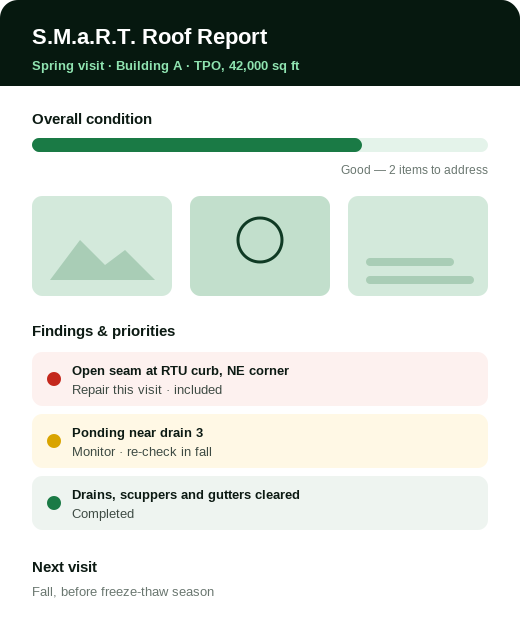
To see what a complete report includes, read our guide to roof survey and inspection reports. For the extra visits beyond spring and fall, see how often to inspect a commercial roof.
Some findings point to wet insulation, such as soft spots, blisters or recurring leaks. If you see them, ask for an infrared moisture survey and core cuts before you decide on repairs.
Can the S.M.a.R.T. program run the checklist for you?
Yes. Our S.M.a.R.T. maintenance program (Service, Maintenance and Repair with Truman) turns this checklist into a roof maintenance plan. It puts every item on a calendar. With every level, you get scheduled visits twice a year, as NRCA recommends, plus checks after severe weather. You get a written report after each one.
| Level | What's included | Usually fits |
|---|---|---|
| Level 1: Clear & Check | Drain and gutter cleaning, visual inspection, written report | Newer roofs in good condition |
| Level 2: Clear & Repair | Level 1, plus debris removal and small general repairs during the visit | Most working commercial and HOA roofs |
| Level 3: Survey & Repair | Level 2, plus a full inspection, a roof survey and medium general repairs | Older roofs and capital planning |
We maintain TPO, EPDM, built-up, metal and spray foam roofs, whether or not we installed them. You might run a DTC office building, a warehouse or a condo community anywhere in the Denver metro. Either way, we can maintain your roof. If you manage several buildings, you get one schedule and the same report format for every property.
Want your roofs on a spring and fall schedule? We're based in Centennial, and we handle commercial roofing in Centennial and the rest of our service area. Request a maintenance quote and we'll walk the roof, recommend a level and send a fixed annual price. If water is coming in now, report a leak or call (720) 296-0000.
Roof maintenance checklist FAQs
When should we schedule spring and fall roof maintenance in Colorado?
Spring visits work best between March and May, after the snow and before hail season starts in mid-April. Fall visits fit between September and November, after hail season and before freeze-thaw sets in.
Can our maintenance staff do the checklist?
Staff can watch ceilings, gutters and downspouts and keep a leak log. Leave walking the roof, probing seams and making repairs to a roofing crew. They have fall protection and the right materials for your system.
Is twice a year enough?
For most roofs, twice a year plus a check after severe weather is what NRCA recommends. Roofs with heavy foot traffic, kitchen exhaust, trees nearby or a history of leaks may need more attention.
Does maintenance affect our roof warranty?
Often, yes: many manufacturer warranties require you to maintain the roof and keep records. See roof maintenance and your manufacturer warranty.
Do you maintain roofs you didn't install?
Yes. Your first visit sets a baseline. We record a roof plan, the system, the condition of each section and any warranty requirements.