
Home / Resources / Commercial roofing systems
Types of commercial roofing systems in Colorado
Most commercial and association roofs along the Front Range use one of five types of commercial roofing systems. They are TPO, EPDM, built-up, metal and spray foam. Here's how each is built, how it holds up to hail, sun and snow, and which buildings it suits.
Why does the slope come first?
Slope comes first because it decides how water leaves the roof, and that decides which systems can work. Most commercial buildings, from DTC office towers to warehouses and condo complexes, have low-slope roofs. People call them flat, but they're built with a slight pitch toward drains. Water moves slowly across them, so they need a continuous waterproof surface. TPO, EPDM, built-up roofing and spray foam are all low-slope systems.
If your roof is steeper, gravity sheds the water, so it can use overlapping panels. On commercial, multifamily and mixed-use buildings, that usually means metal. Think standing seam mansards, canopies and whole roofs on metal buildings. Some metal panels are made for low slopes, too.
Why is a roof more than its membrane?
Whatever goes on top, a low-slope roof is a stack of layers, and the layers you can't see decide much of how it performs.
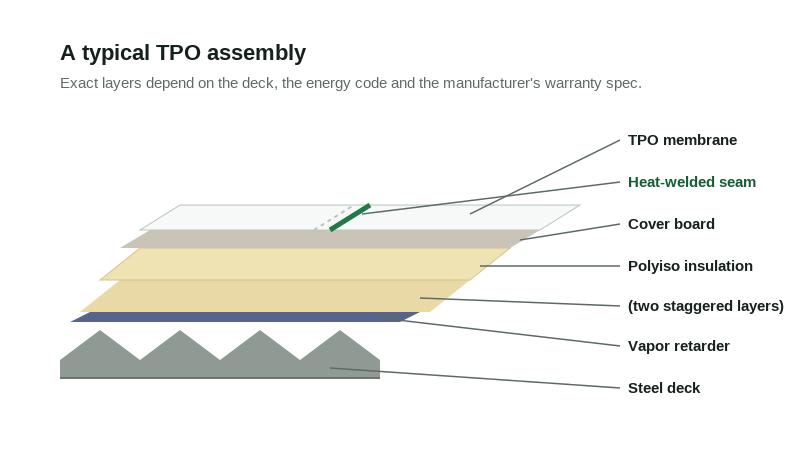
- Deck: steel, wood, concrete or, on older buildings, gypsum. It decides which fasteners and adhesives can be used.
- Insulation: rigid boards, sometimes tapered to build slope toward drains. When you replace the roof, you'll generally have to bring insulation up to the current energy code.
- Cover board: a thin, dense board that protects the insulation from hail and foot traffic.
- Surface and details: the membrane, plies, foam or panels. The details are the flashings at walls, curbs and penetrations, plus edge metal at the perimeter. Most leaks start there.
That's why two roofs with the same membrane can come through the same storm very differently.
What are the five main types of commercial roofing systems?
TPO (thermoplastic polyolefin)
TPO is a white, reinforced single-ply sheet laid over insulation and cover board. A hot-air welder fuses every seam, so the roof becomes one continuous piece. Because it's a thermoplastic, you can weld it again years later for repairs. TPO is the most common choice for new low-slope roofs and full re-roofs.
- Strengths: welded seams you can probe and test. Its reflective surface lowers your cooling loads and protects the membrane from UV.
- Watch for: hail resistance, which depends on thickness, cover board and attachment. Weathered TPO needs careful preparation before it will accept a new weld, and restaurant grease attacks it.
- Usually fits: offices, retail, medical and multifamily buildings where cooling matters, and roofs with cool-roof requirements.
More on TPO roof installation and repair.
EPDM (synthetic rubber)
EPDM is a synthetic rubber membrane, usually black, used on commercial roofs since the 1960s. It's cured at the factory, so seams are joined with tape and primer rather than heat. EPDM comes in large sheets, which means fewer seams. It can be fully adhered, mechanically fastened or ballasted with stone or pavers.
- Strengths: stays flexible in deep cold, tolerates building movement and is simple to patch at almost any age.
- Watch for: seam tape and flashings that age in high-altitude sun, and shrinkage that pulls at edges and penetrations. Chinook winds can scour ballast from corners, and black EPDM absorbs heat.
- Usually fits: repairing, recovering or matching existing EPDM. It also suits lightly conditioned warehouses and buildings where you want simple future repairs.
See EPDM roofing, or our side-by-side guide to TPO vs EPDM.
Built-up roofing (BUR, or tar and gravel)
Built-up roofing is the original multi-layer flat roof. It's usually three to five plies of reinforcing felt set in hot asphalt or cold adhesive. The top is a flood coat and gravel, or a smooth coating or cap sheet. If the top ply is damaged, the plies below still keep water out.
Older roofs may use coal tar pitch, which isn't compatible with asphalt repair products. Modified bitumen is a close relative used on smaller roofs and details. It comes as asphalt sheets that are torched, cold-applied or self-adhered.
- Strengths: redundancy, a surface that takes foot traffic, and gravel that shields the bitumen from sun and hail.
- Watch for: weight on older structures, blisters, alligatoring on smooth surfaces, and gravel scour at corners and drains. Expect kettle odor during installation. Some older felts and mastics contain asbestos. Where Colorado rules require it, you have to test them before tear-off.
- Usually fits: existing built-up roofs worth restoring, and roofs with heavy rooftop traffic.
See built-up roof repair and restoration.
Metal roofing
Three different systems share the name. Structural standing seam panels span between purlins and can be used on low slopes where the manufacturer allows. Architectural standing seam needs a solid deck and a steeper slope, and shows up on mansards, entries and accent roofs. Exposed-fastener panels, screwed through the face, are common on warehouses, shops and carports.
- Strengths: durable panels, good snow shedding, and retrofit options such as new framing and panels over the old roof.
- Watch for: fasteners, washers and lap sealants that fail long before the panels. Many policies treat hail dents as cosmetic. Snow can slide onto entrances and walkways, which snow guards control.
- Usually fits: sloped commercial, multifamily and mixed-use roofs and metal buildings. It also fits accent features that tie into a low-slope roof.
Spray polyurethane foam (SPF)
Two liquids mixed at the spray gun expand into a rigid, closed-cell foam. It forms a seamless roof and insulation layer in one. Foam can't stay exposed to the sun, so it always gets a flexible coating on top. That's usually acrylic, silicone or urethane.
- Strengths: no seams or fastener holes, and foam that flashes itself up curbs and penetrations. It adds continuous insulation, weighs little and can build slope where water ponds. When the coating wears, you recoat rather than replace.
- Watch for: coatings that wear down in UV at altitude, so you have to recoat on schedule. Hail can fracture the coating, and birds peck into foam. During installation, overspray can drift onto cars and buildings.
- Usually fits: recovers over dry built-up and low-slope metal roofs. It also suits irregular roofs with many penetrations and buildings that need more insulation.
See spray foam roofing and recoating.
How do commercial building roof types compare?
Each system has its own page in our commercial roofing section. Here's how they line up:
| System | Surface and seams | Weight | In hail | Main upkeep | Typical use |
|---|---|---|---|---|---|
| TPO | White sheet, heat-welded seams | Light | Depends on thickness, cover board and attachment | Seam and flashing checks | New low-slope roofs and re-roofs |
| EPDM | Rubber sheet, taped seams | Light unless ballasted | Depends on thickness and cover board; ballast shields it | Seam tape, flashings, shrinkage | Existing EPDM roofs, cold-weather flexibility |
| Built-up | Multiple plies, gravel or smooth surface | Heavy with gravel | Gravel helps; smooth surfaces are more exposed | Blisters, gravel, recoating smooth roofs | Older commercial buildings |
| Metal | Panels, seamed or screwed | Light | Dents; function versus appearance matters for coverage | Fasteners, sealants, snow guards | Sloped roofs and metal buildings |
| Spray foam | Seamless foam with a coating | Light | Dents; the coating has to stay intact | Scheduled recoats, bird damage | Recovers and irregular roofs |
How does Colorado weather narrow the choice?
For commercial roofing, Colorado weather adds five tests:
- Hail, mid-April to mid-August. Hail resistance comes from the whole assembly. You want a dense cover board, a thicker membrane or tougher coating, and attachment that keeps the surface tight. Some manufacturer warranties cover hail up to a stated size, if your roof is built to their specification. Ask what's excluded.
- UV at altitude. At a mile up, the sun is stronger. Reflective membranes and coatings run cooler, and sealants and coatings on every system need regular checks.
- Freeze-thaw. Water in a small opening freezes and widens it. Drainage and well-made seams matter more than the membrane label.
- Chinook winds. Uplift is strongest at corners and perimeters. Your roof design should add attachment there and use tested edge metal. If your roof is ballasted, it needs extra scrutiny.
- Snow loads add weight. Snow drifts against parapets and rooftop units, then melts into clogged drains. Before you choose a heavy system or a recover, get a structural check. Metal roofs over walkways need snow retention.
How do you match a system to your building?
When you fully replace a roof, you can choose any system your structure and slope allow. These questions narrow it quickly:
- What's there now, and is it wet? You can only recover a dry roof. If there are already two roofs, codes generally won't let you add a third. An infrared moisture survey and core cuts answer this before anyone picks a system.
- Can the structure carry it? Gravel and ballast are heavy. A lighter system can make a recover possible on an older building.
- How is the roof used? Kitchen exhaust grease attacks TPO and EPDM, so you'll need to protect those areas. Heavy service traffic calls for walkway pads or a tougher surface. Kettle odor and spray overspray need planning on occupied sites.
- What do codes require? If you tear off, you'll generally need to meet current insulation levels. That can change your edge and flashing heights. Denver's green building rules can require a cool roof on larger buildings at replacement. Re-roofs generally need a permit, so check with your city's building division.
- What warranty and maintenance will you commit to? If you want a longer manufacturer warranty, expect to need a specific assembly, an approved applicator and documented maintenance.
- How long will you hold the building? A short hold may favor a repair or recover; a long one can justify a fuller assembly.
For how these choices drive price, see commercial roof cost factors.
Which roofs suit which buildings?
The roof you'll find usually follows the building's use. Here's what's common, and what owners often consider at replacement:
| Building | Roofs you'll often find | Often considered at replacement |
|---|---|---|
| Office and medical | TPO, EPDM, built-up | TPO for cooling loads, with work planned around occupants |
| Retail and restaurants | TPO, EPDM, built-up | A single-ply membrane with protection at kitchen exhaust |
| Warehouse and industrial | Exposed-fastener metal, EPDM, built-up | Coatings or spray foam over sound metal; TPO or EPDM on low-slope decks |
| HOA and multifamily | Low-slope membranes plus metal mansards and canopies | Systems matched across buildings for simpler maintenance and reserves |
| Older gravel roofs | Built-up | Restoration if dry; otherwise tear-off to TPO, EPDM or new built-up, or a spray foam recover |
What should HOA boards and property managers track?
Track each roof by building, with its system, age and condition. Your community may have several systems at once. Think membranes on the main buildings, metal on mansards and carports, and an older built-up roof on a clubhouse or garage. With that inventory, your reserve plan reflects real replacement timing, and a hail claim starts with good records. See HOA and multifamily roofing for how we work with boards.
Not sure what's on your roof, or what should replace it? We inspect commercial and association roofs across our service area, from commercial roofing in Centennial to Denver. Request an inspection and we'll lay out the options side by side, with the cost drivers for each.
Commercial roof system FAQs
What is the most common commercial roof type?
For new low-slope roofs and full re-roofs, TPO. On existing buildings you'll also find plenty of EPDM and built-up roofs, plus metal on sloped roofs and metal buildings.
Which commercial roof lasts the longest?
No system wins on its label. How long your roof lasts depends on the assembly, installation quality, drainage, hail exposure and maintenance. A maintained roof of any of these types outlasts a neglected one.
Which roof system handles hail best?
Hail performance comes mostly from the assembly. Look for a dense cover board, a thicker membrane or tougher coating, and good attachment. Gravel and ballast also shield the surface.
Can we switch systems when we replace the roof?
Yes. On a tear-off you can choose any system that suits the structure and slope. On a recover, the new system has to work over the old one. That's why owners often move from black EPDM to white TPO with a separator or cover board between them.
Is a roof coating a new roof?
No. A restoration coating renews the surface of a sound, dry roof, and it can add years to your roof. Over wet insulation it traps the water, so it's only an option after a moisture survey.