
Home / Resources / Documenting hail damage
How to document hail damage on a commercial roof
An adjuster can only include damage someone can show. Here's how to document hail damage on a commercial roof before the adjuster arrives. It covers what to record, who should record it and how to build a file that matches what's on the roof.
Why is hail damage on a commercial roof hard to prove?
On a steep roof, hail leaves marks you can see from a ladder. On the low-slope roofs common in Denver Tech Center office parks, the damage is usually hidden. Hail fractures the cover board, crushes insulation and bruises the membrane without breaking the surface. Nobody sees it from the parking lot, and it may not leak until a winter of freeze-thaw opens what the hail cracked. That hidden layer is the hail damage commercial roof owners miss most often.
By then the storm is months old and harder to tie to the damage. The adjuster's job is to decide what this storm caused, as opposed to age, wear or an earlier storm. Good documentation answers three questions:
- When did it happen? A storm date backed by records.
- What did it damage? Every affected roof section, component and interior space, with photos tied to a location.
- What was the roof like before? Dated maintenance and inspection records that show how it looked before the storm.
You can gather part of that yourself, from the ground and inside the building. The roof itself needs a trained crew.
What you can document from the ground and inside
Start while the storm is fresh. Our checklist for the first 72 hours after a hailstorm covers safety and leaks. This is the record-keeping part.
- The storm itself. Date, start time, how long it lasted and the largest hail anyone saw. Photograph hailstones next to a coin or ruler, and keep phone photos and video with their original timestamps.
- Weather records. You can look up hail reports by date and location in the National Weather Service's Storm Prediction Center storm reports. Save the report for your storm date, plus any local news stories about it.
- Soft metals at ground level. Dents in gutters, downspouts, signs, metal doors and ground-mounted condensers show hail size and direction. Light fixtures and utility boxes help too. Take a wide shot that shows where each item is, then a close-up.
- Interior water. Photograph ceiling stains, wet tiles and damaged finishes before cleanup, room by room or unit by unit, and note the date each one appeared.
- Reports from tenants or residents. Keep a dated log of every leak report, with the location and who reported it.
Stay off the roof. Wet membranes are slick, and hail can hide roof edges and cracked skylights. Every set of footprints also adds marks the adjuster then has to sort out. Leave the roof to a crew with fall protection, and don't let door-to-door contractors walk it "to take a look."
What should a professional roof inspection record?
A hail report should let someone who has never been on your roof see what the inspector saw. Ours cover these areas.
A map and a numbering system
Every building, roof section and elevation gets a number on a site map or roof plan. That number then goes on every photo, note and estimate line. You might have one office building with four roof areas, or an HOA community with forty buildings. Either way, the owner or board, the manager and the adjuster should all be looking at the same labels.
Impacts on the surface
Inspectors mark hail hits, often with chalk, and photograph them with a scale so size and spacing show in the picture. Wide shots show you where each close-up was taken. Drone imagery helps on large or hard-to-reach roofs.
What's under the membrane
On low-slope roofs the worst damage often sits beneath an intact surface. Small test cuts expose fractured cover board or crushed insulation. We photograph each cut open, then again once it's patched watertight. Where water may have gotten in, an infrared moisture survey maps wet insulation before it leaks. Core samples then confirm what the camera sees.
Edges, penetrations and rooftop equipment
Edge metal, coping, vents, drains, skylights, curb flashings and pipe supports all take hits. So does mechanical equipment: hail bends condenser fins and dents fan housings and unit panels. Have your HVAC contractor document equipment damage so you can put it in the same claim.
Existing conditions, honestly noted
Old patches, ponding areas, worn seams and earlier damage belong in the report too. When you separate old wear from new storm damage, the rest of your file is easier to trust. The adjuster will look for that anyway.
Hail signs to document by roof system
| Roof system | What hail does | What to photograph |
|---|---|---|
| TPO and EPDM | Bruises or cracks the membrane, crushes insulation and fractures the cover board beneath it, stresses seams | Marked impacts with a scale, test cuts open and patched, seams and flashings near impacts |
| Built-up and modified bitumen | Displaces gravel, knocks off granules, fractures the surfacing and plies | Bare spots and fractures, granules collected at drains and downspouts, test cuts through the plies |
| Metal | Dents panels and ribs, cracks paint finishes, damages seams, fasteners and trim | Dent size and density with a scale on each section, damage at seams and fasteners, chipped finishes |
| Spray foam | Dents the foam and can fracture the protective coating or crush the foam surface | Impacts with a scale, and whether the coating is broken at each one |
Metal roofs deserve a note. Your policy may limit hail damage coverage on metal to functional damage, such as damage that lets water in, and leave out cosmetic dents. Document both kinds so the record is complete, and ask your agent how your policy treats each.
Pre-storm records are your best evidence
The strongest hail file starts before the storm. Every adjuster asks whether the damage is new. Dated photos and reports from last spring or fall help you answer that. Pull together what you have:
- Recent inspection and maintenance reports, with photos
- Repair invoices and the dates of earlier leaks
- The roof's installation date, the system and any manufacturer warranty
- Roof plans or a site map, if you have them
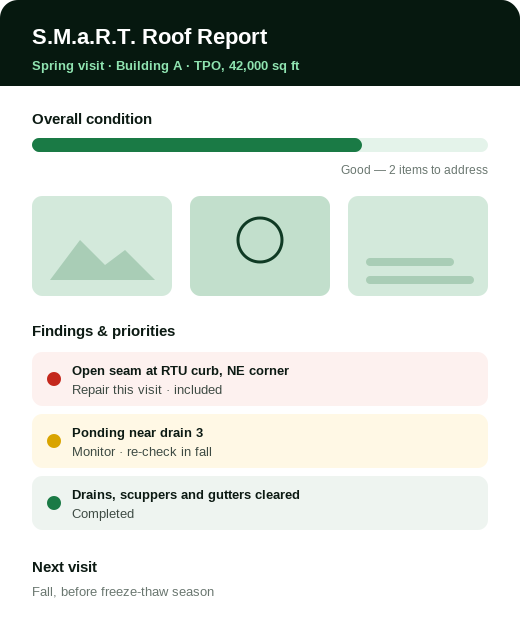
If you don't have a baseline, start one now. The NRCA recommends inspecting low-slope roofs twice a year and after severe weather. Our S.M.a.R.T. maintenance program leaves you a written report with photos after every visit. Along the Front Range, where hail season runs from mid-April to mid-August, the spring visit is the one that pays off at claim time.
Document temporary repairs, too
Most policies expect you to prevent further damage, so stop any active leaks first. Then record what was done:
- Photos of the damage before the temporary repair, and of the repair after
- The invoice, with the date, location and materials
- Damaged parts that were removed, such as a cracked skylight dome or a crushed vent cap. Keep them until the adjuster has seen them or tells you they aren't needed.
Hold off on permanent hail damage repair until your adjuster has seen the roof, unless waiting would cause more damage. If water is coming in now, call us first at (720) 296-0000 or report a leak.
Organize the file before the adjuster arrives
A complete file shortens the adjuster meeting and makes gaps in the carrier's estimate easier to spot later. Keep these in one shared folder:
Storm record
Date and time, hail size, timestamped photos and saved weather reports.
Site map and building list
The numbering every other document uses, with roof access notes.
Inspection report
Photos by roof section, test cut and core results, infrared findings and rooftop equipment notes.
Interior and occupant records
The leak log, interior photos and any reports from tenants or residents.
Pre-storm records
Maintenance reports, prior repairs, roof age and warranty information.
Mitigation records
Temporary repair photos, invoices and any parts you kept.
Policy and contacts
Policy number, claim number, the adjuster's contact details and a log of every call and visit.
For associations, keep the file by building number. Our guide to association hail claims covers multi-building records, deductibles and payments. If you manage several properties, our page for property managers shows how we report across a portfolio.
At the adjuster meeting
When you ask us to, we meet the adjuster on the roof and walk the documented damage together. We show the test cuts and explain how the roof is built. Afterward we prepare a detailed, line-item scope of the repair or replacement. If the carrier's estimate misses items, we document them for a supplement. Each one gets photos, measurements and the reason it's needed. Our hail claim timeline shows where this fits from storm to closeout.
What we don't do is negotiate your claim. You and your insurer make the coverage decisions. You negotiate the claim, with help from your agent or a licensed public adjuster. Policies differ on notice rules, deductibles, exclusions and how roofs are valued. Read yours, and ask your agent what applies to you. Treat this page as general information, not legal or insurance advice.
No deductible deals. Truman never pays, waives or rebates an insurance deductible on any job. Colorado's roofing contractor law forbids it on residential property, which can include condo and townhome buildings. An offer to "take care of the deductible" is a red flag.
Documentation mistakes to avoid
- Waiting for a leak. Hidden damage may not leak for months, and by then the storm date is harder to establish.
- Photos without locations. A close-up nobody can place on the roof is hard to use.
- Too many people on the roof. Several contractors walking it add scuffs and punctures that muddy the record.
- Blending buildings. Damage that isn't tied to a building number is hard to match against a carrier's building-by-building estimate.
- Permanent repairs too soon. If you replace damaged parts before the adjuster sees them, you remove the evidence.
The sooner hail damage is documented, the stronger the record. We're a local contractor based near the Denver Tech Center, not a storm crew. We document commercial and association roofs across the metro. Learn more about our commercial roofing in Centennial and our roof inspections and infrared surveys. When you're ready, request a hail damage inspection or call (720) 296-0000.
Hail damage documentation FAQs
Can our maintenance staff photograph the roof?
From the ground and inside the building, yes, and those photos are useful. Leave the roof itself to a crew trained and equipped for fall protection. Wet or hail-covered roofs are slippery, and extra foot traffic adds marks to the record.
How soon should we document hail damage?
As soon as it's safe. Hail melts, evidence fades and later storms blur the record. Your policy also sets notice deadlines, so tell your agent or carrier about the storm soon and ask which deadlines apply.
Why do you cut into the roof?
On low-slope roofs, crushed insulation and fractured cover board often sit under a membrane that looks fine. A small test cut is the most direct way to see and photograph that damage. Each cut is patched watertight.
Will the adjuster accept your report?
The adjuster and the insurer make their own determination. A clear report with photos tied to roof locations makes the damage easier to see. We'll also walk the roof with the adjuster to show it.
Should our rooftop HVAC units be checked separately?
Yes. Have your HVAC contractor check and photograph the units after the storm, so you can include equipment damage in the same claim. We note visible damage to curbs, flashings and housings in our report.
Can you negotiate the claim for us?
No. We'll document the damage, meet your adjuster on the roof and write a detailed scope. You negotiate the claim, with your agent or a licensed public adjuster.