
Home / Resources / Hail claim timeline
Commercial roof hail damage claims: a Colorado timeline
A commercial or association roof claim runs in stages, and each one depends on the last. Here's how hail damage claims usually move in Colorado, from storm to closeout. You'll see who does what at each step and where claims tend to stall.
General guidance, not legal or insurance advice. Every policy is different. Read yours with your insurance agent, and call an attorney if you have a coverage dispute.
The insurance claim process at a glance
No two claims run on the same clock. If you have one building with a clear scope, you'll move faster than a community with many buildings, supplements and board votes. The stages, though, are consistent, and so is the split between your role and your roofer's.
| Stage | You (owner, manager or board) | Truman |
|---|---|---|
| 1. Before hail season | Know your deductible, how roofs are valued and the notice rules; keep roof records current | Spring inspection and a dated baseline report |
| 2. Storm day and first days | Check for leaks, protect people and contents, notify your agent or carrier, brief the board | Emergency leak repair and documented temporary repairs |
| 3. Inspection | Arrange access; decide with your agent how to proceed | Roof-by-roof inspection, test cuts, infrared where needed, written report |
| 4. Claim and adjuster visit | File the claim; keep one point of contact | Meet the adjuster on the roof and walk the damage |
| 5. Estimate and scope | Review the carrier's estimate; resolve coverage questions with your agent | Detailed line-item scope; document missed items for a supplement |
| 6. Payments | Pay the deductible; track depreciation and deadlines | Invoicing that matches the approved scope |
| 7. Contract and permits | Approve the scope and funding plan | Written contract, permits, materials and schedule |
| 8. Construction | Tenant or resident notices and access | The work, progress photos and hidden conditions documented |
| 9. Closeout | Final walk and sign-off; send completion documents to the carrier | Final invoice, warranty documents and photos |
1. Before hail season
The smoothest claims start before the storm. Colorado's hail season runs from roughly mid-April to mid-August, so use winter and early spring to get ready:
- Read the policy with your agent. Find your wind and hail deductible, and check whether it's a percentage of insured value. See whether roofs are valued at replacement cost or actual cash value. Look for cosmetic-damage limits on metal roofing and ordinance or law coverage for code upgrades. Note the notice and deadline rules, too.
- Set a baseline. A spring inspection with dated photos records the roof's condition before the season. Our S.M.a.R.T. maintenance program includes a written report with photos after every visit.
- Know who decides. If you're on a board, confirm who can approve emergency repairs between meetings. If you own or manage the building, decide who speaks for it with the carrier.
2. Storm day and the first days
Safety and water come first: check top floors and units for leaks, protect people and contents, and keep staff off the roof. If water is coming in, call us first at (720) 296-0000 or report a leak.
Then start the record. Note the storm date, time and hail size. Photograph dented metal at ground level and interior damage before cleanup, and log every call and decision. Tell your agent or carrier soon, since most policies require timely notice. Make temporary repairs to stop further damage, and keep the photos and invoices. Our checklist for the first 72 hours after a hailstorm covers this stage step by step.
3. Inspection and the decision to proceed
Next comes a professional hail damage roof inspection on every building. On low-slope roofs, the inspector marks impacts and photographs them with a scale. Test cuts check for crushed insulation and fractured cover board. Where water may have entered, an infrared moisture survey maps it. You should get a written report with photos, organized by building and roof section. Our guide to documenting hail damage before the adjuster arrives covers what belongs in it.
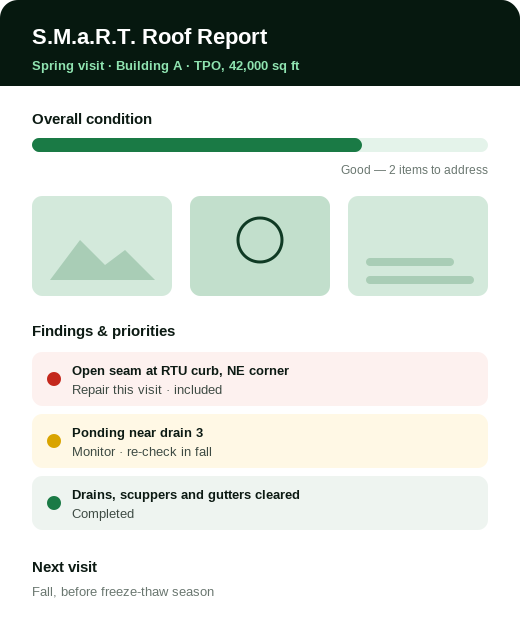
Once you have the report, talk with your agent about whether to file and how. Weigh the extent of the damage, your deductible and how a claim may affect future premiums. That decision belongs to the owner, or the board.
4. The claim and the adjuster visit
Once the claim is open, the carrier assigns a claim number and an adjuster. If your loss is large or covers several buildings, it may also send an independent adjuster or an engineer. Ask for the inspection to cover every building. Keep one point of contact, usually the property or community manager, so messages don't get crossed.
If you ask, we'll meet the adjuster on the roof and walk the documented damage. We show the test cuts and explain how the roof is built. Bring the site map and photo report, and note where you and the adjuster disagree. Ask for the estimate in writing, by building, with line items.
5. The carrier's estimate and the scope
The first estimate on a commercial roof often misses items. Look for edge metal, flashings, insulation, permit costs and code-required work. Check for rooftop equipment that has to be lifted, too. We prepare a detailed, line-item scope and compare the two line by line. When items are missing, we document them for a supplement. Each gets photos, measurements and the reason it's needed.
Coverage disagreements are a different matter. We don't negotiate your claim; that's your role, with your agent or a licensed public adjuster. What if the estimate and the documented damage still don't match? You may be able to ask for a re-inspection or use the policy's dispute process, such as appraisal. Your agent or attorney can explain the options.
6. Payments, depreciation and the deductible
Claim money usually arrives in pieces. On a replacement cost policy, the first check is usually the actual cash value, less your deductible. Actual cash value means replacement cost minus depreciation.
Your insurer holds back the depreciation until the work is done. You get it once you document the cost, within the policy's time limit. On an actual cash value policy, you may never get the depreciation back. If a lender is named on your policy, it may need to sign the claim checks too, so allow time for that.
If you run a multi-building community, our guide to association hail claims explains percentage deductibles, depreciation and phased payments.
The deductible is yours to pay. Truman never pays, waives or rebates a deductible on any job. Colorado's roofing contractor law forbids it on residential property, which can include condo and townhome buildings. For an association, your governing documents usually say how it's paid: from reserves, operating funds or an assessment.
7. Contract, permits and scheduling
Once you have an approved scope and a funding plan, we can sign the contract and set the schedule. You'll get a written contract from us that spells out the scope, price and schedule. A re-roof generally needs a permit. A full replacement can also trigger current energy-code insulation and other code items. Ordinance or law coverage pays for those up to its limit. Rules differ from city to city, so we check with your local building department before work starts.
Material lead times, crane and staging plans and weather come next. After a major Front Range hailstorm, crews and materials are in demand across the metro. In winter, freeze-thaw, chinook winds and snow shape the schedule. If you run an association, you can help cash flow by sequencing buildings. Where the policy allows, finished phases release depreciation that pays for the next ones.
8. Construction
If your building stays occupied, the plan covers staging, noise, odors, rooftop air intakes, parking and access. Tenants or residents get notice before work starts on each building. The roof is closed up watertight at the end of every working day. Some conditions only appear once the old roof is off, such as wet insulation or damaged decking. We photograph those as we find them and submit them as supplements.
9. Closeout
Closeout ties the claim to the finished work. Expect a final walk with you and a manufacturer's inspection where the warranty requires one. You'll get warranty documents, photos and a final invoice that matches the approved scope and supplements. Associations get it broken out by building. Send the carrier the completion documents it asks for right away, so it can release the held-back depreciation. We don't collect final payment until you sign off.
Then file the report, photos and warranty with your roof records and get back on a maintenance schedule. This claim's records become the baseline for the next storm.
What slows hail damage claims down
- Late notice. Reporting long after the storm invites questions about when the damage happened.
- No storm date. If your records don't tie the damage to a specific storm, the date of loss is harder to prove.
- Thin documentation. Photos without locations, no test cuts and no pre-storm records leave gaps the carrier has to fill.
- Too many voices. Several people calling the carrier with different information slows everything down.
- Board timing. Decisions that wait for the next regular meeting add time. Know who can approve what in between.
- Scope gaps found late. Items missed in the first estimate are easier to add before work starts than after.
Wherever your building is in the Denver metro, your first step is the same: get a documented inspection. We're based in Centennial and work across the metro. See our pages on commercial roofing in Aurora and our other service areas. Request an inspection and we'll reply within one business day, or call (720) 296-0000.
Hail claim timeline FAQs
How long does a commercial roof hail claim take?
It depends on how many buildings you have and how big the loss is. Your documentation, your carrier and any scope disputes matter too. A single building with a clear scope moves faster than a community-wide claim with supplements. Material lead times and weather affect how long construction takes.
How soon do we have to report hail damage?
It depends on the policy. Many policies want prompt notice and set time limits for filing and finishing repairs. Check your policy with your agent and report as soon as you know there may be damage.
Can work start before the insurer approves the claim?
Temporary repairs to stop leaks and prevent further damage, yes, with photos and invoices. Full replacement usually waits until you have an approved scope and a funding plan you're comfortable with.
Who talks to the insurance company?
You do, since it's your policy, or your manager or board does. We document the damage, meet your adjuster on the roof and write a detailed scope. You negotiate the claim, with your agent or a licensed public adjuster.
What is recoverable depreciation?
On a replacement cost policy, it's the part of the claim held back at first for the roof's age and wear. You usually get it back once the work is done and you document the cost, within the policy's time limit.
Can a roofer cover our deductible?
No. Truman never pays, waives or rebates a deductible on any job. Colorado's roofing contractor law forbids it on residential property, which can include condo and townhome buildings.