
Home / Resources / Drone roof inspections
Drone roof inspections for commercial and HOA buildings
In a single visit, a drone can put a camera over every roof in a community. It can also reach every corner of a large building. Here's what drone imagery shows well, what it can't show, and how to use it alongside a hands-on commercial roof inspection.
What is a drone roof inspection?
In a drone inspection, a small aircraft flies a planned route over the roof. It captures overhead photos and video of the surface, drains, edges, flashings, penetrations and rooftop equipment. Our team reviews the images, marks findings on a roof plan and decides which areas need a closer, hands-on look.
The drone doesn't make the judgment calls. It gathers evidence quickly and from angles that are hard to get any other way. A roofer still decides what the images mean and what to do about them. On most roofs, the best result comes from using both: the drone for the overview and a crew on the roof for the details.
Where do drones help most?
Drones help most on large or multi-building properties and on roofs that are hard or unsafe to reach. They're also useful right after a storm, and when you need clear images for a board or a capital plan.
Large roofs and multi-building properties
Walking every roof takes a long time on an HOA community with dozens of buildings. The same goes for a business park in the Denver Tech Center or a large warehouse. A drone covers that ground quickly and produces the same kind of image for every roof. That makes your buildings easy to compare, and changes easy to spot from one year to the next.
Roofs that are hard or unsafe to reach
Steep metal roofs, mansards, canopies, tall buildings and roofs without a hatch or fixed ladder are slow and risky to access. So are roofs covered in skylights or fragile surfaces. A drone documents them without extra ladders, lifts or foot traffic, and shows where a crew actually needs to go.
After a storm
After a Front Range hailstorm, the first question is often which buildings got hit and how hard. A flight gives you dated images of every roof while the storm is fresh. It also helps you sort roofs that need a full hands-on inspection from those that look unaffected. See the first 72 hours after a hailstorm for the rest of that checklist.
Board packets and capital plans
Most board members and asset managers will never climb onto a roof. An overhead image with each problem circled is easier to read than a page of roofing terms. It helps your board approve the right work.
What can a drone see, and what can't it?
Aerial inspections give you a visual record of the surface. That's a lot, but it isn't everything:
| Drone imagery shows well | Still needs hands-on work |
|---|---|
| Ponding water, debris and clogged drains or scuppers | Wet insulation under the membrane, which takes an infrared survey and core cuts |
| Loose or missing edge metal and coping | Whether seams are still bonded, which a roofer checks by probing |
| Displaced ballast or gravel at corners and edges | Hail bruising and cracked cover board beneath an intact-looking membrane |
| Broken skylights and damaged rooftop equipment | Flashing attachment, fasteners and sealant condition up close |
| Blisters, splits, worn coatings and old patches | Soft spots and deck problems you can feel underfoot |
| Dents in metal panels, vents and gutters, in the right light | Test cuts to confirm damage for an insurance claim |
That's why a drone flight is a starting point, not a final answer. Be wary of a "drone-only" report that recommends a full replacement, unless someone confirmed the moisture and damage findings on the roof.
How do drones work with infrared moisture surveys?
A drone can carry a thermal camera as well as a regular one. Fly it on a clear evening after a sunny day, and it can map warm areas where wet insulation is holding heat. It covers a large roof in one pass. A walk-on crew then marks those areas and confirms them with core cuts, because a warm spot isn't proof of water. Patches, extra layers and rooftop equipment can all read warm.
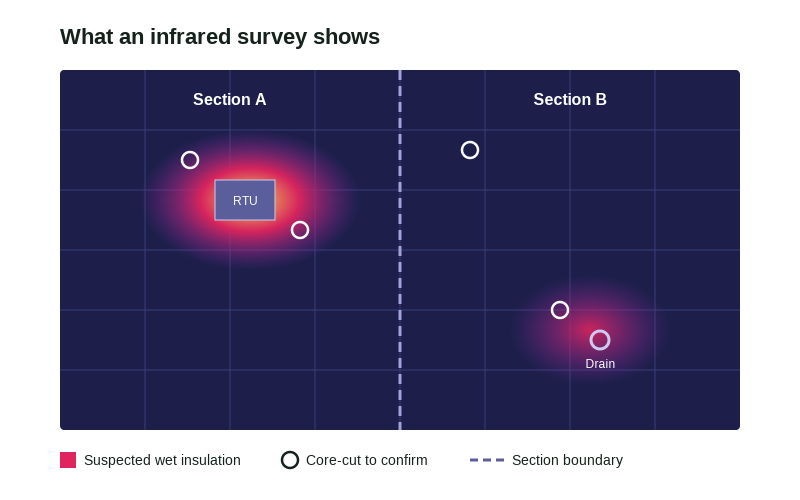
On big or complex roofs, we often use both. The drone gives the overview, and the crew marks and cores the suspect areas. To learn what conditions the method needs and what the results mean for repair or replacement, read our guide to infrared roof moisture surveys.
What should a drone flight look for on each roof system?
- TPO and EPDM: ponding, debris, open seams and laps, shrinkage at edges, punctures near equipment and flashing pulling away at walls.
- Built-up and gravel roofs: bare spots where gravel has scoured, blisters, cracks in smooth surfaces and drains choked with stone.
- Metal: dents, loose or missing fasteners, lifted panel edges and trim, rust at cut edges and missing snow guards.
- Spray foam: coating wear, exposed foam, bird damage and hail fractures in the coating.
For more on each system, see our commercial roofing pages.
Why do drone inspections suit HOA communities?
Associations get more out of a drone than almost anyone, because the job is usually many roofs, not one:
- Records by building. Every roof is photographed the same way and labeled by building. Your board, manager and reserve specialist then work from the same picture. See HOA reserve planning.
- Less disruption. Fewer ladders against buildings, less time on roofs above residents' units and a quicker visit overall.
- Storm claims across a community. After hail, imagery of every roof helps show the extent of the storm and points the hands-on inspection to the right buildings. Our guide to association hail claims covers what happens next.
- A heads-up for residents. Tell residents when a flight is planned and what it's for. A well-planned flight keeps the camera on the roofs.
To see how we work with boards and managers, read about HOA and multifamily roofing. There's also a page for property managers.
When should you schedule a drone inspection?
Schedule one before hail season, after big storms, before budgets and repair scopes, and as part of regular maintenance:
- In spring, before hail season. Hail season runs roughly mid-April to mid-August. Images taken before it starts give you a baseline, so storm damage later is easy to tell apart from wear.
- After hail, high chinook winds or heavy snow, while the storm date is fresh.
- Before a budget, reserve study or capital plan, so your numbers reflect what's on the roof.
- Before a repair or replacement scope, to show where the work is and how much there is.
- As part of regular maintenance. Our S.M.a.R.T. maintenance program schedules visits twice a year, as NRCA recommends, plus checks after severe weather. Overhead images from those visits build a record you can compare year to year.
Weather decides flight days. Wind, rain and snow ground a drone, and infrared flights need a clear, calm evening after a sunny day, so we schedule around the forecast.
What should a useful drone report include?
A useful report ties every image to a place on the roof and a next step:
- An overhead image of each roof, labeled by building and dated
- A roof plan with drains, equipment and every finding located on it
- Close-up images of each finding, with a plain-language description
- Which findings were confirmed on the roof and which still need a closer look
- Prioritized recommendations: fix now, fix soon and plan for later
- Imagery kept on file, so the next flight can be compared against it
How should you prepare for a flight?
You don't need roof drawings to schedule a flight, but these help:
- Addresses, a site map or building list, and gate or roof access details
- Known leak locations and dates, and any recent hail, wind or snow concerns
- Previous inspection reports and roof warranties, if you have them
- Tenant, resident or security contacts who should know a crew is on site
- The questions your board or owner wants answered
We're based in Centennial and inspect commercial and association roofs across the Denver metro. That covers commercial roofing in Centennial and communities throughout our service area. Request an inspection and tell us how many buildings you have. We'll recommend a drone flight, a walk-on inspection or both, depending on your question. Our inspections page covers our drone inspection services alongside walk-on inspections and infrared surveys. If water is coming in now, call (720) 296-0000 or report a leak.
Drone roof inspection FAQs
Does a drone inspection replace walking the roof?
No. A drone documents the surface quickly and safely. But probing seams, checking flashings up close, finding soft spots and taking core cuts all happen on the roof. Most decisions rest on both.
Can a drone find hail damage?
It can show you dented metal, broken skylights, damaged equipment and impact patterns across many roofs. Bruising in single-ply membranes and cracked cover board beneath them usually take a hands-on inspection and test cuts to confirm.
Can a drone find wet insulation?
With a thermal camera, on the right evening, a drone can map areas that may be wet. Core cuts are still needed to confirm moisture before you decide on repairs or replacement.
Should we tell residents or tenants before a flight?
Yes. Send a short notice with the date, the purpose and a contact, and you'll avoid surprises. The flight focuses on the roofs.
Will our insurance carrier accept drone images?
Carriers and policies vary, so ask your agent. Drone images are useful documentation, but an adjuster may still want to see the roof in person. If so, we'll meet the adjuster on the roof and walk the damage together.