
Home / Resources / Roof core cuts
Roof core cuts: what they tell you about a commercial roof
From the top, a commercial roof shows you only its surface. A core cut shows everything underneath: how many roofs are there, what the insulation is, whether it's wet and what it all sits on. Here's what a core tells you and how it changes the decision.
What is a roof core cut?
A core cut is a small roof core sample, cut through every layer of a low-slope roof, down to the structural deck. The roofer lifts it out, reads the layers from top to bottom, takes moisture readings, photographs it and records it on a roof plan. Before the crew leaves, they fill the opening and patch it watertight with materials that work with your roof.
You may also hear people call it a "test cut." That usually means the same kind of opening, sometimes larger. A test cut looks at one specific question, such as hail damage to the cover board. Either way, the point is to stop guessing about what's under the membrane.
Why can't the surface tell you what's underneath?
A membrane over soaked insulation often looks exactly like one over dry insulation. Water that gets in at a seam or flashing travels through the insulation, so the stain inside rarely sits below the entry point. And many buildings, especially older ones, have had more than one roof, with records long gone. A visual inspection is still the starting point of any commercial roof assessment. For an expensive decision, though, it isn't enough on its own.
What does a core show, layer by layer?
Each layer in the core answers a different question about your roof:
| Layer | What the core tells you | Why it matters |
|---|---|---|
| Surface | The membrane or surface type and its condition, plus any old roofs buried underneath | Codes generally prohibit a recover when there are already two roofs, so the count decides whether a recover is even an option |
| Cover board | Whether there is one, and whether it's cracked or crushed | Cracked cover board under an intact-looking membrane can be a sign of hail damage |
| Insulation | Type, number of layers, approximate thickness, and wet or dry | Wet insulation has to come out. On a tear-off, the energy code generally requires bringing insulation up to current levels, which can change edge and flashing heights |
| Attachment | Whether the roof is adhered, fastened or ballasted, and the condition of fasteners and plates | Rusted fasteners point to long-term moisture, and attachment affects how a recover or repair has to be built |
| Vapor retarder | Whether one is present | It affects how moisture moves through the assembly and what a new roof needs |
| Deck | Steel, wood, concrete or, on some older buildings, gypsum, and its condition | The deck decides which fasteners and adhesives can be used, and rust or rot adds deck repair to the scope |
Cores also show past repairs and materials that don't work together. Some older built-up roofs use coal tar pitch, which doesn't mix with asphalt repair products. Some black EPDM roofs have been recovered with other membranes. A good repair, recover or replacement plan starts with knowing what's really there.
How do core cuts and infrared surveys work together?
On their own, a few random cores can miss a wet area or exaggerate one. That's why cores are usually paired with an infrared moisture survey. The thermal scan maps areas that hold heat after sunset, which is how wet insulation shows up. The cores then confirm what the camera saw.
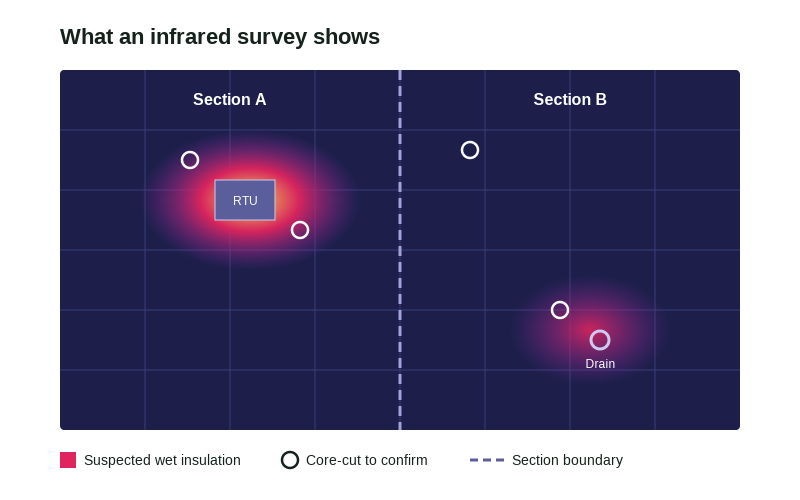
- Cores in suspect areas confirm whether a warm spot is really wet, or just a patch, an extra layer or a piece of equipment.
- Cores in areas that read dry give a comparison and confirm the survey is reading the roof correctly.
- Cores at transitions, such as between roof sections or old additions, show where the assembly changes.
Where infrared doesn't work well, such as heavy ballast, gravel or metal roofs, a grid of cores and moisture-meter readings takes its place. To see how we choose between them, visit our inspection and infrared survey services page.
How do core results change the decision?
The cores turn "the roof is old" into a scope you can price:
| What the cores show | Typical next step |
|---|---|
| Dry insulation, sound deck, one roof | Repair defects and keep the roof on maintenance. A recover or restoration may be an option. |
| Wet insulation in a few areas | Cut out and replace the wet sections, fix what let water in, then consider a recover or restoration over the dry roof. |
| Wet insulation across much of the roof | Plan a full tear-off and replacement. Covering wet insulation isn't allowed under most codes and won't be warranted. |
| Two roofs already in place | A recover is generally off the table, so the decision is repair now or tear-off. |
| Deck rust or rot | Add deck inspection and repair to the replacement scope before any new roof goes down. |
The same information sets the details of a new roof. It tells you how to attach it to the deck and how much insulation goes back. It also shows where tapered insulation can improve drainage and which commercial roofing system will work over or in place of what's there. That information keeps bids comparable, too. When every contractor prices from the same core log, you're comparing prices, not guesses. See commercial roof cost factors for how those findings drive cost.
When should you ask for core cuts?
Ask for core cuts whenever a decision depends on what's under the membrane:
- Before choosing between repair, recover and replacement
- Before a recover or restoration coating, to confirm the roof is dry enough to keep
- When leaks keep coming back after repairs, or show up far from any visible defect
- When the roof's age, materials or number of layers are unknown
- When an infrared survey shows suspect areas
- After a hailstorm, when damage below the membrane is in question
- Before buying a building, or before a reserve study or capital plan
What can core cuts show after a hailstorm?
Hail can crack the cover board and crush insulation while leaving the membrane looking intact. After a Front Range hailstorm, small test cuts at impact areas let an inspector see and photograph that damage. The inspector can then compare it with areas that weren't hit. That evidence matters when the adjuster visits.
We meet adjusters on the roof, walk the damage together and show the cuts. Policies vary, so check yours and talk with your agent about what's covered. Our guides to documenting commercial roof hail damage and the first 72 hours after hail cover the rest.
What happens on the day of the core cuts?
Plan the locations
We choose core locations based on your question. That means suspect wet areas, dry comparison areas, roof sections and transitions, and spots tied to the planned work.
Check the warranty and what's below
If your roof has a manufacturer warranty, we check its requirements first. When the manufacturer requires it, we coordinate with them. We also confirm what sits under the deck, such as conduit or sensitive spaces. On older built-up roofs, we'll talk with you first about whether asbestos testing is needed. Colorado has rules for disturbing those materials.
Cut and read the layers
We lift out each core, measure it, check it with a moisture meter and photograph it with its layers visible.
Patch watertight
We fill the opening with insulation and patch it with materials that work with your membrane, so your roof stays watertight.
Log it
Every core goes into your report. The log shows its location on the roof plan and the layers from top to bottom. It also records insulation type and thickness, moisture condition and deck type.
That core log belongs with your roof records and in any roof survey report. It answers the same questions for the next inspection, the next contractor and the next owner. Level 3 of our S.M.a.R.T. maintenance program, "Survey & Repair," includes a roof survey. That way you track moisture over time instead of discovering it all at once.
Facing a repair-or-replace decision on a DTC office building, a warehouse or the roofs of an HOA community? We inspect commercial roofs across the Denver metro. That includes commercial roofing in Centennial, where we're based. Request an inspection and we'll recommend whether cores, an infrared survey or both will answer your question.
Roof core cut FAQs
Will a core cut cause a leak?
Not when it's done right. Before the crew leaves, we fill each core and patch it watertight with materials that work with your roof. We also record each patch location so it can be checked on later visits.
Will core cuts void our roof warranty?
They shouldn't, but some manufacturers have requirements for any opening in a warrantied roof. We'll check your warranty first and coordinate with the manufacturer when it's required.
How many cores does a roof need?
It depends on the roof's size, how many sections and additions it has, and what question you're answering. If an infrared survey guides the cores, you need fewer, and each one tells you more than a random core would.
Can't you tell if insulation is wet without cutting?
Infrared and moisture meters can point to wet areas, but they read indirectly. A core is the only way to see and confirm what's under the membrane.
Do metal roofs get core cuts?
Rarely in the panel field. Cores are mostly a low-slope roof tool for membrane, built-up and spray foam roofs. They can still help where a metal roof was retrofitted over an older low-slope roof.