
Home / Resources / Flat roof drainage
Flat roof drainage: drains, scuppers, gutters and crickets
A low-slope roof is only as good as the path water takes off it. Here's how each part of a commercial roof's drainage works, what goes wrong with it along the Front Range, and how it's maintained and fixed.
How does water leave a flat roof?
No commercial roof is truly flat. Slope moves the water toward an exit. The slope is either built into the structure or created with tapered insulation. There are three exits: interior drains, scuppers through a parapet or roof edge, and gutters along an edge. Crickets and saddles steer water around obstacles on the way, and overflow drainage takes over when the main path is blocked.
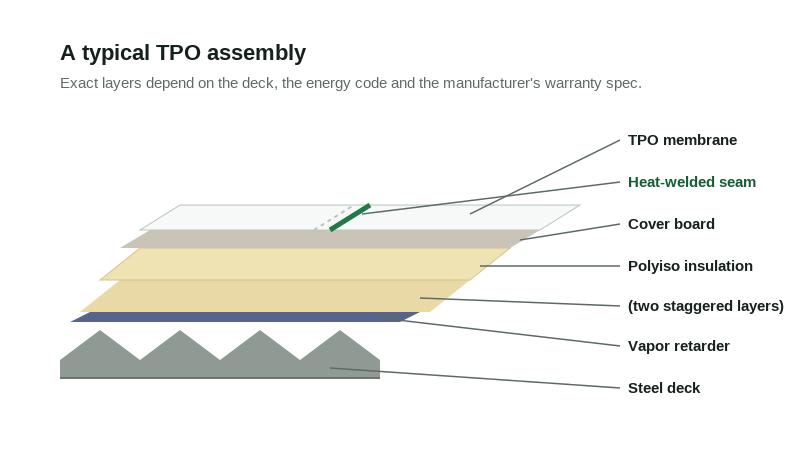
Roof drainage systems only work when every part does. When one part fails, water ponds, backs up against flashings or runs where it was never meant to go. A leak usually follows.
| Component | What it does | What goes wrong |
|---|---|---|
| Interior roof drain | Collects water at low points and carries it down through piping inside the building | Clogged or missing strainers, failed membrane seal at the drain, leaks in interior piping |
| Overflow drain or scupper | Takes water off the roof if the primary drain clogs | Blocked with debris, set at the wrong height, or plugged by someone who thought it was a leak |
| Scupper | An opening through a parapet or edge that drains to a conductor head and downspout | Dried-out sealant at the flanges, ice and debris in the opening, leaks into the wall below |
| Gutter and downspout | Catches water at a roof edge and carries it to the ground | Clogs, hail dents, open seams, loose hangers, ice and sliding snow |
| Crickets and saddles | Small sloped areas that divert water around curbs and between drains | Missing or too small, leaving water trapped behind rooftop units |
Interior roof drains
Most larger commercial roofs drain to interior drains. Each one has three parts. The drain body is set in the deck. A clamping ring locks the membrane to the drain. A strainer dome on top keeps debris out of the piping. Many sit in a sump, a slightly recessed area of tapered insulation that pulls water into the drain.
The problems we see most:
- Missing strainers. Without one, leaves, gravel and debris go down the pipe and clog it inside the building, where it's much harder to clear. Never remove a strainer to make a roof drain faster.
- Clamping rings work loose. If the bolts loosen or the membrane isn't fully under the ring, water runs around the drain instead of into it.
- Drains set high. Sometimes a drain sits above the roof around it, often after a recover or added insulation. Then you'll see a ring of standing water around it.
- Piping leaks. Joints in interior drain lines can leak, especially after a hard freeze. That's a plumbing repair, but it shows up on ceilings like a roof leak.
What is overflow drainage for?
Parapets and raised edges can trap water on a roof. Where they do, building codes generally require a second way off the roof. That can be overflow drains set slightly higher than the primary drains, or overflow scuppers through the parapet. They exist for the day the main drains clog, so that water spills off before it builds up enough weight to threaten the structure.
Two rules follow. Water coming out of an overflow means a primary drain is blocked, so get it cleared. And never cap, plug or caulk an overflow because it "leaks."
Want to change any part of the drainage? Your city's adopted code sets the rules, so check with its building division first. If a proposal uses a drainage term you don't know, look it up in our commercial roofing glossary.
Scuppers, conductor heads and downspouts
A scupper is a metal-lined opening through a parapet or roof edge. It's flashed into the roof membrane on the inside and usually empties into a conductor head, a box that feeds a downspout.
- Sealant and flashing. The joints where the scupper meets the membrane and the wall depend on sealant, which dries out under high-altitude sun. An open joint here leaks into the wall, not just the roof. See parapet wall and coping leaks for how that water travels.
- Size and height matter. A scupper that's too small, or that sits above the roof surface after a recover, holds water back. If you raise the roof with new insulation, you may need to lower or rebuild the scuppers.
- Ice and debris. Scuppers and conductor heads on shaded walls freeze shut in winter and collect leaves in fall.
- Where the water lands. A scupper that spills straight off the building stains the wall below and can freeze into ice on a walkway or entry. A conductor head and downspout, or an outlet moved away from foot traffic, fixes that.
Gutters and edge drainage
Smaller commercial buildings, many HOA buildings and most metal roofs drain to an edge, into gutters and downspouts. The weak points are seams and end caps, hangers that loosen, and outlets that clog. Hail dents gutters, and on metal roofs a full sheet of snow can slide off at once and tear gutters loose.
Watch where downspouts discharge, too. An upper roof that drains onto a lower roof concentrates water and wear on one spot of the lower membrane. A splash pad or an extended downspout fixes that. At ground level, downspouts that empty onto sidewalks, entries or garage aprons freeze into ice sheets on cold nights. That matters most in HOA and multifamily communities, where residents walk past them every day.
What do crickets and saddles do?
Think of a cricket as a small ridge of tapered insulation. It splits the water and sends it around an obstacle. The most important ones sit on the upslope side of rooftop units and curbs. Without one, water pools against the curb flashing. Our guide to leaks around rooftop HVAC curbs shows why that matters. Saddles do the same job between drains and along parapets, so water doesn't collect in the valleys between them.
Crickets are best designed in during a new flat roof installation, but they can often be added during a repair on an existing roof.
Front Range drainage problems
- Hail. After a hailstorm, drains pack with ice, debris and, on granule-surfaced roofs, granules. Water backs up while the roof is at its most vulnerable, so check drains right after a storm.
- Leaves and seeds. Fall leaves and spring cottonwood fluff clog strainers on buildings near trees.
- Summer cloudbursts. Short, heavy afternoon storms test drains and overflows that rarely see that much water at once.
- Freeze and melt. Snow drifts against parapets and units. It melts on a sunny afternoon or in a chinook warm spell, then runs toward drains that are still frozen. The water backs up and refreezes overnight.
How should you maintain roof drainage?
Drainage is the cheapest part of flat roof maintenance, and the most expensive part to neglect. The NRCA recommends inspecting low-slope roofs at least twice a year and after severe weather. Here, that means spring, after the snow and before hail season. It also means fall, after the leaves and before the freeze. A good drainage check covers:
- Every drain clear, with its strainer in place and clamping ring tight, and checked with water moving through it after a rain when possible
- Overflow drains and scuppers open, with nothing stored in front of them
- Scupper and gutter seams sealed and conductor heads clear
- Downspouts open all the way to the ground, and discharge points away from lower roofs and walkways
- Notes and photos of any ponding, so changes show up year to year
Every level of our S.M.a.R.T. maintenance program includes drain, scupper and gutter cleaning. Levels 2 and 3 add debris removal from the roof surface and small repairs during the visit.
When does drainage need a redesign?
If water keeps ponding after the drains are clear, the problem is slope or drain placement, and cleaning won't fix it. Our guide to ponding water on a flat roof walks through the causes. The best time to correct drainage is when you replace the roof. That's when you can add a tapered insulation design, drain sumps, and new or moved drains and overflows. You can also adjust scupper heights for the thicker insulation the energy code generally requires. Adding drains means plumbing and sometimes structural work, and generally a permit.
If a backed-up drain is already leaking, call us first at (720) 296-0000 or report a leak, and see why commercial roofs leak. Does your drainage need a closer look? Request an inspection. We work across the Denver metro, from Centennial to commercial roofing in Littleton. We maintain and repair every system in our commercial roofing section.
Flat roof drainage FAQs
Why is water coming out of our overflow scupper?
Because the primary drain it backs up is blocked or can't keep up. Overflows are designed to run in that situation. Have the primary drains cleared and checked, and never plug the overflow.
How often should roof drains be cleaned?
Clean them at least at the spring and fall inspections the NRCA recommends. Clean them again after hail, high wind or heavy storms. Buildings near trees may need more frequent visits in fall.
Can we take the strainer off so the roof drains faster?
No. Without a strainer, debris goes into the drain piping and clogs it inside the building. That clog is harder and more costly to clear than a strainer on the roof.
Who fixes a leaking drain pipe inside the building?
A plumber repairs interior drain piping. The roofer handles the drain body, clamping ring and membrane at the roof. If you're not sure which is leaking, start with the roof inspection and we'll tell you.
Should a re-roof change our drainage?
Often. Use the replacement to add tapered insulation, crickets and sumps. It's also when you adjust drains and scuppers for the new roof height. It is usually simpler and less costly then than as a separate project later.