
Home / Resources / Foot traffic and walkway pads
Roof foot traffic damage: how walkway pads prevent it
Most commercial roofs see more boots than you'd think. HVAC technicians, plumbers, electricians and telecom crews go up, along with inspectors and snow removal crews. Every visit leaves wear. Here's what foot traffic does to each roof system, where walkway pads belong and how to set rules for the people who use your roof.
Who walks on your roof?
A roof is designed to keep weather out, not to be a work floor. Yet on a typical office building, retail center or condo community, people are on the roof regularly.
There's HVAC service and filter changes, plumbing vent and drain work, and electrical and lighting crews. Telecom, satellite and solar installers go up too, along with inspectors and, in winter, snow removal crews. Most of them aren't roofers, and few think about what's under their feet.
The damage concentrates where they go. People walk the shortest line from the hatch or door to the equipment. They kneel and set tools down in the same spots around each unit, and cross the same seams every time. Over months, those routes turn into wear paths, and wear paths turn into leaks.
What does foot traffic do to each roof system?
| Roof system | What traffic does | Where it shows up |
|---|---|---|
| TPO and EPDM | Punctures from screws, dropped tools and debris ground in underfoot; scuffs; crushed insulation and cover board below; stress on seams | Around rooftop units, along the route from the hatch, at seams people step on |
| Built-up | Gravel kicked aside, leaving bare bitumen to dry out; cracked surfacing; blisters stepped on and broken | Bare paths through the gravel, cracked spots near equipment |
| Metal | Dented panel flats, bent ribs and seams, loosened fasteners, scratched finishes that start to rust | Between supports, where people step off the ribs, at panel laps |
| Spray foam | Coating worn through, foam surface crushed or gouged, which exposes foam to the sun | Service areas and routes, around penetrations |
The worst damage is often the hardest to see. A screw left on a single-ply membrane gets stepped into the sheet and leaves a pinhole. Crushed insulation under a route leaves a low spot where water sits.
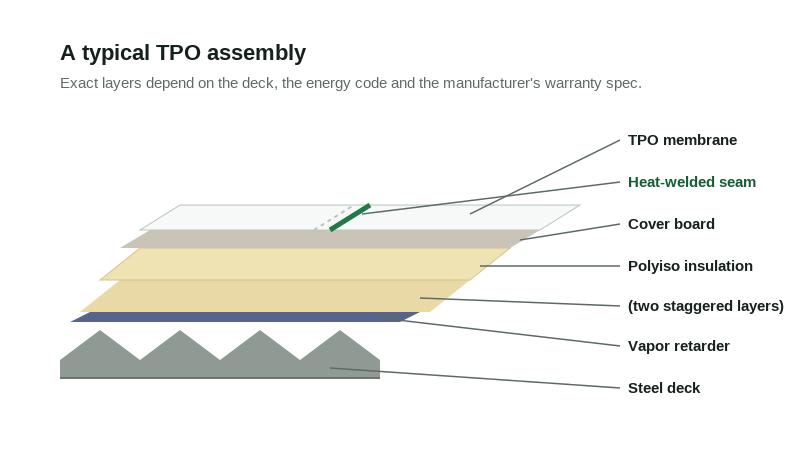
Neither leaks right away, and both can let water reach the insulation before anyone sees a stain inside. Our guide to leaks around rooftop HVAC curbs covers the damage service work leaves around units.
Why is it worse on a Colorado roof?
- Cold and heat. Membranes stiffen on cold winter mornings, and asphalt surfaces soften and mark easily on hot summer afternoons at altitude.
- Freeze-thaw. A small puncture or scuff lets water in, and freezing water widens the opening through the winter.
- Snow. Snow hides screws, debris, skylights and roof edges, and steel shovels and ice chippers puncture membranes. Many of the punctures we repair each spring come from snow removal.
- After a storm. Hail season runs from mid-April to mid-August. It brings extra visits from inspectors, adjusters and HVAC contractors, and sometimes uninvited door-knockers. Every set of footprints adds marks on a roof that's already been hit.
What are roof walkway pads?
Walkway pads are protective sheets or treads laid over the roof surface along the routes people need to use. They take the wear so the membrane doesn't, spread the load of each step, and mark a clear path so people stay on it. Many come in a contrasting color, so the route is obvious from the hatch.
They have to match the roof. On TPO, walkway pads are typically heat-welded to the membrane. On EPDM they're adhered with compatible tape or adhesive.
Built-up roofs use mineral-surfaced cap sheet strips or treads set into the surface. Spray foam roofs use pads or a reinforced, granule-surfaced coating along the route.
Metal roofs are different. They usually need a walkway system that clamps to the seams, or a defined path at the supports, not pads on the panel flats. Pads that don't match the membrane can damage the roof or affect the warranty. So can pads that aren't installed the way the manufacturer specifies.
Walkway pads improve footing, but they aren't fall protection. Anyone working near an unprotected edge, skylight or roof opening still needs the right equipment and training.
Where do walkway pads belong?
A roof doesn't need pads everywhere. They go where traffic is predictable and repeated:
- At the access point. The landing below a ladder or hatch, and the area outside a rooftop door, take the first and last step of every visit.
- From access to each rooftop unit. The most common route on most commercial roofs.
- Around equipment service sides. Where technicians stand, kneel, open panels and set tools down.
- To drains and other equipment that needs routine checks, such as exhaust fans, roof-mounted equipment and antennas.
- Below ladders between roof levels, and where people step down from a higher roof onto a lower one.
- On paths that snow crews clear. These are the routes to drains and around units that crews clear in winter.
What placement mistakes should you avoid?
- Blocking drainage. Pads need gaps so water can flow to drains. A solid run across a slope dams water behind it.
- Loose pavers or treads. Unsecured pieces shift in chinook winds and scrape the membrane under them.
- Pads over critical details. Pads laid across seams, flashings or drains can hide problems from inspectors.
- The wrong material. Asphalt-based treads on a TPO or EPDM roof, or anything not approved by the membrane manufacturer, can do more harm than the traffic.
What roof safety guidelines should vendors follow?
Pads only work if people use them. A short access policy, shared with every contractor who goes on the roof, prevents much of the damage we see:
Control access
Keep the hatch or door locked, log who goes up and why, and require your manager's approval for any new work.
Stay on the route
Use the walkway pads, don't cut across the field, and don't stand on skylights, curbs or flashings.
Protect the surface
Carry equipment instead of dragging it. Set parts and panels on a protection board, and keep sharp tools off the membrane.
Leave nothing behind
Pick up screws, filters, packaging and offcuts before leaving. A magnetic sweep around the unit after service takes minutes.
No new holes without the roofer
Send any new penetration, support or attachment through the roofer who holds your warranty. Penetrations cut by other trades are a common way warranties get voided.
Report damage
Anyone who punctures, cuts or drops something on the roof reports it the same visit, so it can be repaired before it leaks.
Put the policy in your vendor contracts and post a short version at the roof access. Running an association? Your community manager is usually the best person to enforce it across buildings. See our page for property managers.
How do you inspect for traffic damage?
Traffic damage tends to cluster, which makes it easy to check for. During inspections, look closely along each route and around every unit. Look hardest after HVAC replacement or other major service work. Check for punctures, scuffs, soft spots and debris.
Has a route gone unprotected for years? Then an infrared moisture survey can show you whether small punctures have already let water into the insulation.
Visits under our S.M.a.R.T. program for commercial roof maintenance include a look at what other trades left behind. That means screws, panels and punctures from HVAC, solar or telecom work, and damage around rooftop equipment. Levels 2 and 3 add debris removal and small repairs during the visit. The written report gives you photos to take back to the vendor if their crew caused the damage.
Should you add pads now or at replacement?
You can add walkway pads to most existing roofs. The membrane has to be in good enough shape to bond to, and the products have to be compatible.
On a new roof, they're best designed in from the start, with routes planned around the equipment layout and drainage. Planning a re-roof? Ask for the walkway layout in the proposal, and the finished roof is protected from the first service call.
If a puncture is already leaking, call us first at (720) 296-0000 or report a leak. Want to see the wear on your roof and where pads would help? We work across the Denver metro, including commercial roofing in Centennial and Greenwood Village around the Denver Tech Center. Request an inspection.
Foot traffic and walkway pad FAQs
Do we need walkway pads on our roof?
If people visit the roof regularly to service equipment, almost certainly along those routes. Roofs with little equipment and few visits may need only a pad at the access point. An inspection shows where wear is already happening.
Can walkway pads be added to an existing roof?
Usually, yes, if the membrane is sound enough to bond to and the pads are compatible with it. On an older roof, the pads should go on after any damage along the route is repaired.
Will walkway pads affect our roof warranty?
If the membrane manufacturer approves the pads and they're installed to its requirements, they generally help the roof. Pads that aren't compatible, or that are installed the wrong way, can hurt it. We check your warranty's requirements before adding them.
Our HVAC contractor damaged the roof. What should we do?
Have the damage documented with photos and repaired before it leaks. Who pays depends on your contract with the vendor. You'll have a record to work from, because our written reports note damage around equipment.
Is it safe to walk on a metal roof?
Only for trained crews with fall protection, and only along seams or supports or on a walkway system. Stepping on panel flats dents them and can loosen fasteners.
Do walkway pads make the roof safe in snow and ice?
They improve footing, but snow and ice still make any roof dangerous, and snow hides edges and skylights. Pads don't replace fall protection or training.