
Home / Resources / White vs black roofs
White vs black commercial roofs in Colorado
On a low-slope roof, color is more than looks. A white membrane reflects summer sun; a black one soaks it up and sheds snow sooner. Here's how that plays out at a mile of elevation, and how to decide which suits your building.
What roof color actually changes
A roof's color decides how much of the sun's energy it reflects and how much it absorbs as heat. A white membrane reflects much of the summer sun, so the surface and the space below it stay cooler. A black membrane absorbs that energy, so its surface runs much hotter on a clear day.
For commercial roofing in Colorado, that difference is sharper than in many places. The Denver metro sits at about a mile of elevation, where less atmosphere filters the sun, and it sees a lot of clear days. A roof also reflects less as it gets dirty, so a white roof does its best work when it's kept clean.
What color doesn't change matters just as much. Hail resistance, wind resistance and how well the roof keeps water out all come from the assembly underneath. The color on top doesn't decide them.
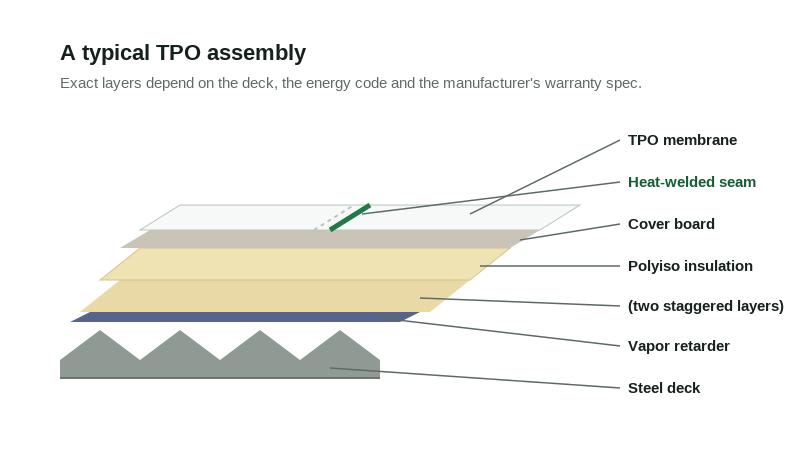
The usual choices on a commercial roof
- White TPO. A reflective, heat-welded single-ply membrane and the most common choice for new low-slope roofs and full re-roofs. It also comes in tan and gray. See TPO roof installation and repair.
- Black EPDM. The standard synthetic rubber membrane. It costs less than white EPDM. The carbon black that gives it its color is also what protects it from UV light.
- White EPDM. A white rubber layer laminated over a black core. It reflects like white TPO but keeps EPDM's taped seams and repair methods, costs more, shows dirt sooner and needs matching white flashing accessories. See EPDM roofing.
- Surfaced and coated roofs. Gravel on built-up roofs changes how much sun the surface takes. So do aluminum or white coatings on smooth built-up roofs and white coatings on spray foam.
Summer: heat and cooling loads
For most air-conditioned commercial and multifamily buildings, a white roof cuts summer heat gain through the roof. The effect is largest on single-story and low-rise buildings, where the roof is a big share of the outside surface. It's also large on top-floor spaces: offices, retail, clinics and apartments right under the deck. Those are the buildings where white usually wins.
Because a white roof runs cooler, the membrane itself also ages more gently. At Denver's elevation, reflecting the sun protects your TPO as much as it lowers cooling loads.
A black roof adds cooling load in summer. On a lightly conditioned warehouse, a storage building or a garage, that may not matter much. There, black EPDM is often the sensible, economical choice.
Winter: snow, ice and heating
A black roof's heat absorption helps snow and ice clear sooner on sunny winter days. That's a real advantage after a Front Range storm, but a modest one:
- Snow covers color. Once a roof is under snow, its color doesn't matter much until the sun gets through.
- Insulation does more for heating. For winter heating costs, the insulation under the membrane matters far more than the color on top. That's why a re-roof is the time to look at both together.
- Meltwater still needs a way off. Faster melting only helps if drains and scuppers are open. Meltwater that reaches a frozen drain backs up against flashings and refreezes at night.
- Snow load design doesn't depend on color. Your building was designed for the snow load your jurisdiction sets, whatever color the roof is. Our guide to snow load on commercial roofs covers drifting, ponding and safe snow removal.
White vs black roof, side by side
| Question | White roof | Black roof |
|---|---|---|
| Summer surface | Runs much cooler; reflects much of the sun | Runs much hotter; absorbs the sun |
| Cooling load | Lower, especially on low-rise buildings and top floors | Higher |
| Snow and ice | Clears more slowly on sunny days | Clears sooner on sunny days |
| UV and aging | Reflecting the sun helps protect the membrane | Carbon black protects EPDM from UV |
| Dirt | Shows dirt and reflects a little less | Hides dirt |
| Cool-roof rules | Can meet them | Usually won't |
| Often fits | Offices, retail, medical, multifamily | Lightly conditioned warehouses and storage |
Codes and cool-roof requirements
Color can be a code question, not just a preference. In Denver, the Green Buildings Ordinance can require a cool, reflective roof when a larger existing building replaces its roof. It can also require another compliance option on top of that, and some building types are exempt. See commercial roofing in Denver for how that works.
Other cities in the metro set their own rules, so check with the building division before you settle on a color. We confirm what applies before we price a replacement, so a color choice doesn't surface as a problem at permit review.
Sustainable roofing options beyond color
If your goal is a more sustainable roof, color is one lever among several:
- Insulation at replacement. A tear-off generally has to bring insulation up to the current energy code. That lowers your heating and cooling loads year-round.
- Recover instead of tear-off. Where the existing roof is dry and code allows another layer, a recover keeps the old roof out of the landfill.
- A longer service life. A roof that's maintained lasts longer, which is the most direct way to use less material.
- Reflective coatings on renewable roofs. Spray foam roofs are recoated rather than replaced, and white coatings keep them reflective.
Switching colors at a re-roof
Many owners move from black EPDM to white TPO when the roof is recovered or replaced. If your existing roof is dry and within code limits on layers, a white membrane can often go over it. A cover board or separator goes between them.
Our TPO vs EPDM guide covers the other differences between the two membranes. To compare all five systems we install, see types of commercial roofing systems.
On a low-slope roof, you rarely see the membrane from the ground. So color usually isn't an appearance issue. On association buildings, boards care about what residents see. So color approval usually centers on metal mansards and steep-slope roofs, not the flat roofs behind them.
Keeping a white roof white
Dirt, dust and debris dull a white roof over time. Twice-a-year maintenance visits, which NRCA recommends for low-slope roofs, clear debris and drains and catch damage early. On TPO, look hardest at flashings on south-facing parapets and around reflective rooftop equipment. Those spots take the hardest sun.
Our S.M.a.R.T. maintenance program handles both colors, and you get a written report after every visit.
Weighing a color change at replacement, or wondering whether a cool roof applies to your building? We work on commercial and association roofs across the Denver metro, from DTC office buildings to warehouses in Centennial. See commercial roofing in Centennial. Request an assessment, and we'll compare white and black options for your building, with the cost drivers for each.
Roof color FAQs
Is a white roof a good idea in Colorado's cold winters?
For most air-conditioned commercial buildings, yes. A white roof cuts summer heat gain, and the insulation under it does more for winter heating than the color does. A black roof clears snow a little sooner on sunny days, but that's a smaller effect.
Will a white roof lower our energy bills?
For most air-conditioned buildings, it lowers cooling costs. You'll notice it most on low-rise buildings and top floors. How much depends on the building, how it's used and how much insulation the roof has.
Does a black roof melt snow faster?
On sunny days, yes, because it absorbs more of the sun. Faster melting only helps if drains and scuppers are clear, so the meltwater can leave the roof instead of refreezing.
Does roof color affect hail resistance?
No. Your roof's hail resistance comes from the assembly: the cover board, the membrane thickness and how it's attached. Our guide to hail-resistant commercial roofing explains what to ask for.
Can we make our black roof white without replacing it?
Sometimes. If your existing roof is dry and code allows another layer, we can put a white membrane over it with a cover board or separator. A moisture survey and core cuts tell us whether that's an option.
Do we have to install a cool roof?
It depends on where the building is and its size. In Denver, the Green Buildings Ordinance can require one when you replace the roof on a larger building. Other cities set their own rules, and we check them before pricing.