
Home / Resources / Hail-resistant roofing
Hail-resistant commercial roofing for the Front Range
No commercial roof is hail-proof. But some roofs come through a Front Range hailstorm with a few repairs, and others need a claim and a replacement. The difference is mostly in layers you can't see. Here's what makes a roof hail-resistant, how each system compares and what to ask for at replacement.
Hail-resistant, not hail-proof roofing
Large or wind-driven hail can damage any roof. A hail-resistant roof takes ordinary storms without functional damage. That means no punctures, no crushed insulation, no broken coating and no new leaks. When a big storm does get through, the damage is smaller and easier to repair.
That matters along the Front Range. Hail season runs from mid-April to mid-August, and your building can be hit more than once in a season. On the low-slope roofs common in Denver Tech Center office parks and across the metro, hail damage also tends to hide below the surface. A roof that resists it saves you from damage you'd otherwise find months later as a leak.
Where hail resistance comes from
On a low-slope roof, hail resistance comes from the whole assembly, not from the membrane label. Two roofs with the same membrane can come through the same storm very differently.
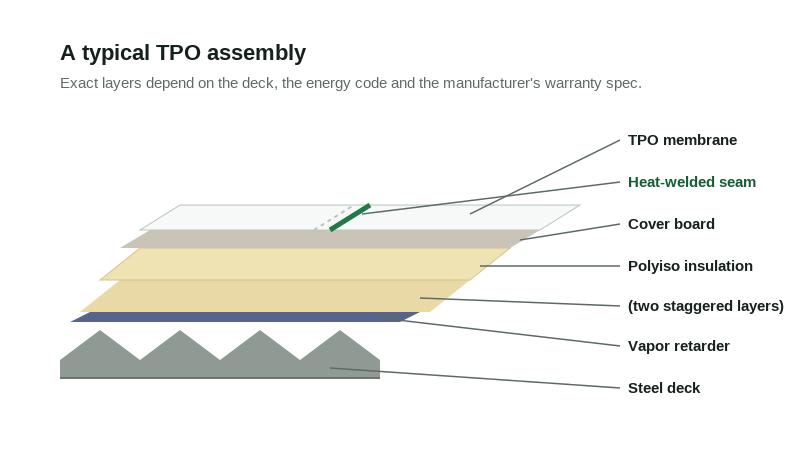
The cover board
Hail rarely punches straight through a single-ply membrane. More often it crushes the insulation or fractures its facer. That leaves a soft spot that flexes underfoot until the membrane cracks. A thin, dense cover board between the membrane and the insulation spreads the impact and protects the insulation. On single-ply roofs, it's one of the most important choices you'll make.
Membrane thickness
Thicker membranes resist punctures better. TPO is commonly sold in 45, 60 and 80 mil, and EPDM in 45, 60 and 90 mil. On hail-exposed Front Range roofs, we rarely recommend 45 mil TPO. For your roof, 60 mil with a cover board and good attachment is a sound baseline. An 80 mil or fleece-backed membrane adds resistance where hail exposure is heavy or warranty terms are long.
Attachment
How the membrane is held down changes how it behaves under hail. Fully adhered systems over a cover board generally perform better than mechanically fastened membranes laid directly over soft insulation. Fleece-backed membranes set in adhesive are the toughest against hail and punctures. Attachment also decides wind performance, which matters on the same roof during chinook season.
Surfacing
Gravel and ballast shield the surface beneath them. On spray foam, the coating is the armor, and tougher base coats or granules broadcast into the coating improve hail resistance.
Details and rooftop equipment
Skylights, pipe boots, vent caps, flashings and rooftop units are often the first things hail breaks. A tough field membrane doesn't help much if a cracked skylight dome lets the storm in.
How each roof system handles hail
TPO
A reflective, heat-welded single-ply membrane and the most common choice for new low-slope roofs. Its hail performance depends on thickness, cover board and attachment more than on the brand. Built with a dense cover board and an adhered or fleece-backed sheet, it's a strong hail assembly. See TPO roof installation and repair.
EPDM
New EPDM is elastic and often flexes under hail and recovers where stiffer materials would crack. That also hides damage: the rubber can look fine while the insulation beneath it is crushed. As EPDM ages and stiffens in the sun, hail is more likely to fracture the membrane itself.
Ballasted EPDM is well shielded from hail, though ballast has weight and wind limits. See EPDM roofing, and our comparison of TPO vs EPDM for how the two membranes differ in hail, sun and cold.
Built-up roofing
Multiple plies give built-up roofs redundancy: if the top is damaged, the plies below still keep water out. A gravel surface takes hail better than a smooth or coated surface, which is more exposed. Weight is the trade-off, so the structure has to carry it. See built-up roof repair and restoration.
Metal
Hail dents panels, flattens ribs and can crack painted finishes. Large hail can damage seams, fasteners and trim enough to leak. Smaller hail often leaves dents you can see from the ground that let no water in. That distinction matters, because your policy may limit coverage for cosmetic damage to metal roofs, as many commercial policies do. See commercial metal roofing.
Spray foam
Hail dents spray foam. The question is whether the coating is broken. Dents with intact coating are usually not a leak risk. Fractured coating or crushed foam opens the roof to UV and water, and you'll need to seal and recoat it.
Urethane coatings and granule surfacing improve hail resistance on a new roof or a recoat. See spray foam roofing and recoating.
| System | What builds hail resistance | Weak points in hail |
|---|---|---|
| TPO | Dense cover board, thicker or fleece-backed sheet, adhered attachment | Crushed insulation under a thin or fastened sheet; flashings and seams near impacts |
| EPDM | Cover board, thicker sheet, adhered attachment or ballast | Hidden damage under elastic rubber; brittle older membrane |
| Built-up | Multiple plies and a gravel surface | Smooth or coated surfaces; fractured plies where gravel has scoured |
| Metal | Sound seams, fasteners and trim | Dents and cracked finishes; damaged seams and trim in large hail |
| Spray foam | Tough base coat, granules, coating kept at full thickness | Fractured coating or crushed foam, especially where coating has thinned |
For more on how these systems compare beyond hail, see types of commercial roofing systems or our commercial roofing section.
Hail ratings and warranties
Some owners and insurers ask for roof assemblies that carry FM Approvals hail ratings. Those ratings are tested on a complete assembly, not a single product. If your carrier or lender has requirements, get them in writing before the roof is designed.
Manufacturer warranties are the other place hail shows up. Many exclude hail above a stated size unless you choose an enhanced assembly. You can often upgrade a no-dollar-limit warranty with hail coverage to a stated size. To get those upgrades, you'll usually need a specific assembly, an approved applicator and documented maintenance. Truman is an approved applicator able to offer extended manufacturer warranties on commercial projects. Before you sign, we'll walk you through what each option covers and excludes.
A hail-resistant roof has to survive the rest of the year
- UV at altitude. Strong sun ages membranes, sealants and coatings. An older, sun-worn surface is more brittle and more likely to fracture in hail. That's why your maintenance and coating thickness matter.
- Freeze-thaw. A small hail fracture that doesn't leak in July can open into a leak after a winter of freezing and thawing.
- Chinook winds. The attachment that helps in hail also has to resist uplift at corners and perimeters, with edge metal tested for wind.
- Snow loads. Heavy assemblies and recovers need a structural check. Keep drains clear so meltwater doesn't pond on damaged areas.
Choosing a hail-resistant roof at replacement
On a replacement or recover, these questions narrow the options quickly:
- Is the existing roof dry? A recover with a new cover board is only an option over a dry roof. An infrared moisture survey and core cuts answer that first.
- What can the structure carry? Gravel and ballast are heavy. On an older building, a lighter adhered assembly may be the better way to get hail resistance.
- How exposed is the building? If your roof has needed hail repairs more than once, that makes a stronger case for a thicker membrane, a cover board and adhered attachment.
- What does your policy look like? With a percentage wind and hail deductible, more of each storm's repair cost can fall on you. Ask your agent how your deductible works before you decide how much hail resistance to buy.
- What warranty and maintenance will you commit to? Hail coverage in a manufacturer warranty comes with conditions.
A cover board, thicker membrane and adhered attachment all add cost. We can price them as options so you can see what each adds. Our guide to commercial roof cost factors explains what drives the numbers. If you manage an association, matching assemblies across buildings keeps maintenance and reserve planning simpler.
Maintenance is part of hail damage prevention
Even a well-built roof loses ground if drains clog, coatings thin and small punctures go unrepaired. Inspect before and after hail season, keep drains clear and fix small damage while it's small. Dated reports also give you a baseline if a storm does cause damage, which makes a claim easier to support. Our guide to documenting hail damage on a commercial roof explains why. Our page on using NOAA hail reports to establish a date of loss covers tying damage to a storm.
The NRCA recommends inspecting low-slope roofs twice a year and after severe weather. Our S.M.a.R.T. maintenance program gives you a written, photo-documented report after every visit.
Thinking about a replacement, or wondering how your current roof would take the next storm? We assess commercial and association roofs across the metro from our base near the Tech Center. See our commercial roofing in Centennial. If you're weighing hail-resistant roofing in Colorado, request an assessment. We'll lay out the options for your building side by side, with the cost drivers for each.
Hail-resistant roofing FAQs
Is there a hail-proof commercial roof?
No. Large or wind-driven hail can damage any roof. A hail-resistant assembly takes ordinary storms without functional damage and limits the damage from severe ones.
What is the most hail-resistant low-slope roof?
It depends more on the assembly than the membrane. A dense cover board, a thicker or fleece-backed membrane and adhered attachment perform best on single-ply roofs. Gravel or ballast shields the surface on built-up and ballasted roofs.
Does a thicker membrane matter more than a cover board?
Both matter, but on single-ply roofs much of the hail damage happens to the insulation beneath the membrane. The cover board protects it. A thick membrane over soft insulation won't solve the problem on its own.
Will a hail-rated roof lower our insurance premium?
Ask your agent. Some insurers ask for FM-rated assemblies, and how a carrier treats a roof upgrade varies. Get any requirement in writing before the roof is designed.
Can we improve hail resistance without a full tear-off?
Sometimes. You may be able to recover a dry roof with a new cover board and membrane. A spray foam roof can be recoated with a tougher coating system. A moisture survey tells you whether a recover is possible.
What about PVC or modified bitumen?
Both are used on commercial roofs, and their hail performance also depends on the assembly. They aren't systems we install. We install TPO, EPDM, built-up, metal and spray foam roofs and can show you how those compare for your building.