
Home / Resources / Wind uplift ratings
Wind uplift ratings for commercial roofs on the Front Range
Wind uplift ratings tell you how well a roof assembly holds down when wind tries to pull it off the building. Here's what the ratings mean, how a roof gets one, why they matter between the foothills and the plains, and when to have your roof's wind resistance checked.
What is wind uplift?
Wind uplift is the combined force that tries to peel the membrane, lift the insulation and pull the edge metal loose. When wind crosses a building, it speeds up over the roof edge and creates suction above the roof. At the same time, air that gets inside the building through doors, vents and openings pushes up on the underside of the roof.
Uplift isn't spread evenly. Designers divide a low-slope roof into zones:
- Corners, where suction is strongest.
- Perimeter, a band along every edge, where it's still high.
- Field, the middle of the roof, where it's lowest.
A properly designed roof has more fasteners, closer fastener rows or more adhesive at the corners and perimeter than in the field. When you see a wind failure, it almost always started at one of those edges. Our guide to wind damage on commercial roofs walks through how that damage spreads.
What is the difference between design pressure and an uplift rating?
Design pressure comes from the wind your building faces, and an uplift rating comes from a laboratory test. The two are easy to confuse.
- Design pressure is what the wind will demand of your roof. The designer calculates it for your building from the building code. The inputs are the design wind speed your city or county adopts, the building's height and its exposure (open ground or surrounded by other buildings). The roof shape, the parapets and how open the building is to the wind count too.
- An uplift rating is what a roof assembly has proven it can resist in a laboratory test. It belongs to the assembly, not to the building.
The job of the roof design is to match them. Choose a tested assembly whose rating meets the design pressure in each zone of your roof, with the attachment pattern that rating requires. We don't give design values here. They come from the code your city or county has adopted, and they change with the building. Ask your building department what applies, and have the designer or engineer of record confirm the calculation.
How are wind uplift ratings earned?
A complete roof assembly earns a rating, not a single product. That means the deck, the insulation and cover board, the fasteners and plates or the adhesive, and the membrane. All of it is built a specific way and tested together. A rating isn't printed on a roll of membrane. Independent testing and listing organizations, such as FM Approvals and UL, publish the assemblies that passed and the rating each one achieved.
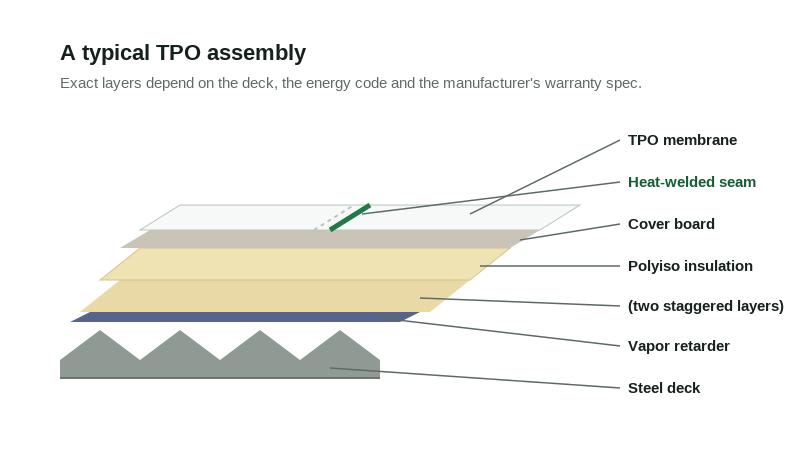
Three things follow from that:
- The rating applies only to the assembly as tested. Change the fastener, the fastener spacing or the brand of insulation, and the roof may no longer match the listing. A different adhesive or a different deck can do the same.
- The deck matters. The fasteners are only as strong as what they bite into. Steel, wood, concrete and older gypsum or cementitious decks each hold differently, and a rusted or damaged deck holds less.
- Installation has to match the listing. Fastener counts, row spacing, adhesive coverage and seam welds all have to be built as specified, especially in the corners and perimeter.
Attachment methods and wind
How a single-ply membrane is held down shapes how it behaves in wind:
| Attachment | How it resists wind | What to watch |
|---|---|---|
| Mechanically attached | Fasteners and plates in rows along the seams, more rows at corners and perimeter | The sheet billows between rows in high wind, which works fasteners and seams over time |
| Induction welded | Plates fastened through the insulation, with the membrane bonded to the plate tops | No fasteners through the membrane; plate layout still has to follow the tested pattern |
| Fully adhered | The whole sheet bonded to the cover board or insulation | No billowing; the bond depends on a clean, dry substrate and adhesive applied within its temperature limits |
| Ballasted | Stone or pavers hold a loose-laid membrane down by weight | Wind can blow ballast off corners and edges; height, exposure and the structure limit where ballast can be used |
Each method can be designed to meet a required rating. The right one depends on your deck, exposure, structure, warranty and schedule; our TPO roofing page compares the attachment options in more detail.
Edge metal: where wind resistance starts
The best-attached membrane can still fail if the edge lets go. Wind that gets under a loose edge pressurizes the space under the sheet and starts peeling it from the outside in. The building code requires tested edge metal (ANSI/SPRI ES-1) on low-slope membrane roofs for this reason. Copings, gravel stops and drip edges should be a tested system with continuous cleats and the specified fasteners. Field-bent metal with a few screws isn't enough.
Why does roof wind resistance matter on the Front Range?
It matters because of chinook winds, thunderstorm gusts, open exposure and code differences from city to city.
- Chinook winds. Strong, gusty downslope winds come off the foothills in winter and spring, hitting buildings from Boulder through Golden and Lakewood.
- Thunderstorm outflow on the plains. Summer storms throw out sudden gusts and microbursts across the Denver metro, often in the same storm as hail. Office parks in the Denver Tech Center and Centennial see mostly this kind.
- Open exposure. Buildings on open ground east toward Aurora, or tall buildings standing above their neighbors, see more wind than buildings sheltered by surrounding structures.
- Local code differences. Design wind speeds and requirements for Front Range roofing vary from one city or county to the next. Areas near the foothills may require more. Check with the building department where your building sits.
- The rest of the climate. UV at altitude ages sealants and membranes, and freeze-thaw opens gaps at edges and seams. Hail can damage the cover board and fasteners that hold the roof down.
Insurers and manufacturer warranties
Some property insurers require a roof built to a specific listed assembly or rating, and some ask for proof at replacement. Check your policy and ask your agent before the roof is designed, not after.
A manufacturer warranty is a separate question from the uplift rating. The rating is a test result; the warranty is the manufacturer's written coverage, with its own wind limit and exclusions. Many warranties cover wind only up to a stated speed. Some can be upgraded when the roof is built to a stronger specification. Read the wind language before you sign. As an approved applicator, Truman can offer extended manufacturer warranties on commercial projects, and we'll explain what each option covers.
How an older roof loses wind resistance
A roof that met its rating when it was installed may not meet it now. Watch for:
- Edge metal and coping that have loosened at joints and corners
- Fasteners that have backed out, showing as small bumps under the sheet
- Adhered areas that sound hollow or lift when pressed
- Wet insulation, which holds fasteners poorly and weakens adhesive bonds
- Rusted or damaged deck around fasteners
- Ballast blown off the corners, and open laps or seams near the perimeter
An infrared moisture survey and core cuts show whether insulation is wet. On a recover or re-roof, fastener pull-out tests on the existing deck confirm it will hold the attachment the design calls for.
When should you have your roof's wind rating checked?
Check it before a replacement or new equipment, after a high-wind event, and when an insurer asks or you take over a building.
Before a replacement or recover
Make sure the design names the tested assembly and shows the attachment for the corner, perimeter and field zones. Re-roofs generally need a permit and have to meet current wind requirements, so check with your city's building division.
After a high-wind event
Look for lifted edge metal, billowing, ballast blown off or debris on the ground, and have the perimeter inspected even if nothing is leaking.
When your insurer asks
Original submittals, the warranty and an inspection report usually answer what the roof is and how it's attached.
Before you add equipment or solar
New curbs, supports and arrays change how wind moves across the roof and add penetrations that have to be flashed and attached properly.
When you buy or take over a building
If nobody has the roof's records, an inspection with core cuts can identify the assembly and its condition.
Questions to ask your roofer
- Which tested assembly will you install, and does its rating meet the design pressure for each zone?
- What attachment pattern will you use at the corners and perimeter?
- Is the edge metal a tested system?
- Will you pull-test the existing deck on a recover or re-roof?
- What wind limit and exclusions does the manufacturer warranty carry?
- Will the submittals include the uplift design and the listing for the assembly?
Our submittals include the uplift design for your building, the assembly we'll install and the warranty to be issued. Andrew Rickert, our Operations Manager, leads estimating. He is a CPA, holds a Class-A GC license and has been with Truman since 2009. If you manage an office, retail or association roof in Centennial or along the foothills, see commercial roofing in Centennial or our work in Boulder. You can also browse our commercial roofing systems. Request a roof review and we'll tell you what's on the roof, how it's attached and whether the edges are holding.
Wind uplift FAQs
What is a wind uplift rating?
It's the result of a laboratory test on a complete roof assembly, showing how much uplift pressure that assembly resisted. The rating belongs to the assembly as tested, including the deck, insulation, fasteners or adhesive and membrane.
How do we find out our roof's rating?
Start with the original submittals, the manufacturer warranty and any permit records. If those are missing, an inspection with core cuts can identify the assembly and how it's attached. An older roof may not match any current listing.
Is the warranty wind coverage the same as the uplift rating?
No. The uplift rating is a test result for the assembly. The warranty is the manufacturer's coverage, with its own wind limit and exclusions. Read both.
Is a fully adhered roof always better in wind?
Not always. Adhered roofs don't billow, which helps, but mechanically attached and induction-welded roofs can meet the same required ratings with the right attachment pattern. The deck, exposure and budget decide which fits.
Can a repair affect the wind rating?
It can. Repairs should use materials and attachment compatible with the original assembly. Restore edge metal as a tested system rather than patching it with screws.
Do buildings near the foothills need a higher rating?
Often the design pressure is higher there, but it depends on the wind requirements your city or county has adopted and on the building itself. Check with your building department and the designer or engineer of record.