
Home / Resources / ACV vs replacement cost
Actual cash value vs replacement cost on commercial roof claims
Two roofs with the same hail damage can produce very different claim payments. It depends on how each policy values the roof. Here's how actual cash value and replacement cost work on commercial and association claims. You'll also see where depreciation fits and how to plan for what the policy won't pay.
General guidance, not legal or insurance advice. Valuation terms, endorsements and deadlines vary. Read your policy with your insurance agent.
How does a policy value a roof?
Replacement cost value (RCV) is what it costs today to repair or replace the damaged roof with like kind and quality. Actual cash value (ACV) is that replacement cost minus depreciation. Depreciation is a reduction for the roof's age and wear.
That's the core of replacement cost vs actual cash value: whether your insurer holds the depreciation back for now or deducts it for good. On a newer roof the difference may be modest. On an older roof, years of high-altitude sun, freeze-thaw and snow load add up. There, depreciation can be a large share of the estimate.
| Term | What it means | Where you'll see it |
|---|---|---|
| Replacement cost value (RCV) | The cost to replace the damaged roof with like kind and quality today | The estimate's total before depreciation and deductible |
| Depreciation | A reduction for age, condition and wear, figured by the insurer | Line by line on the estimate, and as a total on the summary |
| Actual cash value (ACV) | RCV minus depreciation | Usually the basis of the first payment, less the deductible |
| Recoverable depreciation | Depreciation the insurer may pay once the work is done, under a replacement cost policy | Released after completion and proof of cost, within the policy's time limit |
| Non-recoverable depreciation | Depreciation that won't be paid, as on an ACV policy | Shown separately on many estimates |
How do payments flow on a replacement cost policy?
A replacement cost policy rarely pays the full amount up front. The usual sequence:
The estimate
The insurer prices the covered damage at replacement cost and figures depreciation.
The first payment
Usually the actual cash value, less your deductible. The insurer holds back the depreciation.
The work
Your roofer repairs or replaces the roof to match the approved scope and any approved supplements.
Proof of completion
You send the insurer the completion documents and the final invoice.
The holdback
The insurer releases the recoverable depreciation, up to what you actually spent, within the policy's time limit.
Two details trip people up. The first is the deadline. Many policies require you to finish the work within a set period to recover depreciation. Read that clause before material lead times or a Colorado winter push the schedule. The second is the lender. If a lender is named on the policy, it may need to sign the claim checks. Our hail claim timeline shows where each payment falls between storm and closeout.
How does an actual cash value policy work?
On an ACV policy, you generally can't recover depreciation. The insurer pays the actual cash value, less the deductible. You cover the difference between that and the cost of the work. The older the roof, the larger that gap tends to be.
Commercial policies don't always use one basis for everything. Your policy may value roof surfacing at actual cash value even when the rest of the building is insured at replacement cost. Some of those endorsements also exclude cosmetic damage. Others use a payment schedule tied to the roof's age. Your declarations page and endorsements tell you which applies to your roofs, and your agent can explain them.
How is depreciation figured?
Each insurer has its own method. In general, depreciation reflects the roof's age, its condition before the storm and the type of system. You can't change the method, but you can make sure it starts from accurate facts:
- The installation date. Permits, invoices and warranty documents show when the roof went on. Without them, the age may be estimated.
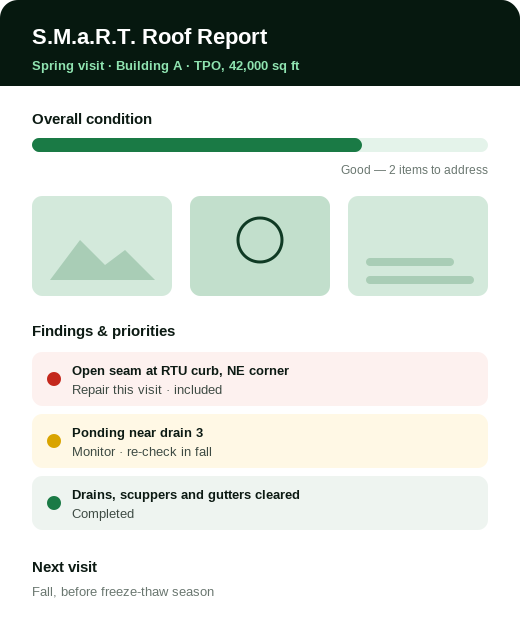
- The prior condition. Dated maintenance and inspection reports show a roof that was cared for. Our S.M.a.R.T. maintenance program leaves you a report with photos after every visit.
- Prior repairs. Records of what was fixed, when and where.
Does the depreciation on your estimate look off? Ask the adjuster in writing how it was calculated. Our article on how to read a carrier's roof estimate shows where depreciation appears on each line.
What doesn't replacement cost pay for?
Replacement cost restores what you had. It doesn't fund everything a roof project can include:
- Upgrades. You might choose a different system, more insulation than code requires or a longer warranty than the original roof had. If so, you generally fund the difference.
- Code-required work. Your new roof generally has to meet today's energy code and other current rules. Ordinance or law coverage usually pays for that work, up to its limit, if your policy has it.
- Undamaged areas and existing wear. The claim covers the storm damage, not roof sections or conditions the storm didn't affect.
- The deductible. It comes off the claim regardless of the valuation basis. See our guide to percentage wind and hail deductibles.
To see what drives the cost of the work itself, from tear-off and insulation to access and edge details, read commercial roof cost factors.
Planning for the gap
Whatever the basis, plan the project around the payments you'll actually receive and when:
| Replacement cost policy | Actual cash value policy | |
|---|---|---|
| First payment | ACV less the deductible | ACV less the deductible |
| Depreciation | Held back, usually recoverable after completion | Generally not recoverable |
| What you fund | The deductible, upgrades and the gap until the holdback is released | The deductible, upgrades and the depreciation |
| What to watch | Completion deadlines and proof-of-cost requirements | The roof's age and documented condition |
For associations, your board needs a funding plan for the deductible and any gap. The governing documents say whether that comes from reserves, operating funds or an assessment. On a multi-building claim, you can help cash flow by sequencing the work. Where the policy allows, finished buildings release depreciation for the next ones. See our association hail claims guide for how phased payments work.
For commercial owners, put the gap in the building's capital plan. Include any upgrades you want to make while the roof is open.
Before the next storm
- Settle the ACV vs replacement cost roof question with your agent for each roof. Ask whether any roof surfacing endorsement applies.
- Write down the time limit for finishing repairs and recovering depreciation.
- Ask whether your policy includes ordinance or law coverage, and what its limit is.
- Gather the installation date and warranty for each roof. Keep your maintenance reports current.
How we help at closeout
Recoverable depreciation depends on clean paperwork. You'll get a written contract from us and invoices that match the approved scope and supplements. Associations get them broken out by building. We also deliver completion photos and warranty documents you can send to the carrier. We don't collect final payment until you sign off.
Our estimating is led by Andrew Rickert, our Operations Manager. He's a CPA with a Class-A general contractor license and has been with Truman since 2009. Learn more about our team. We document damage, meet the adjuster on the roof and prepare a detailed scope. You negotiate the claim, with your agent or a licensed public adjuster.
We're based in Centennial and work on commercial and association roofs across the Denver metro. See our page on commercial roofing in Denver. Request an inspection for a documented condition report, and we'll reply within one business day, or call (720) 296-0000.
ACV and replacement cost FAQs
Why is our first claim check smaller than the estimate?
On a replacement cost policy, the first payment is usually the actual cash value, less the deductible. Actual cash value means replacement cost minus depreciation. You get the recoverable depreciation after the work is done and documented.
What is recoverable depreciation?
The part of a replacement cost claim held back at first for the roof's age and wear. It's usually paid after the work is done and the cost is documented, within the policy's time limit.
Does an older roof get paid less?
Usually an older roof gets more depreciation. On a replacement cost policy, you may recover much of it. On an actual cash value policy, you generally can't. Your agent can explain how your policy treats roof age.
Can we switch roof systems on an insurance job?
Often, yes. The claim generally pays for like kind and quality, so if the new system costs more, the difference is usually yours. Code-required items may fall under ordinance or law coverage.
What happens if we miss the deadline to recover depreciation?
The policy may not pay it. If lead times, weather or board approvals threaten the deadline, talk with your agent and the carrier early.