
Home / Resources / Reading a carrier estimate
How to read an insurance carrier's commercial roof estimate
A carrier's roof estimate can run dozens of pages of codes, quantities and depreciation. Here's how to read an insurance roof estimate on a commercial or association building. You'll see what's on the summary, what each line item tells you and the items these estimates most often leave out.
General guidance, not legal or insurance advice. Each carrier formats its estimates differently, and your policy decides what's covered. Your insurance agent can explain your terms.
What is a carrier's estimate, and what isn't it?
The carrier's estimate is the insurer's value for the covered damage. The adjuster usually writes it in estimating software with regional pricing. It's a line-item roof cost estimate of the work the insurer believes the storm made necessary, and what it values that work at.
It isn't a bid and it isn't a contract. It doesn't schedule the work or bind anyone to perform it, and the first version is often not the last. Carriers revise estimates after re-inspections and supplements. Read it as a statement of what the insurer saw, then check whether that matches what's on your roof.
Start with the header and summary
The first pages identify the claim and total it up. Check the basics before the numbers. Look for the property address, building names or numbers, date of loss, claim number and type of loss. If you have several buildings, make sure every affected one appears.
| Summary term | What it means |
|---|---|
| Line item total | The sum of all priced line items before tax, overhead and profit |
| Replacement cost value (RCV) | The estimated cost to do the covered work today, before depreciation |
| Depreciation | A reduction for the roof's age and condition, often split into recoverable and non-recoverable |
| Actual cash value (ACV) | RCV minus depreciation |
| Deductible | Your share under the policy, subtracted from the payment |
| Net claim | What the insurer intends to pay now, after depreciation and the deductible |
| Overhead and profit (O&P) | An allowance for a general contractor's costs when a project needs several trades coordinated; whether it's included depends on the carrier and the claim |
The difference between RCV and the net claim surprises many owners. Our guide to actual cash value vs replacement cost explains how you get the held-back depreciation after the work is done.
Then read the line items
The body of the estimate is grouped by building, roof area or trade. Each line usually shows:
- Description: the task and material, such as removing the existing membrane or installing new edge metal.
- Quantity and unit: how much, in squares (SQ, one square is 100 square feet of roof), square feet (SF), linear feet (LF) or each (EA).
- Unit price and total: the carrier's price per unit and the extended cost.
- Tax, depreciation and ACV: the line's share of each.
You'll often see short codes such as R&R (remove and replace) and "tear off." D&R means detach and reset, for items lifted and put back, such as rooftop units. Notes at the end of a section often explain the adjuster's assumptions. Read them closely.
Read the depreciation line by line
Depreciation is usually figured on each line, not just as one total. Many estimates also mark each amount as recoverable or non-recoverable. Look at three things:
- The age used. Many estimates show the roof age or the life the adjuster assumed. If it doesn't match your installation date, send the permit, invoice or warranty that shows the right one.
- What's reduced. Your carrier and policy may treat labor, tear-off and disposal differently from materials.
- What's recoverable. On a replacement cost policy, you get recoverable depreciation after the work is done and documented. You won't get non-recoverable amounts.
If you can't tell how a figure was reached, ask the adjuster to explain it in writing. Your agent can tell you how your policy handles depreciation.
Check that it describes the roof you have
The most important question isn't the price per square. It's whether the estimate describes your actual roof:
- The right system. TPO, EPDM, built-up, metal or spray foam, as it's actually installed. An estimate written for the wrong system can't price the right repair.
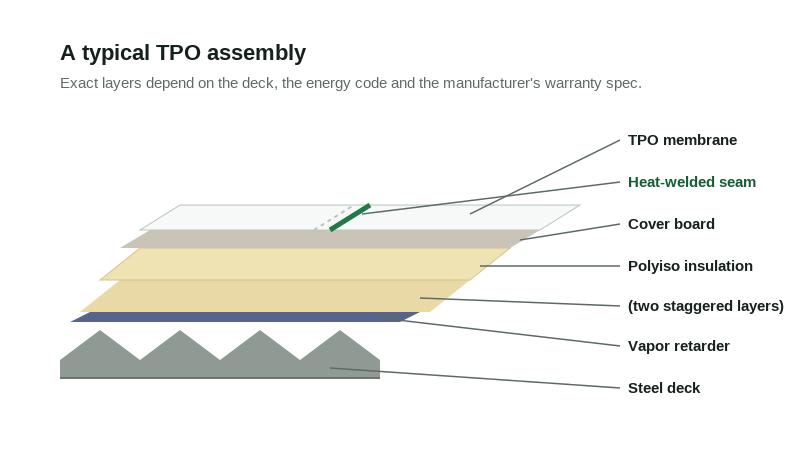
- The full assembly. How many existing roofs have to come off, the insulation layers, the cover board and the deck. A membrane-only estimate on a roof with crushed insulation underneath leaves out most of the work.
- The measurements. Roof area, perimeter, parapet and flashing heights, and counts of drains, curbs and penetrations.
- Every building and section. Some estimates price a sample area or leave out a roof level. Compare them against your site map.
- The right repair method. Watch for a patch line where the damage calls for replacing a section. Also watch for a repair the manufacturer's requirements don't allow.
What do commercial estimates often miss?
On commercial and association roofs, the first estimate commonly leaves out or understates:
- Edge metal, coping and gutters
- Flashings at walls, curbs, skylights and penetrations
- Insulation, cover board and tapered insulation or crickets
- Drains, scuppers and overflow drains
- Rooftop units that must be disconnected and lifted, including the crane and the HVAC contractor
- Walkway pads
- Permits and code-required work, such as bringing insulation up to the current energy code
- Safety and fall protection, hoisting, staging and disposal
Your policy's ordinance or law coverage may pay for code-required items, up to its limit. The estimate sometimes shows it separately. You'll find terms like coping, cricket, curb and cover board in our commercial roofing glossary.
Compare it with your roofer's scope
Put the carrier's estimate next to your roofer's detailed scope and compare them building by building and line by line, before you compare totals. When the totals differ, the reason is usually one of four things:
A missing item
Something on the roof, such as edge metal or insulation, that isn't on the estimate.
A different quantity
Square footage, linear footage or counts that don't match the measurements.
A different method
The estimate prices a repair where you need a replacement. Or it prices a recover where codes or the roof's condition require a tear-off.
A different price
Unit prices that don't reflect the actual cost of the work, access or materials.
Our proposals are line-itemed, which makes this comparison easier. We document missing items and quantities for a supplement, with photos, measurements and the reason each is needed. See supplements on commercial roof claims for when that's appropriate.
What if the estimate and the roof don't match?
- Ask in writing. If a quantity, a method or the depreciation looks wrong, ask the adjuster how it was figured.
- Document the gap. Missed items need photos, measurements and a reason, tied to a location on the site map.
- Request a re-inspection if the adjuster didn't see part of the roof or the hidden damage.
- Keep coverage questions separate. Whether something is covered is between you and your insurer. We don't negotiate the claim; that's your role, with your agent or a licensed public adjuster.
Our hail claim timeline shows where the estimate fits in the larger claim. Our article on what your roofer does at the adjuster meeting covers the visit the estimate is written from. Associations can find more on building-by-building claims in our association hail claims guide.
No deductible deals. The deductible on the summary page is yours to pay. Truman never pays, waives or rebates it on any job. Colorado's roofing contractor law forbids it on residential property, which can include condo and townhome buildings.
If a carrier estimate just landed on your desk, we can walk through it with you. We're based in Centennial, near the Denver Tech Center, and work across the metro. See our page on commercial roofing in Englewood. Request an estimate review and we'll reply within one business day, or call (720) 296-0000.
Carrier estimate FAQs
Is the carrier's estimate the same as a bid?
No. It's the insurer's value for the covered damage, not a contractor's roofing estimate or bid. The price for the work is set by your contract with the roofer. If the two differ, find out why before you sign.
Why is depreciation on our estimate?
Your policy likely reduces the first payment for the roof's age and condition. On a replacement cost policy, you may get some or all of that back after the work is done. Your agent can explain your terms.
What is a square?
A roofing unit equal to 100 square feet of roof area. Membrane, insulation and tear-off are usually priced by the square.
What does O&P mean on our estimate?
It stands for overhead and profit. It's an allowance for a general contractor's costs when the work needs several trades coordinated, such as roofing, HVAC and electrical. Whether it's included depends on the carrier and the claim.
Can the estimate change?
Yes. Carriers often revise estimates after a re-inspection or a supplement for missed items. Hidden conditions found once the old roof is off can change it too.
Will you review the carrier's estimate for us?
Yes. We compare it line by line with our own detailed scope and document anything missing. Coverage decisions remain between you and your insurer.