
Home / Resources / Wind and hail deductibles
Percentage wind and hail deductibles explained
A percentage deductible grows with the value of your building, not the size of the loss. Here's how wind and hail deductibles work on commercial and association policies. You'll also see what to ask your agent and how to plan for the amount before the next storm.
General guidance, not legal or insurance advice. Every policy words its deductible differently. Your declarations page, your deductible endorsements and your insurance agent have the final word on yours.
What is a percentage deductible?
Most people know deductibles as a flat dollar amount: the first part of a covered loss that you pay before the policy responds. A percentage deductible works differently. It's a percentage of an insured value shown on your policy. Each percentage point equals one dollar for every hundred dollars of that value.
Wind and hail are often covered under a commercial property policy, sometimes with their own deductible, rather than through separate windstorm insurance. Ask your agent how yours is written. Many commercial and association property insurance policies give wind and hail their own deductible, apart from the one for other causes of loss. That wind and hail deductible is often a percentage.
If your building is insured for millions, even a low percentage adds up to a large amount. And it's the same whether the storm damaged one roof section or the whole roof. Our guide to association hail claims walks you through an example.
What does the percentage apply to?
The percentage is only half the calculation. The other half is the value it's applied to. The same percentage can produce very different deductibles depending on the wording. When you read your policy with your agent, look for:
- The value. It might be the building's insured value or the value of everything at a location. It could also be a scheduled value per building, or a blanket limit across several properties.
- Per building or per location. Whether each damaged building carries its own deductible, or one deductible applies across the location.
- Per occurrence. Whether a new deductible applies to each storm.
- A minimum. Your policy may set a minimum dollar amount that applies when the percentage comes out lower.
- What it covers. Whether the wind and hail deductible applies only to wind and hail, or to other weather causes as well.
- Related limits. Check for cosmetic damage exclusions on metal roofing and roof surfacing limits. See whether roofs are valued at replacement cost or actual cash value.
Why do per-building and per-occurrence terms matter?
Communities and campuses
Say the deductible applies per building. Then a community with many buildings, or an office campus with several, can face a total many times larger than one building's deductible. Two associations with the same percentage can end up with very different numbers. One line of policy wording makes the difference.
More than one storm
If your deductible applies per occurrence, you pay a deductible for each storm. Along the Front Range, where hail season runs from mid-April to mid-August, a roof can be hit more than once in a season. That makes the date of loss important. Damage you can't tie to a specific storm is harder to claim, and damage split across storms may fall below each deductible. Our guides to documenting hail damage and the hail claim timeline show you how to establish the storm date.
How does the deductible shape roof decisions?
A large deductible changes how you handle hail damage claims. Ask these questions after a storm.
- Is the damage above the deductible? You won't know until the roofs are inspected and the damage is scoped. Get the inspection first, then talk with your agent about whether to pursue the claim. That decision belongs to the owner or the board.
- Is the whole loss documented? In general, the deductible is measured against the covered loss from the storm. Damage to rooftop units, skylights, gutters, edge metal and other exterior items counts along with the roof membrane. If you miss them, you understate the loss. Your agent can confirm how your policy applies it.
- Repair or claim? If the damage is limited and close to the deductible, a documented repair may make more sense for you than a claim. Ask your agent how a claim may affect future premiums.
- Can you fund it? The insurer subtracts the deductible from the claim payment, so that share of the work comes from your own funds. Knowing the number in advance keeps a claim from stalling while the money is found.
To see how claim payments are figured once the deductible comes off, read actual cash value vs replacement cost on roof claims.
Planning for the deductible
HOA and condo associations
Your declarations and other governing documents usually say how the association pays a deductible. The options are reserves, operating funds or an assessment to owners. Read them with your community manager and association attorney before a storm, not during one. You may want to set aside a deductible fund for exactly this reason.
Make sure your reserve study reflects the roof's real condition and your deductible exposure. Our guide to HOA roof reserve planning shows how roof inventories and condition reports feed the study. Our reserve planning page explains how we help boards phase work.
Commercial owners and managers
Put the deductible exposure in the capital budget for each building. Then check whether your leases say how insurance deductibles or repair costs are shared. If a lender is named on the policy, find out whether it has requirements for claim proceeds.
Questions to ask your agent at renewal
Is there a separate wind and hail deductible?
And is it a percentage or a flat amount?
What value does the percentage apply to?
Building, location, scheduled value or blanket limit.
Does it apply per building, per location or per occurrence?
And is there a minimum?
How are our roofs valued?
Ask whether it's replacement cost or actual cash value, and whether any roof surfacing or cosmetic damage limits apply.
What deductible options exist?
And how each one would change the premium.
What are the notice and repair deadlines?
How soon a loss must be reported and how long you have to complete repairs.
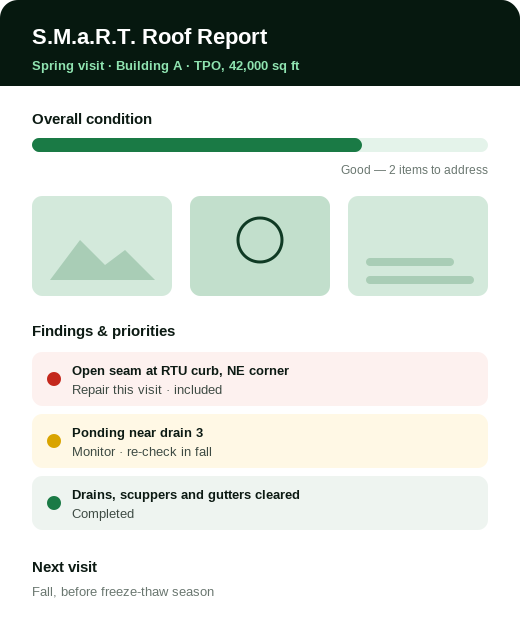
Pair those answers with a current roof condition report. A spring inspection before hail season gives you dated photos of each roof. It also lists maintenance items to fix before they complicate a claim. Our S.M.a.R.T. maintenance program leaves you a written report with photos after every visit.
No one can make your deductible disappear
The deductible is yours to pay. Truman never pays, waives or rebates a deductible on any job. Colorado's roofing contractor law forbids it on residential property, which can include condo and townhome buildings. That includes offers dressed up as advertising payments, gift cards or "discounts." A roofer who offers to cover it is a red flag.
A large deductible is exactly what some door-to-door contractors target after a storm. Expect a written contract from any reputable contractor, and don't sign anything on the spot.
How we help
We can't change your deductible, but we can make sure your decision rests on accurate information. After a storm, we inspect and document every roof by building. That includes edge metal, flashings and rooftop items, so you can see the full loss. If you ask, we'll meet the adjuster on the roof and prepare a detailed, line-item scope. For an association, we invoice by building to match the insurer's estimate. We can also phase work to fit your board's cash position.
What we don't do is negotiate the claim. That's your role, with your agent or a licensed public adjuster.
We're based in Centennial, near the Denver Tech Center. We work with associations and commercial owners across the Denver metro. See our page on commercial roofing in Highlands Ranch. Request a pre-season inspection and we'll reply within one business day, or call (720) 296-0000.
Wind and hail deductible FAQs
How is a percentage deductible calculated?
Your policy's percentage is applied to an insured value it names, such as the building's insured value. Each percentage point equals one dollar for every hundred dollars of that value. Your declarations page and endorsements show which value applies.
Does the deductible apply to each building?
It depends on the wording. Your policy may apply it per building, per location or per occurrence. For a multi-building community or campus, that wording can change your total a great deal.
Can a roofer cover our deductible?
No. Truman never pays, waives or rebates a deductible on any job. Colorado's roofing contractor law forbids it on residential property, which can include condo and townhome buildings.
How do associations usually pay the deductible?
Your governing documents usually say: from reserves, from operating funds or through an assessment to owners. Ask your community manager and association attorney to confirm what yours say.
Should we file if the damage might be close to the deductible?
Get the roofs inspected and the full loss documented first, including rooftop equipment and exterior items. Then talk with your agent about the numbers and the effect on future premiums. Filing is the owner's or board's decision.
Can we change our deductible?
Ask your agent at renewal what options you have and how each would change your premium.