
Home / Resources / Roof maintenance plans
Commercial roof maintenance plans: scope and cost
A commercial roof maintenance plan puts your roof on a schedule instead of waiting for the next leak. Here's what a good plan covers and what moves its price. You'll also see what to read for in a maintenance contract and how to choose a level of service.
What is a commercial roof maintenance plan?
A commercial roof maintenance plan is a standing agreement between you and a roofing contractor. The contractor visits your roof on a set schedule and keeps it draining. They inspect it section by section, make the repairs you agreed on and give you a written record of every visit.
You may also hear it called a roof maintenance contract, a preventive maintenance agreement or a service program. The name matters less than what's written into it.
The alternative is reactive: nobody goes on the roof until water shows up on a ceiling tile. On a low-slope roof, that's an expensive way to learn about a problem. By the time a leak shows inside, water has usually been working through the insulation for a while.
Why does a commercial roof need a plan, not just a phone number?
Most low-slope roofs don't fail all at once. They fail at the details, one small opening at a time:
- Drains and scuppers clog. Leaves, hail, gravel and debris plug strainers, water ponds against flashings, and ponding speeds wear on the membrane.
- Sealant-dependent details dry out. Pitch pans, termination bars and counterflashing sealant age fastest under the strong UV at altitude.
- Freeze-thaw widens small openings. Water in a tiny seam gap freezes, expands and opens it a little more each cycle through a Front Range winter.
- Wind works the perimeter. Chinook winds pull at corners, edge metal and loose flashing.
- Other trades leave damage behind. HVAC, solar and telecom crews drop screws, cut curbs and walk on unprotected membrane.
Each of these is a small repair when someone catches it on a scheduled visit. If it's missed, water reaches the insulation. Wet insulation is what turns a repair budget into a re-roof years ahead of plan. A maintenance plan exists to catch the small things on a schedule.
There are three other reasons owners and boards put plans in place:
- Warranties. Many manufacturer warranties make you, the owner, responsible for maintenance. They ask for proof of it when you file a claim.
- Storm claims. A dated record of the roof's condition before a hailstorm makes new damage easier to tell apart from wear.
- Budgets. Regular reports turn "the roof is getting old" into a list of what needs money this year, next year and later.
What does a good roof maintenance plan include?
When should the visits happen in Colorado?
The National Roofing Contractors Association recommends inspecting low-slope roofs at least twice a year and after severe weather. Along the Front Range, the two visits do different jobs. A spring visit clears what winter left in the drains and repairs freeze-thaw damage before hail season starts in mid-April.
A fall visit looks for hail and wind damage from the summer and clears leaves before they freeze into the drains. Add a visit after a hailstorm, a chinook wind event or a heavy wet snow. Our post-storm roof checklist covers what your staff can check in the meantime.
Why does drainage come first?
Drains, scuppers, gutters and downspouts get cleared on every visit. The inspector also notes any standing water, missing strainers and how the overflow drains look. Drainage is the cheapest part of roof care and the part most often skipped.
What should the inspection cover?
A useful inspection follows the same route every time. It covers the field of the roof, seams, curbs and penetrations, and pitch pans. It also covers parapet walls and coping, edge metal, expansion joints, skylights, hatches and walkway pads. It includes a look at what other trades did since the last visit.
Which repairs are included?
Some plans only inspect. Others also remove debris and make small repairs during the visit. That way an open seam or a dried-out pitch pan gets fixed while the crew is already on the roof. Your agreement should say which repairs are included and which get quoted separately for you to approve.
What should the report show?
The report is what you're really paying for. It should give the overall condition and photos of each finding, located on a roof plan. It should also say what was fixed and list what's next, in order: fix soon, and plan for it. Reports for one building or forty should read the same way, so you can compare them year over year.
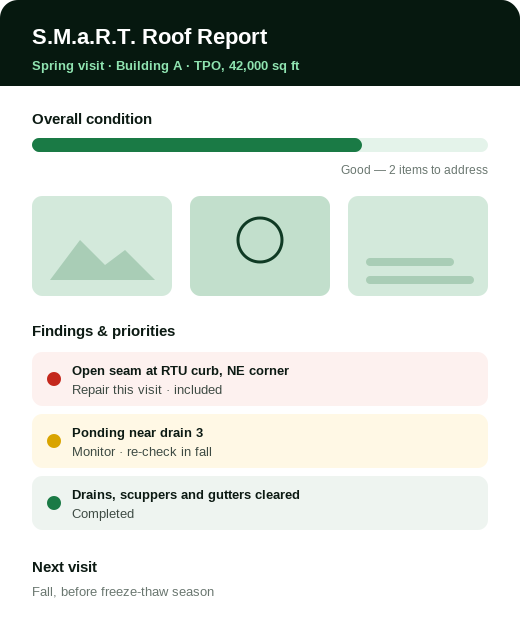
What goes in the roof record?
The first visit should set a baseline. It records the roof plan, system, approximate age, sections and their condition, any warranty and past repairs. That record is what lets the crew know your roof before they climb the ladder on a leak call.
What drives the cost of commercial roof maintenance plans?
We don't publish prices for maintenance plans, because two buildings with the same square footage can need very different amounts of work. These are the factors that set the price:
| Cost driver | Why it changes the price |
|---|---|
| Roof size and layout | More area and more separate roof levels mean more time walking, clearing and documenting. |
| Number of buildings | A community or portfolio has more roofs to visit and report on, though grouping nearby buildings saves travel and setup. |
| Roof system | Gravel built-up roofs hide problems and take longer to inspect. Spray foam needs its coating watched. Single-ply seams need probing. |
| Age and condition | An older roof with recurring problems needs more repair time on every visit than a roof still under warranty. |
| Rooftop equipment and penetrations | Every curb, pipe, vent and skylight is a detail to inspect and, eventually, to reseal. |
| Drainage and debris | Interior drains, long gutter runs and nearby trees mean more clearing. |
| Access and safety | Roof height, hatch or ladder access, lifts, skylights and low parapets affect the fall protection and setup each visit needs. |
| Level of service | Inspection only, inspection plus small repairs, or a fuller survey with larger repairs included. |
| Extra visits and reporting | Post-storm visits, warranty documentation and board-ready or portfolio reporting add time. |
A plan should be priced per building after someone walks the roof. A price quoted sight unseen has to guess at every one of these factors. These same factors drive repair and replacement budgets too. See commercial roof cost factors.
Which S.M.a.R.T. level fits your roof?
Our maintenance program, S.M.a.R.T. (Service, Maintenance and Repair with Truman), comes in three levels that build on each other. Every level includes scheduled visits, and you get a written report after each one.
| Level | What's included | Usually fits |
|---|---|---|
| Level 1: Clear & Check | Drain, scupper and gutter cleaning, a visual inspection and a written report | Newer roofs in good condition |
| Level 2: Clear & Repair | Everything in Level 1, plus debris removal and small general repairs during the visit | Most working commercial and association roofs |
| Level 3: Survey & Repair | Everything in Level 2, plus a full inspection, a roof survey and medium general repairs | Older roofs, capital planning and reserve studies |
Your agreement lists what counts as a small or medium repair on your roof. That way you know before the visit what's covered and what gets quoted separately. Nothing beyond your level's scope happens without your approval.
We maintain TPO, EPDM, built-up, metal and spray foam roofs, whether or not we installed them. See the full S.M.a.R.T. maintenance program for what each visit covers.
What should you look for in a roof maintenance contract?
Whoever you hire, read the agreement for these points before you sign:
- Scope per visit. What gets cleared, inspected and documented, in writing.
- Visit schedule. How many visits, roughly when, and how post-storm visits are handled and priced.
- Repair limits. What's included, what needs a quote, and who can approve work on the spot.
- Report contents. Photos, a roof plan, a prioritized list and how you'll receive it.
- Leak calls between visits. How to report one and how it's billed.
- Warranty fit. Whether the contractor will check your manufacturer warranty's requirements and is authorized to repair that system.
- Insurance and safety. Certificates of insurance on file, workers' comp for the crew, and fall protection on every visit. A plan also means fewer trips for your own staff; see rooftop safety for building staff.
- Exclusions. Storm damage, damage by other trades and larger repairs are usually handled outside the plan. The contract should say so plainly.
- Term and renewal. How the agreement renews and how either side can end it.
When a plan isn't enough. Maintenance extends the life of a sound roof. It can't fix a roof where wet insulation is widespread.
Do visits keep finding the same problems? Then an infrared moisture survey can tell you whether repair, recover or replacement is the honest next step.
How do HOA boards and property managers use a plan?
Associations and portfolios get the most out of a plan because the records add up. Condition by building feeds your reserve study, and visits can be grouped by area. Every report arrives in the same format for the board or owner.
You can also put each building at its own level. For example, use Level 1 on newer roofs and Level 3 on the ones nearing replacement. See how we work with property managers and our guide to roof reserve planning.
How do you set up a plan?
We're based in Centennial, near the Denver Tech Center. We handle commercial roof maintenance in Denver and the communities within about 30 miles. That includes the flat roofs common in DTC office parks, townhome communities and warehouses. See commercial roofing in Centennial or our work in Denver.
Send us the address and the roof size if you know it. We'll walk the roof, recommend a level and quote each building. Request a maintenance plan quote, and if water is coming in now, report the leak first. We reply within one business day.
Roof maintenance plan FAQs
How much does a commercial roof maintenance plan cost?
It depends on roof size, the number of buildings, the system and its condition, rooftop equipment, access and the level of service you choose. We walk the roof first and then quote each building, so the price reflects your roof rather than an average.
How often should a commercial roof be inspected?
The NRCA recommends at least twice a year for low-slope roofs, plus after severe weather. In Colorado that means spring, before hail season, and fall, before freeze-thaw.
Do we need a plan if the roof is new and under warranty?
Usually, yes. Many manufacturer warranties require you to maintain the roof and keep records. A light plan, such as Level 1, keeps drains clear and builds that record from the start.
Will you maintain a roof another contractor installed?
Yes. Our first visit sets a baseline. We record the roof plan, system, condition by section and any existing warranty. If the roof is under a manufacturer warranty, we check its requirements before making repairs.
Does a maintenance plan cover hail damage?
A post-storm visit documents what the storm did, with dated photos, which supports a claim if there is one. Whether repairs are covered depends on your policy, so check it with your agent, and your agreement should say how storm repairs are quoted. See what to do after a hailstorm.
What's the difference between a maintenance plan and a warranty?
A warranty promises to fix covered defects. A maintenance plan is the routine care that keeps problems from starting. It's often a condition of keeping your warranty valid.