
Home / Resources / Post-storm roof checklist
Post-storm roof checklist for facility and property managers
After hail, high wind or a heavy snow, you need to know quickly whether your roofs were damaged, without sending anyone up a ladder. This checklist covers what to set up before storm season and what to check inside and from the ground. It also tells you what a professional roof inspection should include.
What should you set up before storm season?
The work you do in March pays off in June. Along the Front Range, hail season runs from roughly mid-April to mid-August. Chinook winds can hit in any cold month, and spring snows are heavy and wet. Have these ready before the first storm:
- A contact list. Include your roofer, HVAC contractor and insurance agent. Add whoever approves spending: the owner, asset manager or board president.
- Roof access: hatch keys, ladder locations and who can let a crew in after hours.
- Roof plans and records for each building, with the system, approximate age and any warranty.
- Baseline photos or a recent inspection report. A record of the roof's condition before a storm makes new damage easier to prove. A spring maintenance visit sets that baseline.
- Policy information. Note your carrier, policy number and agent's contact. Check what your policy requires after a loss.
- A priority list of your buildings. Put the ones with sensitive occupants or known roof problems at the top.
Step 1: how do you keep people safe?
- Keep staff off the roof. Wet membranes are slick, hail can hide cracked skylights, and wind may have loosened edge metal. Rooftop checks belong to a crew with fall protection. See rooftop safety for building staff.
- Watch for water near electrical equipment. Keep people away and have the circuit shut off if needed.
- After heavy snow, look for signs of overload: sagging ceilings or deck, new cracks, doors that stick, or creaking and popping sounds. If you see them, clear the area and call a structural engineer before anyone goes on the roof.
- If water is coming in, call us first. A temporary repair now prevents wet insulation and interior damage later. Call (720) 296-0000 or report a leak.
Step 2: what should you check inside?
Start inside: water in the building is what you need to find first. It's also the easiest damage to document. Check:
- Top-floor ceilings, corridors and stairwells
- Ceiling tiles around skylights, roof hatches, rooftop units and roof drains
- Walls below parapets and roof edges, where wind-driven water often enters
- Electrical rooms, elevator machine rooms and mechanical rooms
- Units or suites where tenants or residents have reported drips
Photograph water and stains before anyone cleans up: a wide shot of the room, then close-ups. Note the time and whether the water appeared during the storm or after.
Step 3: what can you see from the ground?
You can learn a lot about the roof without leaving the parking lot:
- Hail signs. Look for dented gutters, downspouts, edge metal and vents. Check for spatter marks on dumpsters, painted surfaces and pavement. Torn screens, damaged condenser fins and broken skylights or lights are signs too.
- Wind signs. Look for lifted or missing edge metal and coping, and membrane flapping at the perimeter. Gravel or ballast on the ground and debris on the roof or against the building are signs too.
- Snow signs. Look for drifts against parapets and rooftop units, and icicles or ice at gutters and scuppers. Water pouring from overflows is a sign too.
- Hailstones. If any are still on the ground, photograph them next to a coin or ruler.
Not seeing anything doesn't mean the roof is undamaged. Hail damage on a low-slope roof is often invisible from below, which is why the next step matters.
Step 4: what should a professional roof inspection cover?
Your storm damage assessment should have dates and photos, sorted by roof section and by building. What the inspector looks for depends on the storm. Use the lists below as roof inspection tips for each kind of storm.
After hail
- Punctures, fractures and bruising in membranes, and granule loss on asphalt-based roofs
- Fractured cover board and crushed insulation under an intact-looking surface, checked with test cuts
- Damaged seams, flashings and sealants
- Dented metal panels, edge metal, coping and vents
- Damage to rooftop units, skylights and vents. See hail damage to rooftop equipment.
- Drains clogged with hail and debris
Our guide to documenting hail damage on a commercial roof covers what a good record includes.
After high wind
- Lifted perimeter and corner sheets, and loose fasteners or plates
- Loose or missing edge metal, coping and counterflashing
- Displaced ballast or gravel, and debris punctures
- Shifted rooftop equipment, panels and access doors
See wind damage to commercial roofs.
After heavy snow
- Drift loads against parapets, walls and rooftop units
- Ponding and ice in drains and gutters as the snow melts
- Membrane cuts from snow removal
- Signs of deflection at the deck or framing
See snow load on commercial roofs.
After heavy rain
- Clogged drains, scuppers and gutters, and whether overflows worked
- Ponding areas and leaks at flashings and curbs
See flat roof drainage.
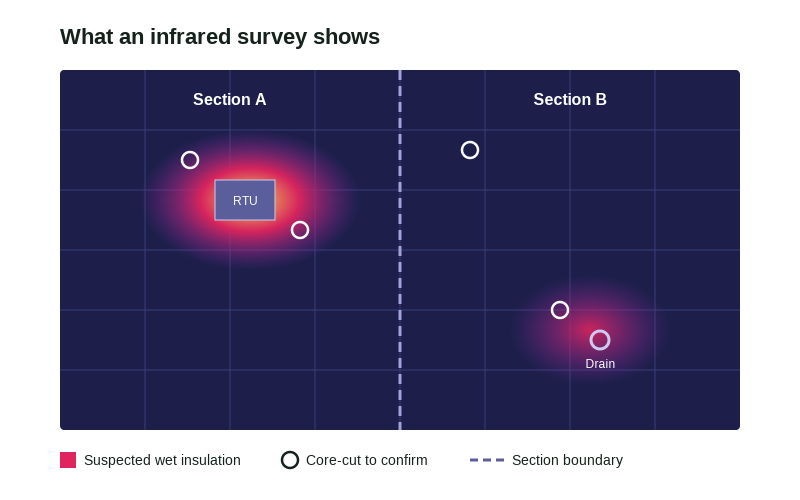
Where water may have reached the insulation, an infrared moisture survey shows new wet areas before they show up as leaks. Our inspections and IR surveys cover all of this. For large or hard-to-reach roofs, we add drone imagery.
Step 5: what records should you keep?
- Storm details: date, time, duration, storm type and the largest hail anyone saw.
- Photos from inside and from the ground, with dates.
- A log of every call, visit and decision, with names and times.
- Storm reports. The NOAA Storm Prediction Center posts daily storm reports. They can help you pin down the date of loss. See NOAA hail reports and the date of loss.
- Notice. Notify your insurance agent or carrier promptly if you suspect damage. Policies vary, so check yours and ask your agent what it requires.
We document the roof storm damage, meet your adjuster on the roof and write a detailed scope. The claim itself is between you, your agent and your carrier, or a licensed public adjuster if you hire one.
What shouldn't you do after a storm?
- Don't sign with the first crew that knocks. Out-of-town contractors arrive after every big Front Range storm. Check for a local office, insurance and licensing first. See storm chaser red flags.
- Don't make permanent repairs before the adjuster sees the roof, unless waiting would cause more damage. Temporary repairs to stop leaks are expected; photograph before and after and keep the invoice.
- Don't send staff up to shovel snow or clear hail. Shovels cut membranes, and the roof edge is the hazard.
- Don't let tenants' vendors onto the roof unescorted until it has been checked.
How do you handle several buildings at once?
A storm that crosses the south metro can hit a whole portfolio or HOA community at once. Work through the buildings in this order:
- Buildings with active leaks
- Buildings with sensitive occupants: medical, data rooms, restaurants, schools
- Older roofs and roofs with known problems
- Everything else in the storm's path
Ask for findings by building, so the owner or board can see which roofs were hit and which weren't. For large communities, drone roof inspections speed up the first pass.
The one-page version
Safety
Staff off the roof, water away from electrical, watch for snow overload, call for emergency repairs.
Inside
Top floors, skylights, hatches, walls under parapets, mechanical rooms. Photograph before cleanup.
Outside
Gutters, edge metal, coping, debris, ballast, spatter marks, hailstones.
Inspect
A dated, photographed roof inspection by section and building.
Record and notify
Storm details, photos, a log, storm reports, and notice to your agent and decision-makers.
We're based in Centennial, near the Denver Tech Center. After a Front Range storm, we can inspect your commercial or association roofs anywhere in the metro. See commercial roofing in Centennial or our guide to the first 72 hours after a hailstorm.
Our S.M.a.R.T. maintenance program includes visits after severe weather. If water is coming in, report the leak. Otherwise, request a post-storm inspection.
Post-storm roof FAQs
Should our maintenance staff check the roof after a storm?
Not on the roof itself. Have staff check inside and from the ground, and leave rooftop checks to a crew trained and equipped for fall protection.
How soon should we get an inspection?
As soon as it's safe. Damage is easiest to document, and to tie to the storm date, while the storm is fresh.
We can't see any damage. Do we still need an inspection?
After hail, often yes. Damage to low-slope roofs is hard to see from the ground. Dented gutters or damaged HVAC fins are a sign the roof was hit hard enough to check.
Is it only hail we should worry about?
No. Chinook winds lift perimeters and edge metal, and heavy snow brings drift loads, ice in drains and membrane cuts from snow removal. Each calls for its own post-storm check.
Will you meet our insurance adjuster?
Yes. We meet adjusters on the roof, walk the damage together and prepare a detailed scope. Your policy and your agent govern how the claim works.