
Home / Resources / Roof survey and inspection reports
Commercial roof survey and inspection reports
A commercial roof survey and a routine inspection answer different questions. Either way, the report is what you're really paying for. Here's the difference, what a complete report includes and how to tell a useful one from a page of boilerplate.
Commercial roof survey or inspection: what's the difference?
The words get used loosely, but they describe two levels of detail.
A roof inspection is a section-by-section walk of the roof: the field, seams, flashings, drains, penetrations, walls and edges. It answers "what needs attention now?" and ends with photos and a prioritized repair list. It's what happens on routine spring and fall maintenance visits, after storms and when a leak shows up.
A roof survey goes further. It adds what's under the surface and what's coming. Core cuts show the roof's layers and insulation, and an infrared moisture scan finds wet areas. You also get condition and remaining life by section, and a budget for the coming years. It answers "what should we spend, and when?"
| Inspection | Survey | |
|---|---|---|
| Question it answers | What needs fixing now? | What will this roof need, and when? |
| Method | Visual walk, probing seams, photos | Inspection plus core cuts and, where it works, an infrared moisture survey |
| What's under the membrane | Inferred from the surface | Confirmed by cores and moisture readings |
| Output | Condition, photos, repair list | Roof plan, assembly, wet areas, remaining life, recommended action and budget by section |
| Typical use | Maintenance, post-storm checks, leak calls | Repair-or-replace decisions, purchases, reserve studies, capital plans |
For most roofs, you need inspections twice a year and a survey only before big decisions. See how often to inspect a commercial roof for the routine schedule.
What should every roof inspection report include?
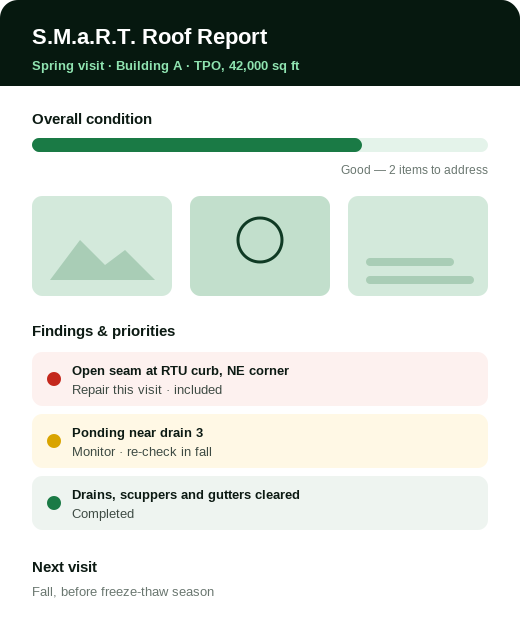
Whether it follows a routine visit or a leak call, a report should let someone who never climbed onto the roof understand it:
- The basics: property, building, roof section, date of the visit and who inspected it.
- A roof plan with sections, drains, penetrations, rooftop equipment and skylights marked.
- Condition by section, in plain language, not one rating for the whole building.
- Photos of every finding, each located on the roof plan. Each one needs a short description of what it shows and, where it can be told, the cause.
- Drainage notes: clogged or damaged drains, scuppers and gutters, and ponding.
- Details: flashings, coping and edge metal, seams, pitch pans and curbs, where most leaks start.
- Safety items: unguarded skylights, damaged hatches or ladders and edge hazards.
- What was repaired during the visit, with before-and-after photos, kept separate from what's recommended.
- A prioritized list: fix now, fix soon and plan for later, with a written quote for anything beyond routine work.
What does a full survey add?
A survey report includes everything above, plus the information you need to budget:
- The roof assembly by section, from a core-cut log. It lists the number of roofs, membrane, cover board, insulation type and thickness, attachment and deck. Our guide to roof core cuts explains what each layer tells you.
- Moisture findings: thermal images paired with daylight photos of the same spot. The report should also give the approximate area of wet insulation in each section. See infrared roof moisture surveys for how that works.
- Estimated remaining life by section, as a range with the reasoning behind it. A single number based on age isn't enough.
- Recommended action by section: repair, remove and replace wet areas, restore, recover or replace.
- Budget ranges by year for the larger work, so it can go into a capital plan or reserve study.
- Replacement considerations, such as whether a recover is allowed and what insulation the energy code will require on a tear-off. It should also note permits, since re-roofs generally need one from the city's building division.
- Warranty status, including what the manufacturer requires and when coverage ends.
What are the red flags in a roof condition report?
Not every report earns its fee. Be cautious when you see:
- Photos with no location, so nobody can find the problem again
- One condition rating for a whole building with several roof sections
- A replacement recommendation with no moisture data or core cuts behind it
- Generic text that could describe any roof, with no mention of your system or details
- No priorities, so every item looks equally urgent
- Repairs made and repairs recommended mixed together
A report should make a decision easier. If you can't tell what to do next after reading it, ask for a better one.
How should you use the report?
Approving repairs
A prioritized list with photos lets a manager approve urgent work quickly and schedule the rest, and lets an owner or board see why.
Capital plans and reserve studies
Remaining life and budget ranges by section replace the guess that comes from roof age alone. For associations, give the survey to your reserve specialist. See HOA reserve planning.
Buying or leasing a building
A survey before closing shows the roof's real condition, so the price, the lender and your first-year budget reflect it.
A baseline before storms
Hail season along the Front Range runs roughly mid-April to mid-August. A dated report from before a storm makes new damage much easier to show to an adjuster.
Comparing bids
Have every contractor price from the same survey. Then you're comparing prices for the same scope, not different guesses about what's under the membrane.
What should you have ready before a survey?
A survey goes faster, and the report comes out more useful, when the surveyor starts with what you already know:
- The decision it supports. Tell us if it's for a purchase, a reserve study, a hail claim or a repair-or-replace choice. Each needs a different emphasis, and sometimes there's a deadline.
- Roof drawings and past reports, if you have them. Plans help us draw an accurate roof map, though we can create one if none exist.
- Install dates, past repairs and warranties. They tell the crew what layers to expect in the cores and what the manufacturer requires.
- Leak history: where water has shown up inside, and when. It helps make sense of what the roof shows.
- Access details: hatch or ladder location, keys and after-hours access for an evening infrared scan. Also tell us who should know a crew is on the roof.
If records are thin, that's normal. Filling the gaps is part of what a first survey does, and the result becomes the roof record you build on from then on.
How do we put surveys on a schedule?
A survey is most useful when it's kept current. Our S.M.a.R.T. maintenance program builds the record over time. With every level, you get visits twice a year, as NRCA recommends, plus checks after severe weather. A written report follows each one.
Level 1, "Clear & Check," covers drain and gutter cleaning, a visual inspection and a report. Level 2, "Clear & Repair," adds debris removal and small general repairs. Level 3, "Survey & Repair," adds a full inspection, a roof survey and medium general repairs. That way you track moisture and remaining life year over year, instead of discovering them all at once.
Andrew Rickert leads our estimating. He's a CPA and a Class-A licensed general contractor, so your survey budget comes laid out the way owners, boards and finance teams expect to read it. We survey roofs across the Denver metro, from DTC office buildings to warehouses and HOA communities. That includes commercial roofing in Centennial, where we're based. See our roofing inspection services, including infrared surveys. Or request a survey and tell us what decision it needs to support.
Roof survey and report FAQs
Do we need a survey or just an inspection?
An inspection is enough for routine maintenance, leak calls and most post-storm checks. Order a survey before you make a repair-or-replace decision, buy a building, start a reserve study or set a capital plan.
What does a roof survey cost?
It depends on roof size, the number of buildings and roof levels, and access. It also depends on whether you need an infrared scan and core cuts, and on the type of report. We quote a fixed price before scheduling.
Will core cuts damage the roof?
No. Cores are small, and the crew patches each one watertight before leaving, with materials that work with your roof. On a warrantied roof, we check what the manufacturer requires first.
Can a survey be done in winter?
An inspection and core cuts can, once snow is off the roof. Infrared scans need a clear, dry evening after a sunny day, so they're easiest to schedule from late spring through early fall.
Can our reserve specialist or lender use your report?
Yes. We'll lay out condition, remaining life and budget ranges by building and by year, in whatever form they need.