
Home / Resources / How often to inspect
Commercial roof inspection in Denver: how often?
The short answer for a commercial roof inspection in Denver is twice a year, plus after severe weather. The longer answer depends on your roof's age, what sits on it and what decisions are coming. Here's how to set the schedule.
What's the baseline inspection schedule?
The National Roofing Contractors Association (NRCA) recommends inspecting low-slope roofs at least twice a year. It also recommends an inspection after severe weather. Along the Front Range, the two routine visits do different jobs, so timing matters as much as frequency:
- Spring, roughly March through May. After the snow and before hail season starts in mid-April. The inspection finds what freeze-thaw and winter winds opened up, clears drains and sets a baseline before storm season.
- Fall, roughly September through November. After hail season and before freeze. The inspection finds summer hail, wind and UV damage and gets it repaired before water in a small opening freezes and widens it.
Steep metal roofs shed water faster than low-slope roofs. But their fasteners, sealants and flashings still need regular roof inspections, and hail and wind don't spare them. On most commercial and association properties, you're best off putting every roof on the same calendar.
Which events call for an extra inspection?
Hail, high wind, heavy snow, leaks and work by other trades all call for an extra inspection, whatever the calendar says. So do big decisions about the building, its warranty or its budget:
- After hail. Damage to low-slope roofs often can't be seen from the ground. Dented gutters, damaged condenser fins or broken skylights are a sign the roof took hits. See the first 72 hours after a hailstorm.
- After high wind. Chinook winds can lift perimeter sheets, loosen coping and edge metal, and move ballast. Our guide to wind damage on commercial roofs lists what to look for.
- After heavy or drifting snow, especially when it melts fast and refreezes in drains.
- After any leak, so the source is found rather than just the spot above the stain.
- After other trades work on the roof. HVAC replacements, solar, telecom and signs all bring people, tools and new penetrations onto the roof.
- Before a manufacturer warranty expires, so covered defects are reported while they're still covered.
- Before buying, selling or leasing a building, so the roof's condition is part of the deal.
- Before a budget, reserve study or capital plan, so the numbers reflect what's on the roof rather than its age.
- When a new manager or board takes over and the roof records are thin.
Which roofs need closer attention?
Twice a year is a floor, not a ceiling. Older roofs, busy roofs, restaurant roofs, roofs near trees and roofs with drainage or leak problems earn extra visits or closer looks:
- Older roofs, where seams, flashings and sealants are near the end of their service and small problems turn into leaks quickly.
- Roofs with a lot of equipment and traffic. Every service call to a rooftop unit is a chance for a dropped screw or a cut membrane.
- Restaurants and food service, where kitchen exhaust grease attacks single-ply membranes.
- Roofs near trees, where leaves and seed pods clog drains in spring and fall.
- Roofs with drainage problems or a history of ponding. See ponding water on flat roofs.
- Spray foam and coated roofs, where the coating has to be watched so recoats happen before UV at altitude reaches the foam.
- Roofs with a leak history. If a roof keeps leaking after repairs, an inspection isn't enough. You need a leak investigation and possibly a moisture survey.
What does a Front Range inspection calendar look like?
Each season does different damage here, so each one gets a different job:
| Season | What the weather does | What to do |
|---|---|---|
| Spring | Freeze-thaw opens seams and flashings; snowmelt and debris clog drains | Routine inspection, drain cleaning, repairs before hail season, baseline photos |
| Mid-April to mid-August | Hail season, plus summer storms and strong sun | Inspection after any significant hail or wind; watch for leaks after storms |
| Fall | Leaves fill drains; summer UV has dried sealants; hail damage may be hiding | Routine inspection, repairs before freeze, snow and drainage prep |
| Winter | Snow loads, drifting, chinook winds, ice in drains | Watch from inside and from the ground; inspect after big storms or wind events once it's safe |
Our spring and fall roof maintenance checklist lists what each routine visit should cover. For more on the fall visit, see preparing a roof for winter.
What should a commercial roof inspection in Denver cover?
Whatever the reason for the visit, a useful inspection walks the whole roof section by section and checks the same things every time:
- Drains, scuppers, gutters and downspouts, and any ponding
- The field of the membrane or surface, and every seam and lap
- Flashings at walls, curbs and parapets, plus coping and edge metal
- Penetrations, pitch pans, rooftop equipment and skylights
- Damage from other trades and from foot traffic
- Interior signs of leaks, such as stains below the roof
It should end with a written report: condition by section, photos located on a roof plan and a prioritized list of what to fix.
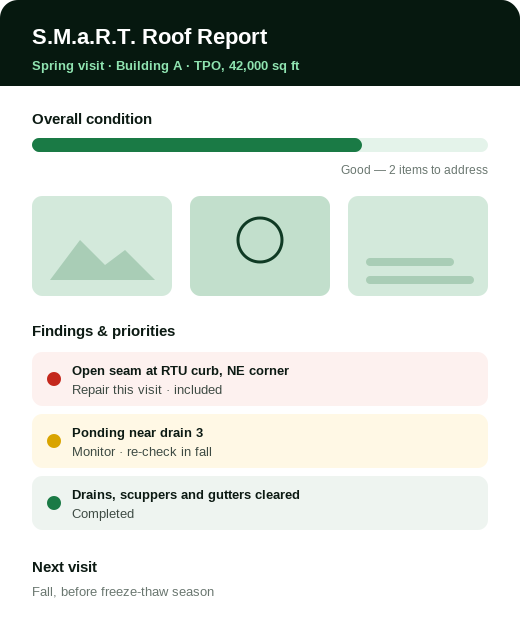
To see what a complete report includes, read our guide to commercial roof survey and inspection reports.
Which kind of inspection do you need, and when?
It depends on the question you're asking, since not every question needs the same inspection. We'll recommend the lightest one that gives you a reliable answer:
| Inspection | Use it for |
|---|---|
| Condition inspection | Routine spring and fall visits, and the starting point for most decisions |
| Post-storm inspection | Dated photos and test cuts after hail or high wind, while the storm date is fresh |
| Leak investigation | Leaks that keep coming back, or that show up far from any visible defect |
| Infrared moisture survey | Finding wet insulation before a repair, recover or replacement decision |
| Core cuts | Confirming layers, insulation, moisture and deck when the decision is expensive |
| Drone inspection | Large, tall, steep or hard-to-reach roofs and multi-building communities |
| Pre-purchase and warranty inspections | Before closing on a building, or before a manufacturer warranty expires |
See all of our roof inspection and infrared survey services.
What drives the cost of an inspection?
Your price depends on roof size, the number of buildings and roof levels, and access. It also depends on whether you need an infrared survey or core cuts, and on the type of report. We quote a fixed price before scheduling so you know the cost up front. If you're on a maintenance program, your routine inspections are part of the annual price.
How can you put the schedule on autopilot?
The easiest way to keep the calendar is to hand it off. Our S.M.a.R.T. maintenance program schedules your visits twice a year, as NRCA recommends, plus checks after severe weather. You get a written report after each one.
Level 1, "Clear & Check," covers drain and gutter cleaning, a visual inspection and a report. Level 2, "Clear & Repair," adds debris removal and small general repairs. Level 3, "Survey & Repair," adds a full inspection, a roof survey and medium general repairs.
We're based in Centennial, near the Denver Tech Center, and our crews inspect roofs across the metro. That includes commercial roofing in Denver and the communities around it. Request an inspection and we'll recommend a schedule for each roof. If water is coming in now, call (720) 296-0000 or report a leak.
Roof inspection frequency FAQs
Is once a year enough for a commercial roof?
NRCA recommends at least twice a year for low-slope roofs, plus after severe weather. Here, one visit a year misses something. You either miss winter damage before hail season, or hail damage before freeze-thaw.
Does a new roof need inspections?
Yes. A new roof still collects debris in drains and damage from other trades. Many manufacturer warranties also require you to maintain the roof. An early inspection gives you a clean baseline, too.
Should we inspect after every hailstorm?
After any storm that dents gutters, damages rooftop equipment or breaks skylights, yes. You often can't see hail damage on a low-slope roof from the ground. Finding it while the storm date is fresh matters for a claim.
Can our maintenance staff do the inspections?
Staff can watch ceilings, gutters and downspouts and keep a leak log. Walking the roof, probing seams and judging flashings should be left to a roofing crew with fall protection.
How long does an inspection take?
It depends on the size of the roof, the number of buildings and access. When we schedule, we'll tell you about how long we'll be on site. That way you can give tenants or residents notice ahead of time.