
Home / Resources / Commercial roofing contract terms
What a commercial roofing contract should include
The contract is where a roofing proposal turns into promises someone can be held to. Here's a clause-by-clause checklist for owners, property managers and HOA boards, so the roof you approve is the roof that gets built.
Why does the paperwork matter on a roof?
Because most roofing disputes aren't about bad workmanship. They're about a scope nobody wrote down. Were the gutters included? Who pays for rotten deck? What did "warranty" mean, and when was final payment due? A good commercial roofing contract answers those questions before the crew arrives, when they're cheap to answer.
You'll get a written contract from us on every project. Whoever you hire, insist on one, and have your attorney review it on a large project. This article is general information, not legal advice.
A note on Colorado law. Colorado's roofing contractor law sets written-contract rules for roofing work on residential property. That definition can reach some condo and townhome buildings an association maintains. For other commercial buildings, a detailed written contract is simply good practice. Your attorney can tell you which rules apply to your property.
1. Who and what does the contract cover?
It should name the parties, the property and every document that's part of the deal:
- Legal names of the owner or association and the contractor. Say who can sign and approve changes. If you're an association, your governing documents and management agreement decide that.
- The property: address, buildings and roof areas covered. On a multi-building site, list each building.
- The documents that make up the contract: the proposal, any specification or drawings, the warranty sample and the payment schedule. Say which one controls if they conflict.
2. What should the scope of work say?
Enough that a stranger could tell what's included. This is the heart of the contract. By roof area, look for:
- Tear-off or recover, and how many existing layers come off.
- The roof system: product, thickness or gauge, color, and attachment method.
- Insulation and cover board: type and thickness, and any tapered insulation and crickets. It should also say whether the work meets the current energy code.
- Flashings and sheet metal: wall and curb flashings, edge metal, coping, counterflashing, gutters and downspouts. Each should be named as included or excluded.
- Penetrations and rooftop equipment: who disconnects, lifts and resets units, and whether a crane is included.
- Exclusions in plain language: electrical, mechanical, structural, abatement, interior repairs.
If a term is unfamiliar, our commercial roofing glossary explains it.
3. How are hidden conditions priced?
With unit prices agreed before work starts. No one knows exactly what's under an old roof until it comes off. So your contract should set unit prices for the conditions most likely to turn up, usually deck replacement and wet insulation. It should also say how quantities are measured and documented.
With agreed prices and photos of every area replaced, the crew keeps moving and you get no surprise change orders. Without them, you end up negotiating every discovery while the roof is open.
4. What payment terms should you expect?
Payments that follow the work, with final payment after you sign off. Look for:
- The contract sum, what's in allowances, if any, and how unused allowance money is handled.
- Deposit, if one is required, and what it's for, such as ordering materials.
- Progress payments tied to completed work. Larger projects often use a schedule of values.
- Retainage, common in general contractor subcontracts: how much is held and when it's released.
- The trigger for final payment. We don't collect final payment until the customer signs off. Your contract should say what sign-off means.
- Lien waivers with payments. See lien waivers, final payment and closeout.
- Price validity and escalation. How long the price holds and whether material price changes can be passed through. After a big Front Range hailstorm, materials and labor can get tight across the metro.
5. How should the schedule handle weather?
By saying how delays are handled, not by promising a finish date to the day. Commercial roofing schedules depend on weather, permits and material lead times. Your contract should still say:
- When work is expected to start
- The sequence of buildings or roof areas
- How weather delays are handled
- What notice you get before the crew arrives
In Colorado, plan for afternoon thunderstorms and hail in summer, and for wind. Some adhesives also have cold-weather limits in winter. The roof should be watertight at the end of every workday.
6. How are change orders approved?
In writing, before the work, and signed by someone with authority. Each one should state the price and any effect on the schedule. Time-and-material work should be written up on tickets signed the day the work is done. This is the clause that protects both sides from "we thought that was included."
7. Who handles permits, codes and inspections?
The contract should spell out who pulls the permit, who pays for it and who schedules inspections. Requirements change from city to city and county to county across the Denver metro. In Centennial, for example, a commercial re-roof needs a permit plus mid-roof and final inspections. See Centennial roofing codes and permits. Put code-required upgrades, such as insulation levels and edge heights, in the scope, not in a change order later.
8. What should it say about the site, safety and occupants?
It should cover how your building keeps running while the crew is there:
- Working hours, quiet hours and access to the roof
- Staging, dumpster and crane locations, and parking for residents or tenants
- Protection of entrances, landscaping, vehicles and air intakes
- Fall protection and a site-specific safety plan; see our safety program
- Daily cleanup, magnetic sweeps for nails and screws, and final cleanup
- Who notifies tenants or residents, and when
9. What insurance and bonds should it require?
General liability, workers' compensation and umbrella coverage, at stated limits. The contractor should name you as additional insured and send certificates before work starts. If your project needs one, a performance bond guarantees the contractor will complete the work. A payment bond protects you against unpaid subcontractors and suppliers.
For reference, we carry $2M general liability, workers' comp on every employee and a $5M umbrella. Our bonding capacity is over $1M. See our credentials.
10. What warranty terms belong in it?
Both warranties, and the conditions that come with them:
- Manufacturer warranty: the type, the term and what it covers. Say who registers it, and whether a manufacturer inspection is required. Attach a sample.
- Workmanship warranty: what the installer covers, for how long and how you make a claim.
- Conditions: the maintenance you have to do, and what voids coverage, such as repairs nobody approved or penetrations cut by other trades.
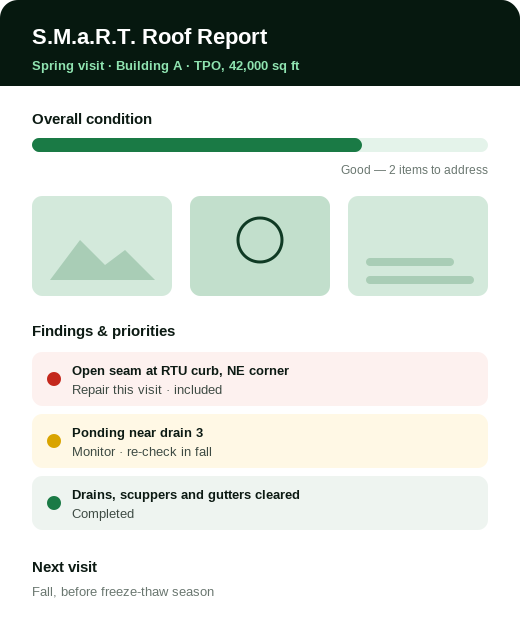
Many warranties expect documented maintenance. Our S.M.a.R.T. maintenance program gives you that record, with a written report after every visit.
11. What counts as closeout?
Whatever you write down as "done." That usually means:
- A final walkthrough and a completed punch list
- The permit finaled
- Warranty documents issued
- Final lien waivers delivered
- Any as-built information you need
On association projects, ask for closeout documents organized by building.
12. How are disputes, termination and cancellation handled?
That's up to the contract, so read this part closely. Most contracts say how disputes are resolved, when either side can end the contract and what's owed if that happens. These clauses vary widely and carry real legal weight. This is the section to send to your attorney.
What if an insurance claim is paying for the roof?
Then your contract needs a few more points. The scope should match what the roof needs, with a process for documenting items the adjuster missed.
The roofer documents damage, meets the adjuster and prepares a detailed scope. But the roofer doesn't negotiate the claim. That's your role, with your agent or a licensed public adjuster.
And the deductible stays yours to pay. Truman never pays, waives or rebates a deductible on any job. Colorado's roofing contractor law forbids it on residential property, which can include condo and townhome buildings. More in Colorado law on roofing deductibles.
A one-page contract checklist
| Clause | Check that it says |
|---|---|
| Scope | System, insulation, flashings, sheet metal and exclusions by roof area |
| Unit prices | Deck and wet insulation prices, with how quantities are documented |
| Payments | Deposit, progress payments, retainage and the final payment trigger |
| Change orders | Written and priced before the work |
| Permits | Who pulls them, who pays, who schedules inspections |
| Insurance and bonds | Limits, additional insured, certificates before start |
| Warranty | Manufacturer and workmanship terms, sample attached |
| Closeout | Walkthrough, punch list, warranty documents, lien waivers |
Looking for more commercial roofing tips? See questions to ask a commercial roofer for the questions that come before the contract. General contractors will find their side of this in working with a roofing subcontractor.
Our proposals break out every item above, so they're easy to compare and easy to turn into a contract. You'll find us on commercial and association buildings across the metro, from Denver to commercial roofing in Centennial. Request an inspection and we'll start with the roof, then put the scope in writing.
Roofing contract FAQs
Does Colorado require a written contract for commercial roofing?
Colorado's roofing contractor law sets written-contract rules for residential property, which can include some condo and townhome buildings. Whatever the law requires for your building, get a detailed written contract. You'll get one from us on every project.
What's a unit price, and why does it matter?
It's an agreed price per unit of work, such as per sheet of deck replaced. It lets hidden conditions be fixed without stopping the job to negotiate a change order.
Should we pay a deposit?
Some projects require one, often for materials. Whatever the deposit, the rest of your payments should follow completed work, with final payment after sign-off.
Who should pull the roofing permit?
The roofing contractor, under its own license. The contract should say so, and include the permit and inspections in the price.
Can our HOA manager sign the roofing contract?
That depends on your governing documents and management agreement. Many associations require a board vote on major contracts, even when the manager signs.