
Home / Resources / Lien waivers and final payment
Lien waivers, final payment and roofing closeout
The last payment on a commercial roofing project is your strongest point of leverage, and the moment it's easiest to make a mistake. Here's how a waiver of lien works, what closeout should include and what to have in hand before you release the final check.
Why do lien rights matter to you as the owner?
Because on a commercial roof, the contractor you hire is rarely the only party with money at stake. A distributor supplies the membrane and insulation, and a sheet metal shop makes the coping. A crane company sets the materials, and some contractors bring in subcontracted crews.
In Colorado, as in most states, contractors, subcontractors and suppliers who aren't paid can generally record a mechanics' lien against the property. So you can pay the roofer in full and still face a lien from a supplier the roofer didn't pay. Lien waivers are the paper trail that keeps you from paying twice.
Lien law has its own notice rules and deadlines, and they're strict, so this article stays general. Talk to your attorney about your rights and duties on a specific project.
What is a waiver of lien?
A lien waiver, or waiver of lien, is a signed document. In it, a contractor, subcontractor or supplier gives up its lien rights for a stated payment or a stated period of work. Waivers come in two pairs:
| Type | What it does | When it's used |
|---|---|---|
| Conditional, partial | Waives lien rights for a progress payment, effective only once that payment clears | Submitted with a pay request |
| Unconditional, partial | Waives lien rights for a progress payment already received | After the payment clears, often with the next pay request |
| Conditional, final | Waives all remaining lien rights, effective once final payment clears | Submitted with the final invoice |
| Unconditional, final | Waives all remaining lien rights after final payment is received | After final payment clears |
The difference protects both sides. You get a waiver in exchange for each payment, and the contractor isn't giving up rights for money it hasn't received. Check the amounts, dates, property description and signer against the payment each waiver covers.
Who should give you waivers?
The contractor, and on larger jobs its subcontractors and major suppliers:
- The roofing contractor: one with every progress payment, and one at final payment.
- Subcontractors who worked on your roof, if the contractor used any.
- Major suppliers, on larger projects. Think of the membrane and insulation distributor, the sheet metal shop and any equipment rental or crane company.
On a small repair, asking for supplier waivers may be overkill. On a full re-roof of an office building or a multi-building association project, it's normal practice. A well-organized contractor won't object.
How should progress payments work?
In stages tied to completed work, with a waiver at each step. Larger projects often use a schedule of values. A clean rhythm looks like this:
- The contractor sends a pay request with a conditional waiver for that amount.
- You make the payment.
- The contractor follows with an unconditional waiver for the payment received.
Before you pay, confirm the work billed is actually in place, with photos or a site visit.
On general contractor projects, the roofing sub's pay applications follow the GC's format and waiver forms. Retainage is commonly held until closeout. See working with a roofing subcontractor.
What should closeout include?
Everything you need to own the roof. A roof isn't finished when the crew leaves. It's finished when you have those things in hand. Before final payment, expect:
Final walkthrough
You, your manager or a board representative walks the roof with the contractor. Every open item goes on a written punch list.
Punch list completed
Each item fixed and confirmed, with photos for anything you can't easily see yourself.
Permit finaled
The city or county's final inspection passed. In Centennial, for example, the permit stays posted until the final is approved; see Centennial roofing codes and permits.
Warranties issued
The manufacturer warranty issued, not just applied for, after any required manufacturer inspection. You should also get the contractor's workmanship warranty.
Closeout documents
Product information, care and maintenance instructions, a roof plan or as-built information where needed, and final lien waivers.
Why does sign-off come before final payment?
Because sign-off is how you confirm the work is complete. We don't collect final payment until the customer signs off. That's the order it should go in on any roofing project: complete the work, walk it together, close the punch list, then pay. Sign-off should mean the work in the contract is complete, not that the roof is perfect forever. That's what the warranties are for.
A fair process cuts both ways. Don't sign off on a roof with open punch items, and don't hold final payment over items that were never in the scope. Write the punch list down at the walkthrough, so everyone works from the same list.
Be wary of front-loaded payment. If a contractor wants most of the contract price before the work is done, you've lost your leverage. When payments follow progress, with final payment after sign-off, the incentives stay where they belong.
What should HOA boards and property managers do?
Settle who signs off, close out by building and keep one file:
- Know who can sign off. Your governing documents and management agreement say who accepts completed work: the manager, a board officer or the full board.
- Walk by building. On a phased project, close out each building or phase on its own, with its own punch list and warranty documents.
- Keep the file together. Contract, change orders, waivers, warranties and photos belong in one place. They're what the next board, the reserve specialist and a future buyer will ask for.
Our board guide to roof replacement covers the rest of the process.
What changes when insurance is paying?
Claim-funded projects add a step. Depending on the policy, your insurer may hold back part of the payment, often depreciation, until the work is complete. It may also ask for an invoice or proof of completion before releasing it. And checks may be made out jointly to you and a lender.
Ask your agent how your policy handles this before work starts. Then your closeout documents are ready when the insurer asks. See ACV vs replacement cost.
What are the red flags at closeout?
Hold the final check if you see any of these:
- No lien waivers offered, or a refusal to provide them
- Waivers with the wrong amount, property or dates
- Pressure for final payment before the walkthrough or punch list
- A manufacturer warranty that's "in process" with no inspection scheduled
- A permit that was never finaled
How does Truman close out a project?
We finish the punch list and deliver the warranty documents before we ask for final payment. We started as a general contractor, so closeout is part of the job, not an afterthought. That includes scheduling the manufacturer inspection.
How lien waivers will be exchanged belongs in the contract, so ask us about it when you review our proposal. If you're a general contractor, our general contractor page has the documents you need. Owners can read more about Truman.
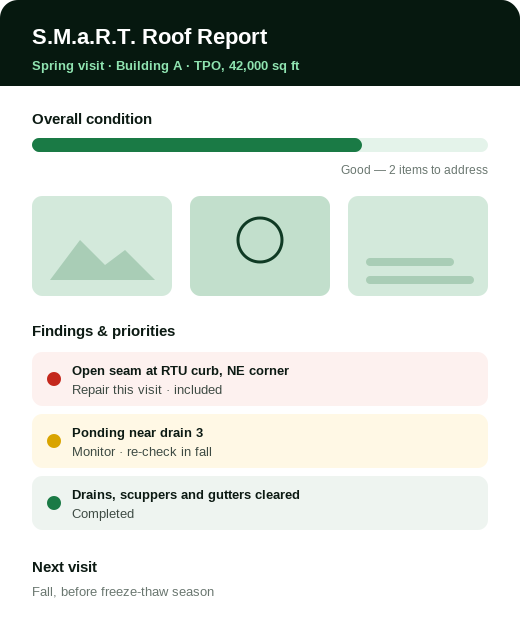
After closeout, our S.M.a.R.T. maintenance program keeps your roof on a twice-a-year schedule. You get written reports, which many warranties expect. We work on commercial and association buildings across the Denver metro, including commercial roofing in Centennial.
Planning a re-roof? Read what a commercial roofing contract should include. Then request an inspection, and we'll walk you through how payment and closeout work on your project.
Lien waiver and closeout FAQs
What's the difference between a conditional and an unconditional lien waiver?
A conditional lien waiver takes effect only when the stated payment clears. An unconditional waiver takes effect right away, so give or accept one only after the payment is received.
Do we need lien waivers from suppliers too?
On larger projects, yes, it's common to ask major suppliers and any subcontractors for waivers. They may have lien rights of their own if they aren't paid.
When should we make the final payment?
After the work is complete, the punch list is closed and you've signed off. We don't collect final payment until the customer signs off.
What should we have in hand at closeout?
You should have a completed punch list, a finaled permit and the issued manufacturer warranty. You should also have the workmanship warranty, care instructions and final lien waivers.
Should we use our own lien waiver forms?
Yes, if your company, general contractor or attorney has standard forms. Name them in the contract, so every party knows what it will be asked to sign at each payment.