
Home / Resources / Questions for a commercial roofer
Questions to ask a commercial roofing contractor
A roofing proposal tells you what a contractor wants to sell. The answers to a few direct questions tell you who you're hiring. Here are the questions to ask a commercial roofing contractor before you sign, and what a good answer sounds like.
Why do the questions matter more than the price?
Because two bids can be far apart for honest reasons. One commercial roofing bid may include a full tear-off, energy-code insulation and new edge metal, and the other may not. Two bids can also be close in price and very different in risk. A contractor who skips the core cuts, carries thin insurance or disappears after final payment will cost you more. That's true even if the other bid had the higher number.
The questions below are the ones we'd want answered if we were on your side of the table. Use them as your contractor vetting process. Ask every bidder the same ones, in writing if you can, and compare the answers the way you compare the line items.
Who is the company?
Start with who you'd be hiring, and who will still be around later:
- Where is your office, and how long have you worked in this area? After a Front Range hailstorm, crews from out of state set up in hotel parking lots. A local address, a local phone number and a history in the area mean someone will be here when a warranty question comes up.
- Who owns the company? National roofing companies and private-equity groups have been buying Denver contractors. That isn't bad on its own, but you should know who is accountable for your roof. Ask, too, whether the people you meet now will answer the phone later.
- Who will be our day-to-day contact, and who runs the crew on site? You want one named contact and a foreman on the roof every day the crew is working.
- Are the crews your own employees? Subcontracted labor isn't automatically a problem. Still, you need to know who is on your roof and who supervises them.
Here's our answer. Truman started as a general contractor in 2003 and has been roofing since 2009. We're based near the Denver Tech Center in Centennial. You can read more about who we are.
Are they licensed, insured and bondable?
Ask for proof of all three. This is where weak contractors are easiest to spot, because the documents either exist or they don't.
- Are you licensed in our jurisdiction? Front Range cities and counties handle contractor licensing differently. Ask who will pull the permit and under which license.
- Can you send a certificate of insurance naming us as additional insured? Ask for it before work starts, not after. Then check the general liability, workers' compensation and umbrella limits against what your lease, lender or management agreement requires.
- Is every person on the roof covered by workers' comp? If a worker without coverage is hurt on your property, the claim can land on you.
- Can you provide a bond if we need one? A performance bond guarantees the contractor will complete the work. Larger projects and many general contractors require one.
Our answers: we hold a Class-A general contractor license and licensing for commercial roofing along the Front Range. We carry $2M general liability, workers' comp on every employee and a $5M umbrella. Our bonding capacity is over $1M. See our licenses and credentials.
Did they actually inspect the roof?
A price built from a satellite photo or a walk around the parking lot is a guess. Ask:
- Did you get on the roof, and can we see your photos? Findings should be tied to photos by roof section.
- How do you know whether the insulation is wet? On a low-slope roof, wet insulation decides whether a roof can be repaired or recovered or has to come off. You find out with core cuts, often guided by an infrared moisture survey. A visual inspection can't tell you.
- What's on the roof now, and how many layers? Codes generally limit recovers when there are already two roofs. So the answer changes your price.
- Why are you recommending this instead of a repair? A good contractor explains the options, including the cheaper ones. They'll tell you why one fits your building and how long you'll own it.
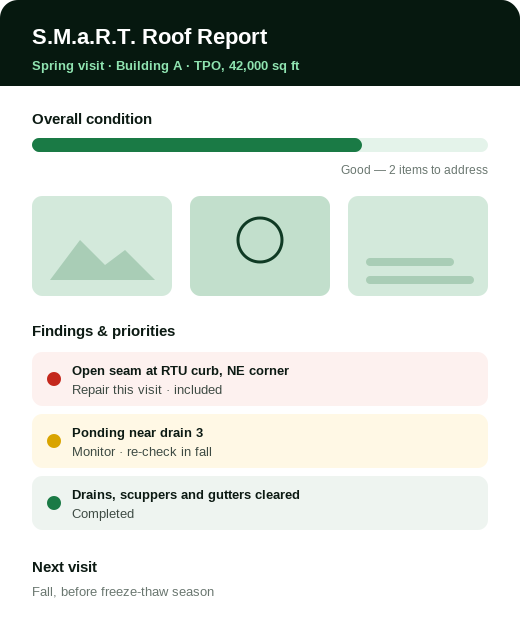
What does each bid include?
Find out in writing, line by line. Most disputes trace back to a scope that was vague at signing. Before you compare totals, make sure you know what each bid includes.
| Ask | What a solid answer includes |
|---|---|
| Which system do you recommend, and why? | The membrane or system, its thickness or gauge, the attachment method and why it suits your building. |
| Tear-off or recover? | How many layers come off and how wet insulation will be handled. |
| What insulation goes back? | Insulation and cover board meeting the energy code, plus tapered insulation where water ponds. |
| What about the details? | New flashings at walls, curbs and penetrations; edge metal, coping and gutters named as included or excluded. |
| What happens if the deck is damaged? | A unit price for deck and wet insulation replacement, with photos of what was replaced. |
| Who handles rooftop equipment? | Who disconnects, lifts and resets units, and whether a crane is included. |
| What's excluded? | A written list, in plain language, not buried in fine print. |
For how each of these moves the price, see commercial roof cost factors.
How does the proposal handle Colorado weather?
A roof in Centennial or Aurora takes hail from mid-April to mid-August. It also gets strong UV at altitude, freeze-thaw cycles, chinook winds and heavy spring snow. Ask how the proposal deals with each:
- A dense cover board for hail
- Attachment at corners and perimeters for wind
- Drainage that keeps snowmelt from ponding
- Cold-weather limits for adhesives if the work runs into winter
A contractor who works here every year will have specific answers.
What should you ask about the warranty?
Ask who stands behind the roof, and what could void that coverage:
- Which manufacturer warranty is included, and are you approved to offer it? To get an extended manufacturer warranty, you'll usually need an approved applicator, a specific assembly and a manufacturer inspection. Ask for a sample of the warranty document.
- What does your workmanship warranty cover, and how do we make a claim? The manufacturer covers materials and, on some warranties, more. The installer's workmanship warranty covers how the roof was put together.
- What would void the warranty? Common causes are repairs nobody approved, penetrations cut by other trades and missing maintenance records. Ask what maintenance the warranty expects.
How will they handle the schedule, safety and the site?
Ask how they'll keep your building safe, dry and running while the work is underway:
- What does your safety program look like on our building? Expect a written program and a site-specific fall-protection plan. See our safety program.
- How will you protect tenants, residents and the public? Barricades, controlled entrances, staging away from doors and air intakes, and daily cleanup.
- How will you communicate? Notices before work starts, a contact for questions, and photos or reports as the job moves.
- How do you handle weather? The roof should be watertight at the end of every day.
When are the deposit, payments and final payment due?
Ask when each payment is due and what has to happen before it. A fair schedule ties your payments to progress, and final payment to completed work. We don't collect final payment until the customer signs off.
Ask, too, whether the contractor will provide lien waivers with payments. They keep a supplier or subcontractor from making a claim against your property for money the contractor already received. See lien waivers and final payment and what a commercial roofing contract should include.
What if insurance is paying?
After hail or wind, add these questions:
- Will you document the damage and meet the adjuster on the roof? A roofer can document damage, meet the adjuster and prepare a detailed scope.
- Who negotiates the claim? You do, with your agent or a licensed public adjuster. A roofer who offers to "handle the claim" for you is overstepping.
- What will you do about our deductible? The only right answer is nothing. Truman never pays, waives or rebates a deductible on any job. Colorado's roofing contractor law forbids it on residential property, which can include condo and townhome buildings.
More on spotting storm chasers.
What should general contractors ask a roofing sub?
Add your prequalification questions. Ask for:
- A certificate of insurance with the endorsements your subcontract requires
- A bonding letter and a written safety program
- Business certifications
- An approved-applicator letter for the specified system
- A bid that follows the spec section by section, with exclusions named
Our general contractor page shows what we provide. For the rest, read working with a roofing subcontractor.
What are the red flags?
Slow down, or walk away, if you see any of these:
- A price offered before anyone has been on the roof
- Pressure to sign today, or an "inspection agreement" that turns out to be a contract
- No certificate of insurance until after you sign
- A vague warranty line such as "warranty per manufacturer"
- Exclusions you only find on the last page
- Most of the money due before the work is finished
- An offer to cover the deductible
Ask us
Use this contractor selection guide with every bidder, including us. We're glad to answer every question on this page, in writing, for any building in our service area.
That includes commercial roofing in Centennial and across the Denver metro. HOA boards can find more in our board guide to roof replacement. When you're ready, request an inspection and we'll start with the roof, not the sales pitch.
Commercial roofing contractor FAQs
How many bids should we get for a commercial roof?
Many owners and boards aim for three. More important than the count is that every bidder prices the same scope, so you're comparing roofs rather than paperwork.
Should the cheapest bid win?
Only if it includes the same scope, warranty and insurance as the others. Low bids are often low because something was left out, such as insulation, sheet metal or deck repair.
What insurance should a commercial roofer carry?
A commercial roofer should carry general liability, workers' compensation on every employee and umbrella coverage. The limits should match what your lease, lender or management agreement requires. Ask for a certificate naming you as additional insured.
Can we ask for references?
Yes, and ask for references on buildings like yours. Then ask those references how the contractor handled problems and warranty calls, not just how the roof looks.
When should final payment be due?
After the work is complete and you've signed off. We don't collect final payment until the customer signs off.
Do you work as a subcontractor for general contractors?
Yes. We work as a pre-qualified roofing subcontractor for Front Range general contractors. Ask, and we'll send the documents you need.