
Home / Resources / Centennial roofing codes
Centennial CO roofing code and permits for commercial roofs
Own or manage a building in Centennial? Then the city's roofing code and permit process shape your re-roof long before the crew arrives. Here's how commercial roofing in Centennial, CO gets permitted and inspected, and what to settle with your roofer first.
Is your building really in Centennial?
Centennial's roofing code only applies if your building actually sits inside city limits. That sounds obvious, but it trips up owners every year. A business park with a Centennial or Englewood mailing address can sit in Centennial, in Greenwood Village or in unincorporated Arapahoe County. Each one has its own building department, forms and inspectors.
So before anyone prices a permit, check the parcel record to confirm the jurisdiction. We do that on every job. It decides who reviews the work, which inspections are required and how they're scheduled. Is your property in a neighboring city? See our work in Greenwood Village or our other service areas.
Who regulates a commercial re-roof in Centennial?
Centennial has its own Building Division, based at the Civic Center on East Arapahoe Road. It reviews building permits, performs inspections and handles contractor licensing. South Metro Fire Rescue handles the fire code side.
You'll find the city's commercial reroofing rules on its Commercial Roof Repairs and Reroofing page. General permit and inspection information is on the City of Centennial Building Division site. You apply for permits and contractor licenses online. Requirements change, so treat both pages as the current word and this article as a guide to what they mean in practice.
What does the Centennial, CO roofing code cover?
Centennial's commercial building codes are based on the International Building Code. For a commercial roof, they come down to a few practical questions.
Does the job need a permit?
If you're re-roofing or replacing a commercial roof, yes, you need a building permit. Small repairs may not, depending on scope. The line isn't always obvious when a "repair" grows to cover a whole roof section. We check with the city on each job and pull the permit whenever one is required.
Electrical, gas, mechanical and plumbing work generally needs its own permit. So disconnecting and resetting rooftop units may need your mechanical contractor's permit too, not just ours.
What does the city want to see?
The city's guidance describes a basic submittal. Larger or more complex jobs may need more detailed plans. Expect to provide:
- A plot or site plan showing which roof areas are in the scope of work.
- Manufacturer specification sheets showing the materials, the approved ways to fasten them and the installation standards.
- Fire classification data showing the roof covering meets the city's requirement.
What materials are allowed?
New materials only. Centennial doesn't accept used, salvaged or harvested roofing materials. Materials should arrive in labeled manufacturer packaging, and material taken off one roof can't go back on another. That rarely affects a well-planned commercial project, but it rules out some shortcuts you may hear about after a big storm.
Which inspections does Centennial require?
Centennial's reroofing guidance requires a mid-roof inspection on every roof, plus a final inspection. These are the two moments that most often affect your schedule.
Permit posted
The approved permit is printed and posted at the site before work starts, and it stays displayed until the final inspection is approved.
Mid-roof inspection
The inspector looks at the work partway through: tear-off and underlayment complete, new roofing partly installed. The permit holder provides and sets up a compliant ladder, because inspectors don't handle ladders. The city also offers virtual inspections for the mid-roof and final stages.
Final inspection
This one's scheduled once the roof is complete. The city won't combine the mid-roof and final inspections into one visit. So plan the sequence, rather than calling for both at the end.
Miss the mid-roof inspection, and the city's options are unpleasant. You can uncover parts of the finished roof for the inspector. Or you can submit an alternative method request with a stamped engineer's letter, and the building official may or may not accept it. Either way the job slows down. When your roofer schedules inspections as part of the plan, you avoid this entirely.
Ask who schedules the inspections. On our projects, we apply for the permit, submit the product data and schedule each inspection. The permit cost is in the proposal. That way you aren't coordinating with the city on top of everything else.
Which code requirements can change the scope?
The permit isn't just paperwork. A commercial re-roof in Centennial can pull in requirements the original roof never had to meet:
- Recover limits. Codes generally don't allow a new roof over an existing one when there are already two roofs. And a recover over wet insulation is a bad idea, whatever the code says. You can settle both questions with core cuts and an infrared moisture survey before you choose a system.
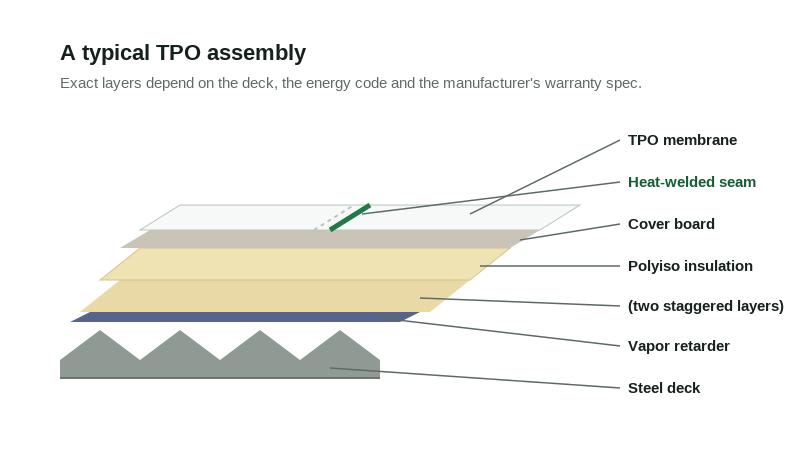
- Energy code insulation. On a tear-off, you generally have to meet the insulation levels in the city's adopted energy code. More insulation raises the roof surface. That can mean taller curbs, raised wall flashings, new edge metal and adjusted drains.
- Wind and edge details. Uplift is strongest at corners and perimeters, and chinook winds test edge metal hard. Your design has to follow the manufacturer's tested assembly for the building's exposure.
- Structure. If you're adding a heavier assembly, ballast or new rooftop equipment, you may need a structural review, especially on an older building. Snow drifts against parapets and units add load in winter.
- Hazardous materials. Some older built-up roofs and mastics contain asbestos. Where Colorado rules require it, they have to be tested before tear-off.
These items are where bids most often differ. To see how they move the price, read commercial roof cost factors. For system choices, see types of commercial roofing systems.
What about HOA and multifamily buildings in Centennial?
Associations deal with two sets of rules at once. The city's permit covers how the roof is built. Your governing documents and design guidelines cover how it looks, such as approved colors, materials and profiles. Check the guidelines before bids go out, so every roofer prices a product the association can actually approve.
Building type matters too. Some townhome and condo buildings follow the city's residential reroofing guidance, not the commercial one. It depends on how the building is classified. We confirm which rules apply to each building before pricing. A phased community project may also need a separate permit for each building or phase. Our board guide covers the approval side.
What changes after a hailstorm?
Centennial sits in the Front Range hail corridor, and hail season runs roughly mid-April to mid-August. After a big storm, permit counters get busy and out-of-town crews arrive. A permitted, inspected re-roof is one of the simplest ways to tell a local contractor from a storm crew. Ask who will pull the Centennial permit, under which contractor license, and who will meet the inspector. See how to spot storm chasers and what to do after a hailstorm.
What should you settle with your roofer?
- Have you confirmed the jurisdiction from the parcel record?
- Do you hold a current City of Centennial contractor license?
- Is the permit, and its cost, included in the proposal?
- Who schedules the mid-roof and final inspections, and who will be on site for them?
- Which code upgrades does the scope include: insulation, edge metal, drains, curbs?
- Will the product data and fire classification sheets be ready for the permit application?
For a fuller list, see questions to ask a commercial roofer before you sign.
Your Centennial neighbor
Our office is at 6422 S Quebec St, near the Denver Tech Center, so Centennial's permit process is the one we work with most. We handle the commercial roofing Centennial CO businesses and associations need, from TPO and EPDM to built-up, metal and spray foam. And we price every permit and code item into the proposal. Learn more about commercial roofing in Centennial. Or request an inspection, and we'll tell you what your re-roof needs before it goes to the city.
FAQs about Centennial roofing codes
Do I need a permit to replace a commercial roof in Centennial?
Yes. You need a building permit from the City of Centennial Building Division to re-roof or replace a commercial roof. Small repairs may not, depending on scope, so we check with the city on each job.
My building has an Englewood mailing address. Which code applies?
The one for the jurisdiction the parcel sits in. In this area, your building could be in Centennial, Greenwood Village or unincorporated Arapahoe County. We confirm it from the parcel record before pricing permits.
What inspections does Centennial require on a re-roof?
A mid-roof inspection while the work is underway and a final inspection when it's complete. They're separate visits, and the permit stays posted on site until the final is approved.
What happens if the mid-roof inspection is missed?
The city may make you uncover parts of the roof for inspection. Or it may ask for an alternative method request with a stamped engineer's letter, which the building official may not accept. Scheduling it correctly is far easier.
Can we put a new roof over the old one?
Sometimes. A recover generally isn't allowed when there are already two roofs, and it should never go over wet insulation. Core cuts and a moisture survey tell you whether it's an option.
Do you pull the permit?
Yes. We apply for it and submit the product data. We schedule the inspections, and the permit cost is in your proposal.