
Home / Resources / Denver roofing codes
Denver County roofing codes for commercial roofs
Denver is both a city and a county, so one department sets the rules for every commercial roof inside its limits. Here's how permits, plan review, cool roofs and inspections usually work when you re-roof in Denver.
Who enforces roofing codes in Denver?
If you've been looking up Denver County roofing codes, the first thing to know is that there's no separate county building office. Denver is a combined city and county. Your permits, plan review and inspections all go through one city department: Community Planning and Development (CPD). The rules that apply to your roof are the city's, published as the Denver Building and Fire Code.
Denver building codes are based on the International Code Council's model codes, with local amendments. Those amendments are where Denver differs from its neighbors. Your roof in Denver can face rules that a similar roof in Aurora, Englewood or Centennial doesn't, and the reverse. That's why we confirm the jurisdiction before we price any job.
One more wrinkle: postal addresses don't follow city limits. Your building can have a Denver mailing address and still sit in another city, or on county land outside any city. Then a different building department and different rules apply. That's common around the Denver Tech Center.
When does a Denver commercial roof need a permit?
Denver's roofing permit requirements start with a general rule: most construction, alteration and repair work on private property needs a permit. Roofing is no exception. On commercial and multifamily buildings, expect a permit for:
- A full replacement, whether it's a tear-off or a recover
- A new roof on new construction or an addition
- Roof repairs beyond a small area. The city sets the threshold, so check it before you assume a repair is exempt.
- New roof penetrations, such as skylights, rooftop units, pipes and solar mounts
- Structural repairs or changes to roof framing
Routine maintenance, such as resealing a flashing or patching a puncture, usually falls below the repair threshold. When a scope sits close to the line, we ask the city rather than guess.
Does your roof need a quick permit or plan review?
Many Denver roofing permits are quick permits, with no plan review. A straightforward re-roof on a smaller commercial building can often go this way. Some roof work can't. Under the city's quick permit rules, these need a full application and review instead:
- Roof permits on larger commercial and multifamily buildings covered by Denver's Green Buildings Ordinance
- Green (vegetated) roofs
- Changes to roof structural framing, and structural roof repairs
The city issues the roof permit separately, even on new construction. If you're a general contractor, keep that in mind when you build the schedule. Denver's quick permits page lists what qualifies. Its plan review, permits and inspections page covers the full process.
Plan review takes longer than a quick permit, and review times move with the city's workload. On larger projects, build that time into the schedule, especially for spring and summer starts when everyone wants to roof at once.
Does the Green Buildings Ordinance require a cool roof?
Larger buildings: check the ordinance before you specify the roof. Say your larger existing Denver building replaces more than a small share of its roof. The Green Buildings Ordinance then generally calls for a cool (reflective) roof on the replaced area, plus one more compliance option. Some building types are exempt.
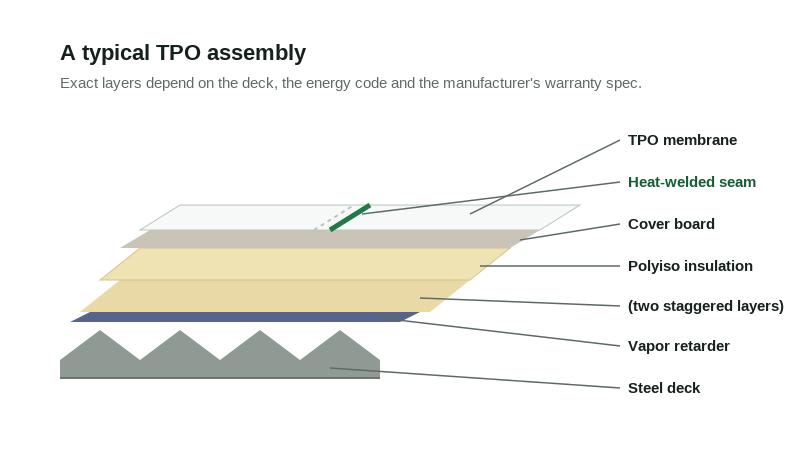
The options and exemptions are detailed, and they change both your specification and your price. We check whether the ordinance applies while we estimate, so it doesn't come up for the first time at permit review. White TPO and other reflective membranes are a common way to meet the cool roof part. They also run cooler under high-altitude sun.
Which code items shape a commercial re-roof?
Permits are the paperwork. The code requirements behind them change what actually goes on the roof. Without getting into section numbers, these are the items that most often affect a Denver commercial re-roof:
- Tear-off or recover. Codes limit how many roofs can be stacked on a building. They generally don't allow a recover over a wet roof, or where there are already two roofs. An infrared moisture survey tells you whether the insulation is wet before you commit.
- Insulation and the energy code. When you replace a roof, you generally have to bring the insulation up to the current energy code. Thicker insulation raises the roof surface. That changes curb heights, edge metal and parapet flashing heights, and sometimes the door thresholds at roof access.
- Wind at edges and corners. Uplift is strongest at corners and perimeters, especially in chinook winds. So the design adds attachment there and uses tested edge metal. Taller buildings downtown see higher pressures.
- Fire rating. Your roof assembly has to meet the fire rating the code requires for the building and its use.
- Drainage. Primary drains, secondary overflow drains or scuppers, and slope to drain. Tapered insulation and crickets can fix chronic ponding during the same project. See flat roof drainage.
- Snow load and structure. A heavier system, a recover or new rooftop equipment can mean you need a structural review. Our guide to snow load on commercial roofs explains why drifts matter.
- Rooftop equipment. New units and curbs need permits too. Curb heights have to work with the new insulation thickness.
What about landmarks, historic districts and the street?
Is your building a designated Denver landmark, or in a historic district? Then Landmark Preservation has to approve certain work before you get the permit. Visible changes such as new parapet caps, rooftop equipment or a new roof color are the usual triggers. Most low-slope roof work behind a parapet isn't visible from the street, but it's worth confirming before work starts.
Staging is its own permit question. Downtown, in LoDo and around Cherry Creek, a crane, hoist or dumpster in the street needs its own right-of-way permit. We plan those picks around building rules and business hours.
What about licensing, safety and older materials?
- Contractor licensing. Your roofing contractor needs the right Denver contractor license. Ask anyone bidding your roof to confirm theirs, along with their insurance. Our guide to contractor insurance and bonding covers what to check.
- Roofing safety standards. On top of the building code, federal OSHA rules set fall protection and other safety rules for roofing crews. Ask for your contractor's written safety program, especially if your building stays occupied.
- Asbestos. Some older felts, mastics and flashing cements contain asbestos. Older built-up roofs are sampled and tested before tear-off where Colorado rules require it, and the results can change the schedule.
How do inspections and close-out work?
The city inspects permitted roof work. Depending on the permit, an inspector may check the work in progress as well as at the end. So your contractor has to time inspections with the crew's sequence. Fail an inspection, and you need corrections and a re-inspection before the permit can close.
When the permit is closed, keep the record with the roof's warranty documents, product data and photos. The next owner, lender, insurer or reserve specialist will want proof that the work was permitted and passed.
How do codes affect insurance claims?
After a Front Range hailstorm, code requirements show up in the claim. Replacing a roof means meeting today's code. A standard policy may not pay for upgrades such as added insulation unless it includes ordinance or law coverage. Check your policy with your agent before storm season.
Our guides to ordinance or law coverage and association hail claims explain how this usually works. We list the code-required items for each building, so they show up in both the permit and the scope we prepare for your adjuster.
How we handle a Denver roofing permit
Confirm the jurisdiction
We check that the building is inside the City and County of Denver, and whether it's a landmark or in a historic district.
Check the ordinance
We check your building against the Green Buildings Ordinance and price the option that complies.
Specify to code
We write insulation, edge metal, drainage, fire rating and attachment into the scope, so nothing is a surprise at review.
Pull the permit
We apply for the permit, and its cost is in your proposal.
Schedule inspections
We coordinate inspections with the crew's sequence and fix anything the inspector flags.
Close out
You get the permit record with the warranty documents and photos.
We're based in Centennial and work across the city, from downtown towers to garden-style apartments in southeast Denver. See our page on commercial roofing in Denver, or browse the commercial roof systems we install. Or request an inspection, and we'll tell you what your re-roof needs to meet Denver building codes and pass inspection.
Denver roofing code FAQs
Does Denver County have its own roofing code?
Yes, but it's the city's code. Denver is a combined city and county, so the Denver Building and Fire Code covers your roof. Community Planning and Development issues your roofing permit and handles inspections.
Do we need a permit to replace a commercial roof in Denver?
Yes. Some re-roofs qualify for a quick permit without plan review. Larger commercial and multifamily buildings, green roofs and structural work go through a full application and review.
Do roof repairs need a permit in Denver?
Repairs beyond a small area of the roof do. Small maintenance repairs usually fall below the city's threshold. If a repair is close to the line, ask the city or your contractor before work starts.
Can a new roof go over the old one?
Sometimes. A recover is only an option over a dry roof. Codes generally don't allow one where there are already two roofs. A moisture survey and core cuts answer the question.
Does the cool roof requirement apply to our building?
It can, if your building is large enough to fall under the Green Buildings Ordinance. It applies when you replace more than a small share of the roof. Some building types are exempt. We check during estimating.
Who pulls the roofing permit?
Your contractor usually does. We apply for the permit, schedule the inspections and put the permit cost in your proposal.