
Home / Resources / Ordinance or law coverage
Ordinance or law coverage for roof code upgrades
When hail or wind leads to a roof replacement, the new roof has to meet today's codes, not the codes your building went up under. The difference can be a large part of the job. Here's how ordinance or law coverage generally works on a commercial or association roof claim. You'll also see how to find out where you stand before the next storm.
General guidance, not legal or insurance advice. Ordinance or law coverage, sometimes called ordinance and law coverage, is written differently from policy to policy. Read yours with your insurance agent, and talk to an attorney about coverage disputes.
Why can a replacement roof cost more than the one it replaces?
Your property policy generally pays to repair or replace damaged property with materials of like kind and quality. But a re-roof generally needs a permit. The city's building division will expect your new roof to meet today's codes. On an older building, that often means more insulation, different edge details and more attachment than your old roof had.
The cost of meeting those requirements is the gap. Many commercial property policies don't pay for it unless you've added ordinance or law coverage, usually as an endorsement. Even then, it pays only up to its limit. Our page on association hail and wind claims lists it as an item to check before a storm. This guide explains why.
What does ordinance or law coverage generally pay for?
The wording varies, but many ordinance or law endorsements are built around three parts:
| Part | What it generally covers | Roof example |
|---|---|---|
| Loss to the undamaged portion | The value of undamaged parts of the building that code requires you to remove or replace | An undamaged lower roof layer that has to come off because code won't allow another recover |
| Demolition cost | The cost to tear out and haul away those undamaged parts | Tear-off and disposal of that layer |
| Increased cost of construction | The extra cost to rebuild to current code | Added insulation, taller curbs and flashings, upgraded edge metal |
Each part may have its own limit, or the parts may share a combined limit. Some policies state the limit as a dollar amount and others as a share of the building's insured value. Common conditions include:
- The work has to be done. You usually get increased cost of construction once the work is done, often within a time limit.
- The code has to apply at the time of loss. Coverage generally responds to code requirements in force at the time of the loss and enforced when you rebuild.
- Existing violations aren't covered. Most endorsements don't pay to correct conditions you were already required to fix before the storm.
- It follows covered damage. It generally applies only when your policy covers the underlying damage.
Your policy may differ on every one of these points, which is why the conversation with your agent matters.
Code items that commonly come up on commercial re-roofs
Insulation to current energy code
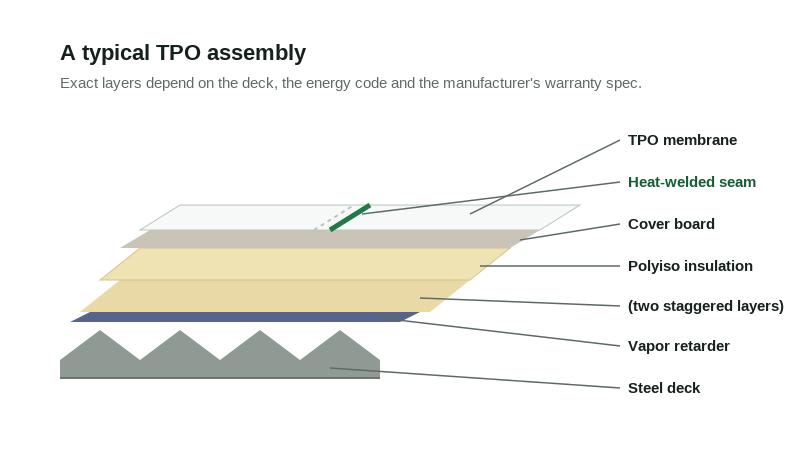
When you replace a low-slope roof down to the deck, Front Range jurisdictions generally require it to meet current energy code insulation levels. Those are often much higher than what your building had. The added thickness raises the roof surface, and that ripples outward. Expect taller wood blocking at the edges, new edge metal, raised flashings at walls and curb extensions under rooftop units. Roof hatches, scuppers and drains may change too.
Edge metal and wind design
The building code requires tested edge metal (ANSI/SPRI ES-1) on low-slope membrane roofs. Your new roof also has to be designed for current wind loads, with more attachment at corners and perimeters. Older roofs often had neither. Along the foothills, where chinook winds hit hardest, the difference can be large. See our guide to wind damage on commercial roofs.
Recover limits
Codes generally won't let you install a new roof over wet or damaged materials, or over two existing roofs. If your building already has two roofs, or the existing roof is wet, a storm replacement becomes a full tear-off. That's where the undamaged-portion and demolition parts of the coverage can matter.
Drainage, decks and assemblies
Re-roofing can bring drainage details, deck repairs and the roof assembly's fire and wind ratings under review. What applies depends on the code your city has adopted and how it treats existing buildings. We confirm it on every project instead of assuming.
Local ordinances
Some requirements come from city ordinances rather than the building code. In Denver, for example, the Green Buildings Ordinance can require a cool roof and an additional compliance option when larger buildings replace their roofs. See our page on commercial roofing in Denver. Ask your agent whether your ordinance or law coverage responds to a requirement like that.
Older materials
Some older built-up roofs contain asbestos in felts or mastics, which has to be tested before tear-off where Colorado rules require it. Ask your agent how your policy treats testing and abatement.
How code upgrades show up in roof insurance claims
Inspection and scope
After the storm, we inspect and document the damage. Then we identify the code items that repairing or replacing each building would trigger.
Confirm with the jurisdiction
Requirements differ from city to city. We confirm them with your local building department, such as the City of Centennial Building Division. Centennial publishes the building, existing building and energy codes it has adopted.
Separate line items
Our scope lists code-required work apart from like-kind replacement, with the requirement behind each item. "Bring to code" as a single line doesn't tell an adjuster anything.
Compare with the carrier's estimate
First estimates often leave out code items and permit costs. Where they're missing, we document them for a supplement with the reason each is needed.
Track payment and deadlines
Like recoverable depreciation, code-upgrade money often arrives after the work is done. Plan your cash flow, and note any time limit in the policy.
Hidden conditions found during tear-off, such as damaged decking, are photographed as the work happens and submitted the same way. Our hail claim timeline shows where these steps fall between the storm and closeout.
Questions to ask your agent before the storm
- Does our policy include ordinance or law coverage, and which of the three parts?
- What are the limits, are they separate or combined, and do they apply per building?
- Would the limit cover a full tear-off and insulation upgrade on our largest roof?
- Is the increased cost of construction paid only after the work is complete, and within what time?
- How does the coverage work if the roof is valued at actual cash value?
- For associations: is it part of the master policy, and how would the board fund costs above the limit?
It helps to bring your agent something concrete. As part of an inspection, we can identify the code items a re-roof of your building would likely trigger, and the cost drivers behind them. Then your agent can check the limit against your building, not a guess. Our guide to commercial roof cost factors explains how insulation, tear-off and code items drive the price.
Code upgrades are not the same as improvements
Ordinance or law coverage pays for what the code requires, not for what you'd like to have. If you choose a thicker membrane, a hail-rated assembly or a longer warranty than the code calls for, that's generally an upgrade you pay for. It should be priced separately so the claim stays clean. It can still be worth it; our guide to hail-resistant commercial roofing covers the options.
What we do, and what we don't
We document damage and identify code requirements. We confirm them with the building department, pull the permit and prepare a detailed scope with code items broken out. When you ask us to, we meet the adjuster on the roof and explain why each item is required. You'll get a written contract from us that spells out the scope.
We don't interpret your policy or negotiate your claim. Coverage decisions are between you and your insurer. Negotiating is your role, with your agent or a licensed public adjuster.
No deductible deals. Truman never pays, waives or rebates a deductible on any job. Colorado's roofing contractor law forbids it on residential property, which can include condo and townhome buildings.
We're based in Centennial near the Denver Tech Center and work with building departments across the metro. See our commercial roofing in Centennial page for how permits work there. Request an inspection and we'll document the roof and the code items a replacement would trigger, or call (720) 296-0000.
Ordinance or law coverage FAQs
Does a standard commercial property policy pay for code upgrades?
Often not, unless the policy includes ordinance or law coverage, and then only up to its limit. Check your policy with your agent before storm season.
Is the insulation upgrade on a re-roof a code upgrade?
Usually. A replacement down to the deck generally has to meet current energy code insulation levels. The added thickness affects curbs, flashings, edge metal and drains. Whether your policy pays the extra cost depends on its ordinance or law coverage.
When is ordinance or law coverage paid?
Often after the work is complete and you've documented the cost. Some policies also set a time limit. Ask your agent how your policy handles it.
Can you tell us what code items our re-roof would trigger?
Yes. During an inspection and estimate, we identify the likely code items for your building. We confirm them with the local building department before we price the work.
Will insurance pay for a better roof than the code requires?
Generally not. Upgrades beyond code are usually yours to pay for, and we price them separately from the claim scope.
Can you negotiate code items with our insurer?
No. We document why each code item is required and can explain it to the adjuster on the roof. Negotiating the claim is your role, with your agent or a licensed public adjuster.