
Home / Resources / Single-ply seam failures
TPO and EPDM roof leaks at the seams: causes and repairs
A single-ply roof is a set of large sheets joined on the roof, and the joints are where most of its leaks begin. Here's why TPO and EPDM seams fail, how they're checked, and how each kind of failure is repaired.
Why do seams matter?
TPO and EPDM membranes arrive on the roof in rolls and are joined where the sheets overlap. The sheet itself rarely fails early.
The seams depend on the crew, the weather on the day they were made and how the roof has been treated since. A properly made seam is as strong as the sheet around it. A poor one can hold for years, then open after a hard winter.
The two membranes are joined in completely different ways, so they fail in different ways, and they're repaired differently too.
TPO seams: how they're made and why they fail
TPO is a thermoplastic. Its seams are joined with a hot-air welder that melts the two overlapping sheets into one piece. Done right, it's a very reliable joint. That means test welds at start-up and every time the temperature changes, and every seam probed afterward. The seam failures behind TPO roof leaks come from a handful of causes:
- Underwelded seams. A welder running too cool or too fast leaves a seam that looks finished but isn't fully fused. A seam probe would have caught it at installation; years later it opens.
- Overheated welds. Too much heat scorches the membrane next to the seam and weakens it.
- Dirty laps. Dirt, dust, dew or frost on the lap at welding time keeps the sheets from fusing.
- Wrinkles and fishmouths. A wrinkle welded over leaves a small channel that water can follow under the seam.
- Open T-joints. Where three layers of membrane meet, there's a small step that has to be patched or sealed the way the manufacturer requires.
- Billowing. On mechanically fastened roofs, wind lifts the sheet between fastener rows and pulls at the seams with every gust.
Weathered TPO is harder to weld than new TPO, which matters at repair time.
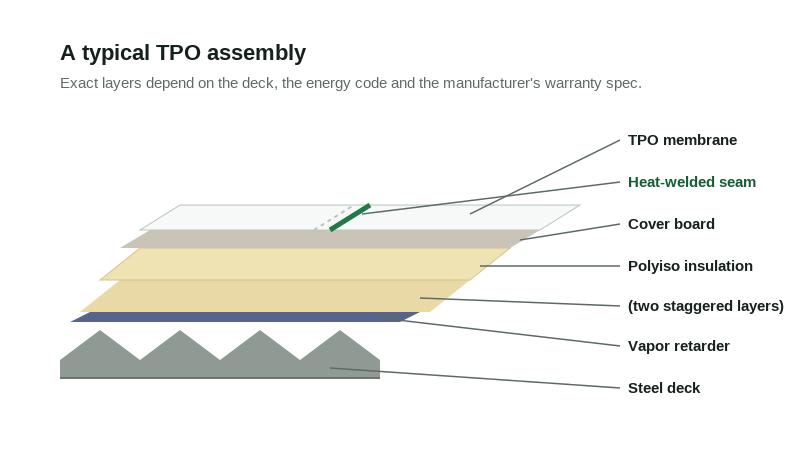
EPDM seams: how they're made and why they fail
EPDM is a synthetic rubber cured at the factory, so it can't be welded. Older EPDM roofs were spliced with liquid adhesive, a contact cement brushed onto both sheets, with lap sealant along the edge. Newer roofs use butyl-based seam tape over a primed surface, often applied at the factory.
- Dried-out adhesive. On older roofs, years of sun and freeze-thaw dry out the splice adhesive. Lap edges lift and open into fishmouths.
- Skipped primer or dirty laps. Seam tape needs a clean, primed, dry surface. Without one, it never bonds fully.
- Lap sealant. The bead along the edge of the seam cracks and shrinks under UV, exposing the seam edge.
- Shrinkage. Aging EPDM shrinks, pulling on seams as well as on flashings at walls and curbs.
- Movement. Fastened sheets billow in high wind and work the seams over time. On ballasted roofs, seams are hidden under the stone, so problems go unseen longer.
- Oils. Oil from rooftop equipment softens and swells the rubber, and seams near units fail first.
What does Colorado weather do to seams?
- UV at altitude dries lap sealant and the exposed edges of seam tape faster than at sea level.
- Freeze-thaw turns a hairline opening into a gap: water gets in, freezes, expands and pries the lap open a little more each cycle.
- Chinook winds along the foothills and thunderstorm gusts on the plains billow fastened sheets and stress perimeter seams most.
- Snow and ice removal with steel shovels and ice chippers catches seam edges. It causes many of the punctures we repair.
- Hail, mid-April to mid-August, stresses seams and flashings near impacts, especially on aged membrane.
- Ponding keeps seams underwater. A lap that would shed water on a slope leaks steadily under a pond. See ponding water on a flat roof.
What are the signs a seam is failing?
- Lap edges lifted, curled or visibly open
- Fishmouths: small, open tunnels at the edge of a seam
- Open T-joints or missing patches where seams cross
- Lap sealant cracked or missing along EPDM seams
- Inside, leaks that line up along the direction the seams run, leaks away from any curb or wall, or leaks that get worse in wind
The proper check uses a seam probe. It's a blunt hand tool run along the edge of every lap to find spots that aren't bonded. That's part of every seam inspection we do. Where a seam has been leaking, the insulation under it is likely wet. An infrared moisture survey, confirmed with core cuts, shows how far it has spread.
How are seam failures repaired?
TPO seam repair means welding. EPDM seam repair means cleaning, priming and taping. Here's how each failure is fixed:
| Failure | Typical repair |
|---|---|
| TPO underwelded or open seam | Clean and prepare the membrane, then reweld the seam or weld a cover strip over it |
| TPO seam on weathered membrane | Clean and prepare the surface and run test welds first; if it won't take a reliable weld, plan for the roof's remaining life |
| TPO wrinkle, fishmouth or open T-joint | Cut out the defect and weld a patch over it |
| EPDM lifted lap or dried adhesive seam | Clean and prime the rubber, apply cover tape over the lap and seal the edges |
| EPDM fishmouth | Cut it open, then patch it with primed cover tape or a membrane patch |
| Seams failing across the whole roof | A roof-wide restoration or a replacement, depending on how much insulation is wet |
Welded patches outlast sealant by years, and a primed, taped EPDM repair is far more consistent than one made with liquid adhesive. Wet insulation under a failed seam gets cut out and replaced before the roof is closed up. A patch over wet insulation doesn't fix a leak.
What doesn't work
- Caulk or roof cement smeared over a seam. It doesn't bond well to single-ply membranes, asphalt products can damage EPDM, and it makes a proper repair harder.
- Tape over a dirty or unprimed surface. It looks fine until the first freeze.
- Repairs by an unauthorized contractor on a warranted roof, which can put the manufacturer warranty at risk.
Repair, restore or replace?
- Repair when failures are isolated, the insulation is dry and the membrane is still sound.
- Restore when seams are aging everywhere but the roof is dry. On EPDM that can mean cover tape on every seam plus new flashings and pipe boots. On TPO it can mean rewelding or cover strips on suspect seams while the membrane is still weldable.
- Replace when seams are failing across the roof and the insulation is widely wet, or when TPO won't take a weld anymore. Our guide to TPO vs EPDM covers the choice of membrane if you get there.
How do you prevent seam failures?
On a new roof, seam quality comes from the crew. Look for test welds at every start-up and temperature change, daily seam probing, and clean, primed laps. On an existing roof, it comes from maintenance.
The NRCA recommends inspecting low-slope roofs at least twice a year and after severe weather. Our S.M.a.R.T. maintenance program probes seams, checks flashings and clears drains. It also fixes small openings before freeze-thaw makes them bigger. Walkway pads to rooftop equipment and care during snow removal prevent much of the rest.
If a seam is leaking now, call us first at (720) 296-0000 or report a leak, and see why commercial roofs leak and how the source is found. To have your seams probed and documented, request an inspection. We repair TPO and EPDM roofs across the Denver metro. That includes warehouses and industrial buildings (see commercial roofing in Commerce City) and offices near our Centennial base.
Seam failure FAQs
Can an old TPO roof be rewelded?
Often, yes, after the surface is cleaned and prepared and test welds confirm the bond. If weathered TPO won't take a reliable weld, that tells you something about its remaining life, and we'll say so.
Why are our EPDM seams lifting?
On older roofs, the liquid splice adhesive dries out with sun and freeze-thaw, and shrinkage pulls at the laps. Cleaning, priming and covering the seams with cover tape is the standard repair.
Is caulking a seam a real repair?
No. Caulk and roof cement don't bond well to single-ply membranes and fail quickly. TPO seams should be welded and EPDM seams taped over a primed surface.
Do seam repairs affect our warranty?
Seam repairs can affect your warranty. Many manufacturer warranties require you to use an authorized contractor and report leaks in writing promptly. We check your warranty's requirements before we work on your roof.
How do we know whether to repair or replace?
It depends on how many seams are failing, whether the insulation is wet and how the membrane is aging. Get a seam inspection, an infrared survey and core cuts, and you'll have the facts to decide.