
Why does the coating decide almost everything?
A spray polyurethane foam (SPF) roof has two working parts. The foam is the insulation, the shape and the waterproof body of the roof. The spray foam roof coating on top, usually acrylic, silicone or urethane, protects the foam from sunlight and weather. Foam can't survive long in the open: sunlight turns exposed foam brown and powdery, and then it erodes.
That makes most spray foam damage a coating problem first. Hail, boots, tools, birds and sun all break or wear through the coating. Once the foam is exposed, UV and water go to work, and a small repair becomes a larger one. Closed-cell foam resists water well, but water that gets in can travel between the foam and the roof below and loosen the bond.
The good news is that foam roofs are repairable: damaged foam can be cut out and replaced, and a worn coating can be renewed. Our spray foam roofing page covers how the system is built.
How do you read the damage?
Most problems on a foam roof show up as one of a few patterns:
| What you see | What it usually means | Typical repair |
|---|---|---|
| Chalky, thin or worn coating | The coating is eroding under sun and traffic, but the foam may still be protected | Clean, test adhesion and recoat before the foam is exposed |
| Brown, powdery or pitted foam | The coating has worn through and UV is eroding the foam | Remove degraded foam to sound material, re-foam if needed, then coat |
| Raised bubbles or soft, spongy areas | A coating blister, or foam that has lost its bond to the roof below, sometimes with trapped moisture | Probe and check for moisture, then cut out and rebuild the affected area |
| Small holes or gouges | Punctures from tools, equipment, debris or birds | Cut back to sound foam, fill with compatible foam or sealant, then coat |
| Dents or cracked coating after a storm | Hail impacts; the question is whether the coating broke | Seal and recoat fractured impacts; document everything for the file |
What does UV wear look like?
At Denver's elevation the sun is stronger than in sea-level cities, and Front Range roofs see a lot of clear days. Coatings erode faster here, and they don't erode evenly. The first places to thin are usually the high spots and south-facing slopes. Areas around reflective rooftop equipment and the paths service techs walk wear early too.
Early signs are chalking, a white residue that rubs off on your hand, and a coating that looks thin or patchy. Later you'll see the tan or brown of bare foam. A coating can look fine from the roof hatch and still be close to wearing through, so we measure its thickness rather than judging it by eye.
What the repair involves
- Coating thin, foam sound: the roof is a recoat candidate. Small worn spots can be spot-coated as maintenance, but widespread thinning calls for a planned recoat.
- Foam exposed and degraded: the damaged surface is removed down to firm, clean foam. Where the loss is deep, we spray new foam to restore thickness and slope. Then we coat the area so it ties into the coating around it.
What do blisters and soft spots mean?
Not every bubble means the same thing. A coating blister sits in the coating, or between the coating and the foam. It often traces back to coating applied over damp or dirty foam.
A foam blister goes deeper: the foam has come loose from the roof below. The cause is often moisture or dirt on the surface when it was sprayed, or water that got in later.
Don't cut a blister open just to see inside. An intact blister is still keeping water out, and opening one without a plan can turn a contained problem into a leak.
What the repair involves
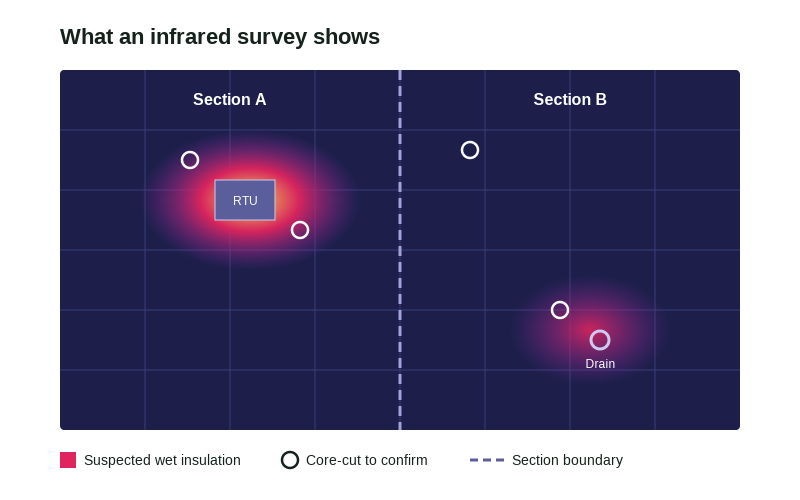
- Find out whether it's wet. We probe the area and take a core where it's warranted. With several blisters or soft areas, an infrared moisture survey shows how far the problem reaches.
- Small and dry: we cut the blister out to sound, bonded material and prepare the surface. New foam fills the area flush with the roof, and then the patch is coated.
- Wet: wet foam has to come out and the surface below has to dry before new foam goes in. Coating over wet foam traps the water.
- Widespread loss of bond: when blisters and soft spots cover large areas, a patch-by-patch repair stops making sense. At that point, the conversation turns to replacement.
Where do punctures and bird damage come from?
HVAC service is the most common source of the punctures we repair. Watch for dropped screws and panels, ladder feet, tools set down on the coating and equipment dragged across the roof. Wind-blown debris, ice chippers and snow shovels add more. Holes near curbs, drains and pipe supports are the easiest to miss.
Birds are their own category. Northern flickers, common along the Front Range, drill into foam, and their holes can go deep. Each one is small, easy to miss and a path for water.
What the repair involves
We clean the spot and cut it back to sound foam, usually in a tapered shape so the repair material can bond. Small holes are filled with a compatible sealant; larger ones get new foam, trimmed flush. Then the repair is coated past its edges.
In walk paths and around equipment, walkway pads or a granule-surfaced coating keep the same spot from being damaged again. Where birds keep coming back, we'll talk through deterrents.
How does hail damage spray foam?
Hail season along the Front Range runs from about mid-April to mid-August, and hail leaves dents in foam. The dents themselves aren't the issue. The question after a storm is whether the coating broke.
A dent with intact coating usually isn't a leak risk. An impact that fractured the coating or crushed the foam surface opens your roof to UV and water. Get it sealed and recoated before freeze-thaw and the next storm make it bigger.
After a storm, we check impact size and spacing on each roof section. We test whether the coating is fractured and photograph everything with the storm date. If you're considering a claim, start with our guides to functional vs cosmetic hail damage and the first 72 hours after a hailstorm. Policies vary, so check yours with your agent.
Freeze-thaw, ponding and edges
Colorado winters find every weak spot. Water in an open puncture freezes and widens it. Frozen drains back meltwater up against curbs and edges, and chinook winds push debris across the roof.
Foam has one advantage here. It can be sprayed thicker in a low area to build slope toward a drain, so ponding gets fixed as part of the repair.
How is a foam roof repair done?
Find and mark the damage
A close walk of every roof section, with each problem photographed and marked on a roof plan. Interior leak locations help, but water can travel before it shows up inside.
Check for moisture
Probing, cores and, on larger or older roofs, an infrared survey. The repair depends on whether the foam is wet.
Remove what's damaged
Degraded, wet or loose foam is cut out to sound, dry, well-bonded material.
Prepare the surface
Cleaning, drying and primer where the coating chemistry calls for it. Preparation decides whether a repair lasts.
Rebuild and coat
New foam or sealant fills the area flush, and a compatible coating goes on past the edges.
Document
Before-and-after photos and locations, so the next visit can confirm the repair held.
When is recoating the right answer?
A recoat renews the protective layer across the whole roof. It's the right call when the foam is dry, firm and well bonded, but the coating has thinned or worn in many places. Done on schedule, it resets the clock without a tear-off. Done after the foam has been exposed across large areas, it costs more, because the foam has to be repaired first.
A good recoat follows a sequence:
- Survey first. Moisture checks, coating thickness readings and adhesion tests show what's dry, what's wet and what's thin.
- Repair everything. Punctures, blisters, bird holes, hail fractures and failed details are fixed before any coating goes on.
- Clean and prime the surface. The roof is washed and dried, and primed where needed.
- Match the chemistry. Not every coating bonds to every other; silicone, for example, generally needs to be recoated with silicone. Adhesion tests keep a new coat from peeling after one winter.
- Apply to a measured thickness. We apply the coating at the thickness specified for the life and warranty you want. Walk paths and areas around equipment get extra protection.
Don't coat over a wet roof. A fresh coating over wet foam looks good for a season and traps the water underneath. Any recoat proposal should tell you how moisture was checked and what happens to wet areas.
Repair, recoat or replace?
Because foam is renewable, you can usually restore an aging SPF roof rather than tear it off. The survey decides how far the work needs to go:
- Targeted repair when damage is isolated and the rest of the roof is dry and well coated.
- Repair plus recoat when the foam is sound but the coating is worn across the roof.
- Replacement when wet foam is widespread or the foam has lost its bond across large areas. It's also the answer when foam was left uncoated long enough to erode badly. The old foam comes off, and a new foam roof or a single-ply system such as TPO goes on.
Cost follows how much foam is wet or damaged, the coating type and thickness, primer, access and overspray protection. See commercial roof cost factors for more.
How do you prevent the next repair?
A foam roof needs more regular attention than most systems, because its coating is its protection. The NRCA recommends inspecting low-slope roofs at least twice a year and after severe weather.
Our S.M.a.R.T. maintenance program does that on a schedule. We clear drains, seal small punctures and bird damage, and check coating thickness where exposure is worst. You get a written report with photos after every visit, so the next recoat shows up in your budget instead of in a leak.
Set rules for everyone who goes up: walk marked paths, never set tools on the coating, and report damage right away.
We inspect, repair and recoat foam roofs across the metro, no matter who installed them. That includes offices near the Denver Tech Center, warehouses and association properties. Learn about our commercial roofing in Centennial and our work in Aurora, then request an inspection. If water is coming in now and you need a roof leak repair, call us first at (720) 296-0000 or report a leak.
Spray foam roof repair FAQs
Can a spray foam roof be repaired, or does it have to be replaced?
Most can be repaired. Damaged or wet foam is cut out and replaced, and a worn coating is renewed with a recoat. Replacement is for roofs where wet foam or loss of bond is widespread, which a moisture survey shows.
How do we know when the roof needs a recoat?
Chalking, thin or patchy coating and any exposed foam are the signs. For a reliable answer, have the coating thickness measured during an inspection. Those readings let you plan the recoat before the foam is exposed.
Can you recoat over our existing coating?
Usually, if the foam is dry and the new coating is compatible with the old one. We test adhesion first. Some coatings, such as silicone, generally need to be recoated with the same chemistry.
Are hail dents on our foam roof damage?
Dents with intact coating usually aren't a leak risk. If an impact fractured the coating or crushed the foam surface, you'll need to have it sealed and recoated. We check after a storm and document what we find.
Do you repair foam roofs you didn't install?
Yes. We inspect, repair and recoat existing spray foam roofs, whoever installed them. We also test your existing coating so repairs bond to it.