
Home / Resources / Functional vs cosmetic hail damage
Functional vs cosmetic hail damage on commercial roofs
After a hailstorm, the question that shapes the repair and the claim usually isn't whether hail hit the roof. It's whether hail changed how the roof works. Here's how the two kinds of damage differ on each roof system, how an inspector tells them apart and why your policy cares.
General guidance, not legal or insurance advice. Policies define and treat hail damage differently. Read yours with your insurance agent.
The short version
Functional damage affects how well the roof does its job. That job is to keep water out and protect the layers underneath. Cosmetic damage changes how the roof looks without changing how it performs.
The line isn't always where it looks. A metal roof covered in dents can be completely watertight. A membrane that looks untouched can sit on crushed insulation and fractured cover board. That's why the call is made on the roof, impact by impact, and often under the membrane rather than from the parking lot.
Why does the difference matter?
- The repair. Cosmetic damage may need nothing more than a record. Functional damage needs repair before freeze-thaw, snowmelt and the next storm make it worse.
- The claim. Your policy may have a cosmetic damage exclusion or endorsement, especially for metal roofing. If it does, it covers only damage that affects function. Other policies cover both. Your policy's wording decides, not the roofer and not the general rule.
- The budget. A roof with only cosmetic damage may stay on its current replacement schedule. If functional damage is widespread, you may need to move the replacement up in your capital plan or reserve study.
- The record. Documenting cosmetic damage from this storm helps you separate it from the next one. That matters on the Front Range, where hail season runs from mid-April to mid-August and your roof can be hit more than once.
What functional hail damage looks like
Functional damage is anything that lets water into your roof or weakens the layers that protect it. On commercial and association roofs, the common forms are:
- Punctures, cracks and fractures in a single-ply membrane
- Fractured cover board and crushed insulation beneath an impact, which leaves the membrane unsupported and prone to fail later
- Split or stressed seams, and damaged flashings at walls, curbs and penetrations
- Fractured surfacing or plies on built-up and modified bitumen roofs
- Fractures in the coating of a spray foam roof that expose the foam to sun and water
- Dents at metal seams, laps, fasteners and trim that open joints or break the seal
- Broken skylights, crushed vent caps and damaged drains
Some functional damage doesn't leak right away. A bruised membrane or a cracked cover board can stay dry through the summer. Then winter freeze-thaw opens it up: water gets into a small break, freezes and widens it. That delay is the reason to inspect after a storm instead of waiting for a stained ceiling tile.
What cosmetic hail damage looks like
Cosmetic damage changes appearance without affecting the roof's ability to keep water out. Typical examples:
- Shallow dents in the flat areas of metal panels, with the finish intact and no harm to seams, laps or fasteners
- Marks and scuffs on a membrane that has no break in it and firm, undamaged layers beneath
- Dents in a spray foam roof where the coating is still continuous
- Gravel moved around on a built-up roof where the flood coat and plies underneath are sound
- Dented gutters, downspouts and vent hoods that still drain and seal
Cosmetic doesn't mean irrelevant. Dents in soft metals show hail size and direction, which helps establish what the storm did to the rest of the roof. Chipped or cracked paint on metal deserves a second look, because bare metal can start to corrode.
And if your roof is visible, such as metal mansards in an HOA community, appearance matters to owners and boards. Whether it's covered is a policy question.
How it shows up on each roof system
| Roof system | Usually appearance only | Usually affects function | How it's confirmed |
|---|---|---|---|
| TPO and EPDM | Surface marks with no break in the sheet and firm layers beneath | Punctures, cracks, split seams, fractured cover board or crushed insulation | Close inspection of marked impacts, test cuts, infrared where water may have entered |
| Built-up and modified bitumen | Gravel displaced with the flood coat intact | Fractured surfacing or plies, bare bitumen left exposed to the sun | Test cuts through the plies, granules collected at drains and downspouts |
| Metal | Shallow dents in flat areas with the finish intact | Dents at seams, laps, fasteners or trim; cracked finishes; opened joints | Dent size and density photographed with a scale on each section; seams and fasteners checked |
| Spray foam | Dents with the coating still continuous | Fractured coating, exposed or crushed foam | Close inspection of each impact for breaks in the coating |
| Edges and accessories | Dented gutters and vents that still drain and seal | Crushed downspouts, broken skylights, damaged drains, edge metal and flashings | Inspection of each component and its attachment |
How does an inspector tell them apart?
Telling functional from cosmetic damage is a process, not a glance. A thorough hail damage assessment should:
Start with the storm
The storm date, the largest hail reported and its direction, so the damage can be tied to a specific event.
Identify the assembly
The membrane, panels or foam on top, and the cover board, insulation and deck beneath. The same impact means different things on different assemblies.
Mark and photograph impacts
Hits marked on each roof section and photographed with a scale, with overview shots that show where each close-up was taken.
Look beneath the surface
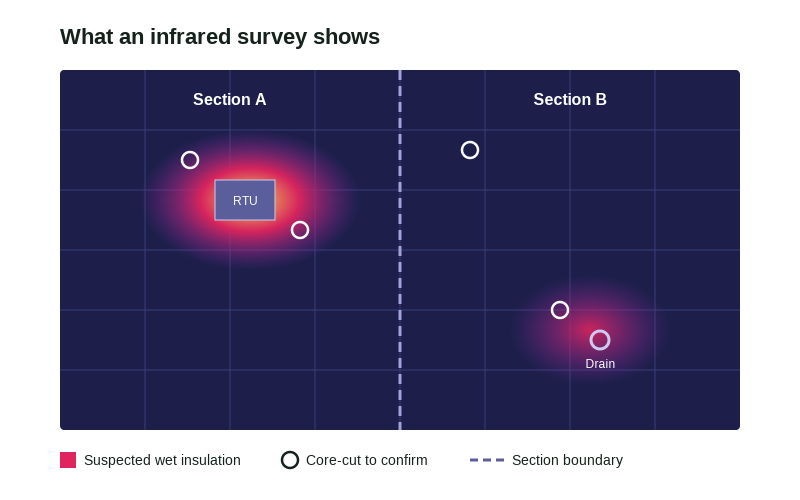
Small test cuts at typical impacts show you whether cover board or insulation fractured. Each cut is photographed and patched watertight. Where water may have gotten in, an infrared moisture survey maps wet insulation.
Check the details
Seams, flashings, edge metal, curbs, drains and skylights, where most leaks start.
Separate old from new
Prior patches, ordinary wear and earlier storm damage noted honestly, apart from this storm's damage.
Report by roof section
What's functional, what's cosmetic and what was already there, building by building.
Our roof inspections and infrared surveys follow that sequence. To organize the results, see our guide to documenting hail damage before the adjuster arrives.
Metal roofs and the cosmetic damage question
Metal is where the question comes up most. Hail dents panels easily. Your roof can be covered in dents you can see from the street and still not let in a drop of water. Many commercial policies add a cosmetic damage exclusion or endorsement for metal roofing. It limits coverage to damage that affects the roof's ability to keep water out. Policies vary widely, so read yours with your agent. The best time is at renewal, before the next storm.
After a storm, we document both kinds of damage on metal:
- Dent size and density by section
- Damage at seams, clips, fasteners, closures and trim
- Cracked or chipped finishes
- Collateral damage to gutters, vents and rooftop units
That keeps the record complete whichever way your policy reads. More on panel types and repairs is on our commercial metal roofing page.
Mixed roofs are common in HOA and multifamily communities. The main buildings often have low-slope membranes, with metal on mansards, canopies and carports. One storm can leave functional damage on the membrane and cosmetic damage on the metal. Your policy may treat the two differently. Reports organized by building and roof type keep that straight.
Who decides what's covered?
The insurer decides what your hail damage insurance covers, through its adjuster and sometimes an engineer. A roofer's job is to show clearly what's on the roof. If you ask, we'll meet the adjuster on the roof and walk the marked impacts. We show the test cuts and explain how the assembly is built. Our article on what your roofer does at the adjuster meeting covers that visit in detail.
We don't negotiate the claim. That's your role, with your agent or a licensed public adjuster. Does the insurer disagree with your documentation about whether damage is functional? Your agent can explain the options. Our article on why commercial roof hail claims get denied covers what to do next. If you're on an HOA board, our association hail claims guide explains how deductibles and payments work.
What to do after the next storm
- Notify your agent or carrier promptly. Most policies want notice soon, even before you know how bad the damage is.
- Don't wait for a leak. Functional damage on a low-slope roof is often hidden.
- Ask for a report that sorts the damage into functional, cosmetic and pre-existing, by roof section.
- Keep the cosmetic record. It helps establish the next storm's damage, too.
- Get on a maintenance schedule. Our S.M.a.R.T. maintenance program leaves you a dated report with photos after every visit. That report becomes your baseline at claim time.
Our checklist for the first 72 hours after a hailstorm covers safety and leaks. The hail claim timeline shows the stages from storm to closeout.
We're a local contractor based in Centennial, near the Denver Tech Center. We inspect commercial and association roofs across the Denver metro. Learn more about our commercial roofing in Centennial, then request a hail damage inspection or call (720) 296-0000. If water is already coming in, call us first or report a leak.
Functional vs cosmetic hail damage FAQs
Is cosmetic hail damage covered by insurance?
It depends on your policy. Some cover it; many commercial policies exclude or limit cosmetic damage, most often on metal roofing. Your agent can tell you how your policy treats it.
Can cosmetic damage turn into functional damage?
Sometimes. Cracked paint on metal can lead to corrosion, and a bruised membrane can crack after freeze-thaw cycles. A good report notes which cosmetic damage to watch, and maintenance visits keep an eye on it.
Do dented gutters mean our roof is damaged?
Not by themselves. Dented gutters, downspouts and vents show the property was hit hard enough to check the roof, and they help show hail size and direction. The roof itself still needs an inspection.
Why do you cut into the roof?
Crushed insulation and fractured cover board often sit under a membrane that looks fine. A small test cut is the most direct way to see and photograph that functional damage. Each cut is patched watertight.
Who decides whether damage is functional?
The insurer, through its adjuster and sometimes an engineer, decides what the policy covers. We document what's on the roof and walk it with the adjuster at your request.
Should we repair cosmetic damage?
Usually it isn't urgent, since it doesn't affect the roof's performance. Whether to repair it is an appearance and budget decision for the owner or board. We can price it separately from functional repairs.