
TPO vs PVC roofing for commercial buildings
TPO and PVC look almost identical on a roof: white, reinforced sheets with heat-welded seams. They're made differently, though, and they age and resist chemicals differently. Here's a fair comparison, and how to decide what belongs on your building.
What's the short answer?
TPO (thermoplastic polyolefin) is the most common membrane on new low-slope roofs and full re-roofs. It's reflective, and you can probe and test its welded seams. It also stays flexible without added plasticizers. It's the single-ply system we install.
PVC (polyvinyl chloride) has been on commercial roofs longer than TPO. It's also heat-welded and usually white, and its standout strength is resistance to grease, oils and many chemicals. It's made flexible with plasticizers, which affects how it ages.
Most offices, retail centers, warehouses, schools and association buildings along the Front Range do well with TPO. The key is a well-built assembly. PVC comes up most on restaurant roofs and buildings with chemical exhaust. Either way, what's under the membrane matters as much as the sheet. So do the details at the edges and penetrations.
What do TPO and PVC have in common?
- Both are thermoplastics. Heat softens them, so seams are fused with a hot-air welder into one continuous sheet, and repairs are welded in rather than glued.
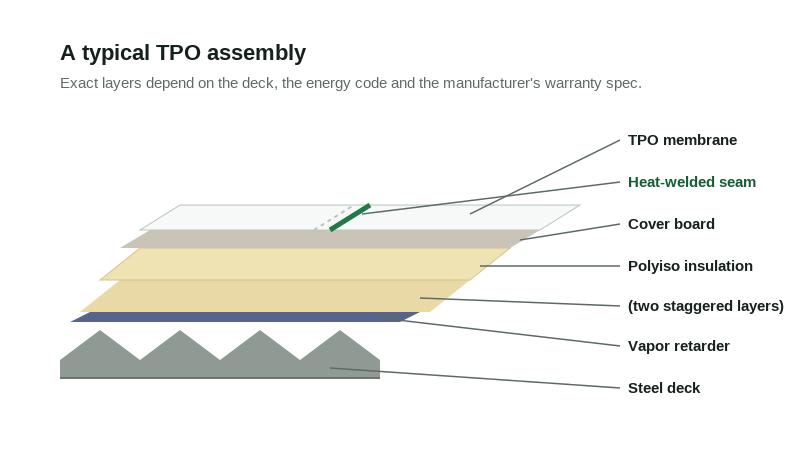
- Both are reinforced single-ply sheets. They go over insulation and, ideally, a cover board.
- Both are usually white and reflective. That lowers cooling loads and helps you meet cool-roof requirements. Denver's green building rules, for example, can apply them to larger buildings at replacement.
- Both can be attached several ways: mechanically fastened, fully adhered or induction-welded. The right method depends on your deck, wind exposure and warranty.
You usually can't tell them apart from the parking lot, and that matters later: the two membranes can't be welded to each other.
PVC vs TPO roofing: how do they differ?
| Factor | TPO | PVC |
|---|---|---|
| Chemistry | Polyolefin blend, flexible without added plasticizers | Vinyl made flexible with plasticizers |
| Grease, oils and chemicals | Restaurant grease attacks it; exhaust areas need protection | Strong resistance to grease, oils and many chemicals |
| How it ages | Weathers from the top surface; older sheets need careful prep to weld | Can stiffen over many years as plasticizers migrate out |
| Contact with other materials | Needs a separator or cover board over some existing roofs | Needs separation from asphalt and some insulations, which draw out plasticizers |
| Seams and repairs | Welded; repaired with TPO only | Welded; repaired with PVC only |
| Cost tendency | Generally the lower-cost single-ply of the two | Generally priced higher than TPO |
| Track record | In wide use since the 1990s, with formulations improved over time | In use on commercial roofs since well before TPO |
Where does PVC have the edge?
PVC's real advantage is chemical resistance. Kitchen exhaust fans put grease on the roof around every restaurant hood, and grease softens and degrades TPO and EPDM over time. PVC tolerates it far better. That's why it's often specified for restaurants and food processing plants. It also suits buildings that vent oils or certain chemicals onto the roof.
PVC also has a long track record, and many PVC membranes resist burning on their own. Fire ratings for both membranes, though, come from the tested assembly, not the sheet alone.
Where does TPO have the edge?
- Cost. TPO generally costs less. That matters on large roofs and in multi-building communities.
- No plasticizers to lose. TPO stays flexible without them, so it doesn't stiffen the way some aged PVC membranes do.
- Fewer material conflicts. PVC needs to be kept away from asphalt, coal tar and some insulations. TPO still needs the right separator or cover board on a recover, but it's less sensitive.
- Easy to find and match. As the most common single-ply, TPO is easy to source, match and repair across the metro.
TPO has two weak spots. Grease is one, so kitchen exhaust areas need protection. Age is the other: weathered TPO needs careful cleaning and test welds before it accepts a repair. You'll find more on the system on our TPO roofing page.
How does each handle Colorado weather?
Hail, mid-April to mid-August
For both membranes, hail performance comes mostly from the assembly. You want a dense cover board, a thicker membrane and attachment that keeps the sheet tight to the board.
Age matters too. A membrane that has stiffened with time is easier for hail to fracture. That's one reason inspections after a Front Range storm look closely at older roofs of either type.
UV at altitude
At Denver's elevation, sun wears every membrane from the top down. Both are formulated for UV, and both stay cooler than dark roofs. On either system, flashings on south-facing walls and around reflective equipment take the most sun.
Cold, snow and freeze-thaw
Both membranes get stiffer in the cold. Both can still be welded in winter, with adjusted settings and more test welds. Neither tolerates ponding well over time. Good drainage, crickets around units and walkway pads where shovels and service techs travel do more than the membrane label.
Chinook winds
Uplift is strongest at corners and perimeters. With either membrane, your best defense is the attachment pattern, extra securement at the edges and tested edge metal.
Restaurants and grease: the main reason people ask
If your building has kitchen exhaust on the roof, grease is the deciding question. On a TPO or EPDM roof, the answer is protection and maintenance around every exhaust fan.
That means grease containment at the fan and a protective layer where grease lands. It also means regular cleaning and a close look at the membrane on every maintenance visit. The rest of the roof stays a standard single-ply assembly.
Some owners choose PVC for those roofs instead. If you're weighing it, an inspection is the place to start. We'll look at how much exhaust is on the roof, where grease is landing and what condition the membrane is in. Then we'll lay out your options and their trade-offs.
What if your building already has a PVC roof?
- Repairs have to match. TPO won't weld to PVC, so patches and flashings on a PVC roof must be PVC.
- Watch for stiffening with age. Older PVC that has lost plasticizer can crack, shrink at the edges or shatter under impact. Brittleness is a sign the roof is near the end of its service life.
- Replacement opens the choice again. At the end of its life, you can tear it off. If it's dry and code allows another layer, you can also recover it. The new membrane goes over a cover board or separator.
An infrared moisture survey tells you which option fits. Our guide to roof recover vs tear-off walks through that decision.
Not sure which membrane you have? A core cut or a close look at the seams and markings will tell you. Find out before anyone repairs the roof.
What about warranties and maintenance?
With either membrane, a manufacturer warranty depends on the assembly, an approved applicator and documented maintenance. We're an approved applicator, so we can offer extended manufacturer warranties on commercial projects.
Whatever your membrane, the NRCA recommends inspecting low-slope roofs at least twice a year and after severe weather. Our S.M.a.R.T. maintenance program does that on a schedule. You get a written report and photos after each visit, which double as the maintenance record many warranties require.
TPO roofing vs PVC: choosing for your building
- Offices, medical, retail, warehouses and HOA buildings without heavy grease or chemical exhaust: choose TPO. Build it with a cover board and the right attachment for your exposure.
- Roofs with a few kitchen exhaust fans: usually TPO with protection and maintenance at each fan. An inspection tells you whether that's enough.
- Roofs with heavy grease or chemical exposure: talk with us before you choose a membrane. Base the decision on what's actually landing on the roof.
- Existing EPDM roofs: see our TPO vs EPDM comparison, since matching or switching is its own decision.
When bids differ, the assembly usually explains more than the membrane does. Look at tear-off, code-required insulation, cover board, attachment, details and warranty. See commercial roof cost factors.
We install and repair TPO roofs for commercial, HOA and multifamily owners across the metro. Learn about our commercial roofing in Centennial, then request an assessment. We'll recommend a membrane and assembly for your building, with the cost drivers for each option.
TPO vs PVC FAQs
Is PVC better than TPO?
Not across the board. PVC handles grease and many chemicals better. TPO generally costs less, doesn't depend on plasticizers and suits most commercial and association roofs. The right choice depends on what your roof is exposed to.
Can TPO and PVC be welded together?
No. They're different materials, so repairs and tie-ins have to use the same membrane as the roof. That's why it's worth knowing which one you have before anyone repairs it.
Do you install PVC roofs?
No. TPO is the single-ply thermoplastic we install, along with EPDM, built-up, metal and spray foam systems. If your building has special exposure, we'll inspect it and talk through the options with you.
Can a TPO roof work on a restaurant?
Often, with protection around each kitchen exhaust fan, grease containment and regular cleaning. Where grease exposure is heavy, an inspection helps you decide whether that's enough.
Can a new TPO roof go over our old PVC roof?
Possibly. If your existing roof is dry, sound and within code limits on layers, a recover with a cover board or separator could work. A moisture survey and core cuts decide it.