
What are the two ways to handle a roof replacement?
With a recover, a new roof system goes over the existing one, usually with a cover board or separator between them. The old membrane and insulation stay in place. A tear-off removes the old roof down to the deck, and the deck gets repaired. Then the new roof installation starts from the bottom up: insulation, cover board, membrane, flashings and edge metal.
A recover skips most of the labor, disposal and disruption of removal. It also keeps your building drier during the work. A tear-off costs more and makes more noise, but it lets you see the deck, fix drainage and bring insulation up to current code. On commercial, HOA and multifamily buildings, the choice is rarely about age alone. Two roofs installed the same year can be in very different shape underneath.
The first question: is the existing roof dry?
A recover keeps whatever is under the old membrane. If that includes wet insulation, the new roof inherits it. Trapped water keeps soaking insulation, adds weight, can corrode a steel deck and makes future leaks harder to trace. Most codes don't allow a new roof over wet or damaged materials. Manufacturers also won't warrant a recover over wet insulation.
You can't tell by looking at the surface. A membrane that looks fine can sit over saturated boards, especially around drains, curbs and old leak spots. That's why the decision starts with moisture data:
- An infrared moisture survey maps suspected wet areas across the whole roof.
- Core cuts confirm what the camera shows. They also reveal how many roofs are already on the building, what the insulation is and what the deck looks like.
- Roof history, including leak logs, prior repairs and install dates, tells us where to look harder.
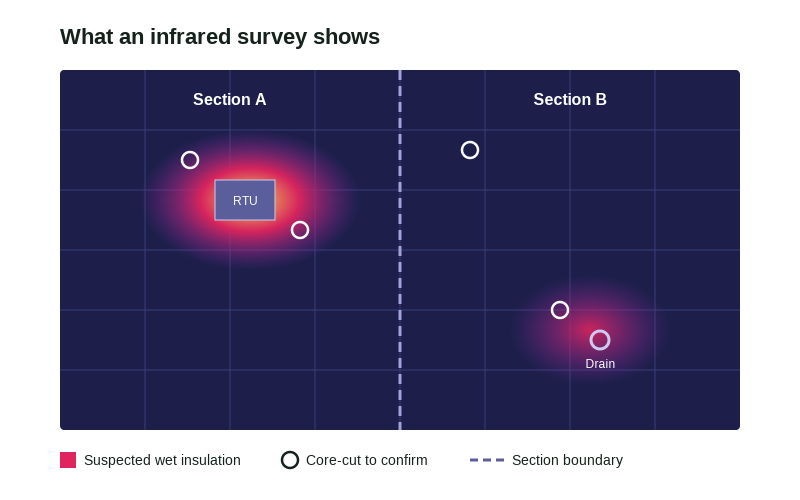
Moisture isn't always all or nothing. When wet areas are limited, we can cut them out and replace them with dry insulation before a recover. When they're widespread, a recover stops being a bargain. Our guide to wet insulation under a flat roof explains why.
When does a recover make sense?
- The insulation is dry, or wet areas are small enough to replace first.
- There's only one existing roof. Codes generally won't let you recover a building that already has two roofs.
- The deck is sound and can hold fasteners. We test fastener pullout on the deck before we recommend a mechanically attached recover.
- Your structure can carry the added weight, including Colorado snow loads.
- Drainage works, or we can fix the problem areas with crickets or tapered insulation over the old roof.
- Flashing heights allow it. A recover raises the roof surface, so we check the height of flashings at walls, doors, curbs and hatches.
When those boxes are checked, a recover is a sound, cost-effective choice, not a shortcut.
When is a tear-off the better call?
- Wet insulation is widespread. Burying it costs you later.
- The building already has two roofs. Both have to come off.
- The deck needs attention. Rusted steel, soft wood or a deck that won't hold fasteners has to be exposed to be repaired.
- Drainage needs a redesign that tapered insulation over the old roof can't deliver, such as new or relocated drains.
- The old roof keeps leaking in new places despite repairs, which usually means the problem is deeper than the surface.
- The new system isn't compatible with what's there, or the existing surface can't be prepared to take it.
A tear-off is also your chance to fix what a recover can't. That includes low flashing heights, too little insulation and a deck nobody has seen in decades.
Recover vs tear-off at a glance
| Recover | Tear-off | |
|---|---|---|
| Existing roof | Must be dry, sound and the only roof on the building | Any condition |
| Deck | Stays hidden; tested through cores and pullout tests | Fully exposed and repaired as needed |
| Insulation | Old insulation stays; new layers can be added | Generally has to meet current energy code |
| Drainage | Improved with crickets or tapered insulation on top | Can be rebuilt from the deck up |
| Disruption | Less noise, debris and exposure to weather | More noise, debris and daily dry-in |
| Up-front cost | Usually lower | Usually higher, mostly removal, disposal and code-required insulation |
| Biggest risk | Covering a problem you didn't find | Hidden deck repairs, which a good proposal prices as unit costs |
What code, energy and permit rules apply?
Re-roofs, including recovers, generally need a permit. Check with your city's building division, or ask us to confirm what applies. A few rules come up on almost every project:
- Layer limits. Building codes limit how many roofs can be stacked on a building. They also don't allow a recover over wet or damaged materials.
- Insulation. When a roof is replaced down to the deck, Front Range jurisdictions generally require current energy code insulation levels. That can be much more insulation than your building had. The added thickness can mean raising curbs, flashings, edge metal and drains. Energy codes often treat a recover differently. Your building department decides how.
- Cool roofs in Denver. Denver's green building rules can add requirements, such as a cool roof, for larger buildings when the roof is replaced.
- Older materials. Older built-up roofs can contain asbestos in felts, mastics or flashing cement. Where Colorado rules require it, those materials have to be tested before tear-off.
Which Colorado conditions tip the decision?
- Hail, mid-April to mid-August. A recover is a chance to add a dense cover board, which protects the new membrane and insulation from hail. Over an old roof full of crushed insulation, though, the new membrane has a soft base. That's one more reason to check moisture and take cores first.
- Snow loads on older structures. Every added layer is added weight, and drifting snow piles it against parapets and rooftop units. Heavy recovers on older structures need a structural check.
- Chinook winds. The new roof has to resist uplift at corners and edges. On a recover, fasteners pass through the old layers into the deck, so pullout tests matter.
- Freeze-thaw. Trapped moisture in a recovered roof freezes and thaws all winter. Dry is the rule, not a preference.
Which recover combinations are common?
What can go over what depends on the existing system. These are the combinations we evaluate most:
- TPO over EPDM, TPO or a smooth built-up roof, with a cover board or separator between them. Many owners use a recover to move from black EPDM to a white TPO roof.
- Spray foam over a dry built-up roof or low-slope metal, once loose gravel is removed. Foam fills uneven spots, adds insulation and can build slope. See spray foam roofing.
- New standing seam on retrofit framing over an existing metal roof. It can change the slope and add insulation, and the old panels stay in place over occupants. See commercial metal roofing.
On a gravel-surfaced built-up roof, the loose gravel has to come off and the surface has to be prepared before anything goes over it. Remember, too, that its weight is already on the structure. Our guide to types of commercial roofing systems gives you an overview of each one.
How do you compare cost, not just price?
A recover is usually cheaper up front because it skips removal and disposal. Over the life of the roof, the comparison depends on what you'd be covering. A recover over a dry, sound roof is good value. A recover over a roof that's partly wet or close to its layer limit can fail early. Then the next replacement has to remove two roofs instead of one.
The main cost drivers are the same either way. They include tear-off and disposal, wet insulation, deck repairs and code-required insulation. Drainage work, flashing and sheet metal, rooftop equipment, access and the warranty you want matter too. Our guide to commercial roof cost factors walks through each. Ask every bidder whether they're pricing a recover or a tear-off. Ask how they handle wet insulation and deck repair, too, so you're comparing the same scope.
What should HOA boards and occupied buildings plan for?
Disruption matters. A recover means less noise, less debris and less time with the roof open. That helps occupied offices, clinics and residential communities. A tear-off can still be done with tenants or residents in place. We only open as much roof as we can make watertight by the end of each day. We also plan staging and parking, and send notices ahead of noisy work.
Boards also need a decision they can explain. Give your board a survey with photos, a marked-up roof plan showing wet and dry areas, and options priced side by side. That's the record a board needs. It also feeds the reserve plan for the roofs that aren't being replaced yet.
How do we make the recommendation?
Review the history
System, install date, leak log, prior repairs and warranty documents.
Survey the roof
Field, seams, flashings, edges, drains and rooftop equipment, with photos by section.
Check for moisture
Infrared and core cuts to map wet areas, count existing layers and see the deck.
Test what a recover depends on
Fastener pullout, flashing heights, drainage and structural questions.
Lay out the options
Roof repair, recover and tear-off side by side, with line items and unit prices for hidden conditions.
Whether you manage a DTC office building or a condo community, we repair, recover and replace commercial and association roofs across the metro. Learn about our commercial roofing in Centennial and Denver, or see the commercial roof systems we install. When you're ready, request an assessment. We'll show you the moisture data behind our recommendation.
Recover vs tear-off FAQs
Is a recover always cheaper than a tear-off?
Usually up front, but only when your existing roof qualifies. It has to be dry, structurally sound and within code limits on layers. A recover over wet insulation fails early and won't be warranted.
How many roofs can a building have?
Codes generally don't allow a recover when there are already two roofs on the building. Core cuts tell us how many are there now.
Can part of a roof be recovered and part torn off?
Often, yes, you can. If a survey shows wet areas in only a few locations, we remove and replace those sections. Then we recover the rest of the roof.
Do we have to add insulation if we recover?
Energy codes often treat a recover differently from a full replacement. Requirements vary by jurisdiction, though. Before we price your project, we confirm with the building department what applies.
Will a recover carry a manufacturer warranty?
It can, if your existing roof is dry and the recover is built the way the manufacturer specifies. Manufacturers won't warrant a recover over wet insulation.
Can tenants stay in the building during a tear-off?
Yes. We open only what we can dry in each day and plan around business hours and residents. We also protect entrances and air intakes.