
Home / Resources / Commercial roof lifespan
How long commercial roofs last: lifespan by roof system
Every roof system has a typical life range. Where your roof lands in that range depends on how it was built, how it's maintained and what the Front Range throws at it. So how long do commercial roofs last? Here are the planning ranges by system, and what moves a roof toward the short or long end.
Commercial roof lifespan by system
The ranges below are general planning figures, not promises. Published life expectancies assume average conditions, and Colorado isn't average. Here you get intense UV at altitude, wide daily temperature swings, freeze-thaw cycles and heavy spring snow. Add chinook winds and a hail season that runs roughly mid-April to mid-August.
| Roof system | General planning range | What tends to shorten it here |
|---|---|---|
| TPO | Roughly 15–25 years or more | Hail punctures, seam and flashing failures, thinner membranes |
| EPDM | Roughly 20–30 years | Seam adhesive aging, shrinkage at edges, hail on unballasted roofs |
| Built-up (BUR) | Roughly 20–30 years | Ponding water, surface weathering, blisters, thin gravel cover |
| Metal / standing seam | Often 30 years or more | Fastener and sealant wear, panel movement, hail denting on some panels |
| Spray foam (SPF) | Can exceed 20 years with periodic recoating | Coating wear from UV, hail damage left unsealed |
Two roofs of the same system and age can be in very different shape. A well-built, maintained roof can outlast its range. A roof that took a bad hailstorm or held water for years can need an early roof replacement. To see how each one is built, read our guide to types of commercial roofing systems.
What shortens a roof's life in Colorado
Hail
Hail fractures cover boards, crushes insulation and bruises membranes and asphalt plies. The damage often doesn't leak until months later, after freeze-thaw opens what the hail cracked. A roof hit more than once can lose years without ever showing a dramatic failure.
UV at altitude
At about a mile up, less atmosphere filters the sun. Membranes, coatings, sealants and seam tapes dry out and crack faster than at sea level. Details that depend on sealant, such as pitch pans, fail first.
Freeze-thaw
Water in a small seam opening freezes, expands and widens it a little more each cycle. Front Range winters bring a lot of cycles, so small defects grow.
Ponding and snow
Snow drifts against parapets and rooftop units, then melts into clogged drains and low spots. Standing water adds weight, speeds membrane wear and can void manufacturer warranties. See ponding water on flat roofs.
Wind
Chinook winds pull hardest at corners and perimeters. Loose edge metal, lifted perimeter sheets and scoured ballast or gravel all age a roof early.
Rooftop traffic
HVAC, solar and telecom crews puncture membranes, leave screws behind and cut new penetrations. Steel shovels and ice chippers do the same in winter.
Wet insulation
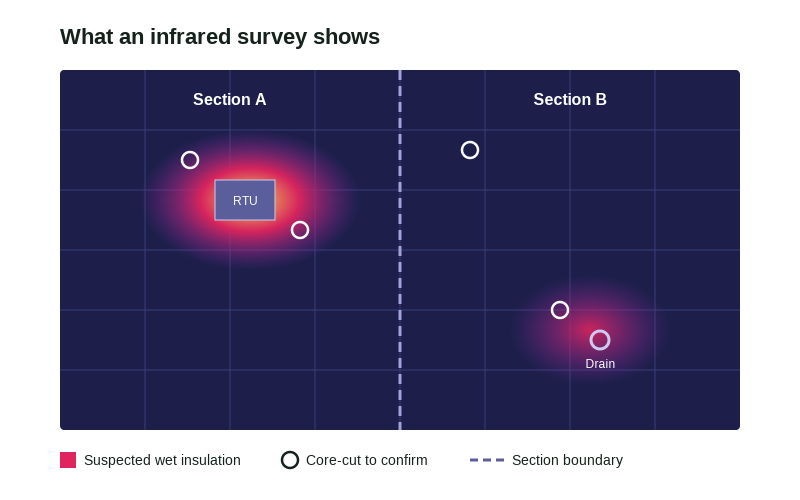
This is the big one. Once water reaches the insulation, it loses its R-value, adds weight, stops the membrane from bonding and can corrode a steel deck. Many roofs that fail years early got there slowly, through small openings that soaked the insulation underneath.
What extends a roof's life
Roofs fail at drains, seams, flashings and penetrations long before the field of the roof wears out. Regular attention to those details is what moves a roof toward the long end of its range:
- Get a roof inspection twice a year and after storms. NRCA recommends inspecting low-slope roofs at least twice a year and after severe weather. On the Front Range, that means spring before hail season and fall before freeze-thaw.
- Keep drains clear. Clear drains, scuppers and gutters so water doesn't pond or back up, especially before winter.
- Fix small things while they're small. Reseal and repair flashings at curbs, walls, vents and rooftop equipment, and repair seams and punctures early.
- Recoat on schedule. Spray foam and coated roofs need their coatings renewed before the surface underneath is exposed.
- Control rooftop traffic. Walkway pads to equipment, supervision of other trades and a look at the roof after they leave prevent many leaks.
- Find wet insulation early. An infrared moisture survey, confirmed with core cuts, shows you wet areas before they spread.
Our S.M.a.R.T. maintenance program puts this on a spring and fall schedule, and you get a written report after every visit.
Choices at installation
Some of a roof's life is decided the day it's built. A dense cover board protects your insulation from hail and foot traffic. A thicker membrane gives you more weathering material over the reinforcement.
Tapered insulation and crickets keep water moving to drains. Tested edge metal and the right attachment at corners and perimeters hold the roof down in wind. On a replacement, these are worth pricing as options.
System by system: what to watch
- TPO: seams and flashings, punctures from other trades, and a membrane that gets harder to weld as it ages. When it won't take a reliable weld anymore, that says something about its remaining life.
- EPDM: seam adhesive that dries out, lap edges that lift, and shrinkage that pulls the sheet away from walls and curbs. Ballast that's scoured away leaves bare rubber.
- Built-up: blisters, cracking like alligator skin on smooth surfaces, gravel scour at corners and drains, and base flashings that slump. Smooth-surfaced roofs need recoating to reach their full life.
- Metal: fasteners, washers and lap sealants, which fail long before the panels. Also watch for rust at cut edges and fastener holes.
- Spray foam: coating thickness, hail fractures, bird damage and water that gets into the foam.
Signs a roof is near the end
- Wet insulation across large areas, not just around one leak
- Seams failing across the whole roof rather than in one spot
- A membrane that's brittle, shrinking or won't hold a repair
- Surface cracking that has reached the felts on a built-up roof
- Foam eroding where the coating wore through
- Leaks returning in new places faster than they can be repaired
Age alone doesn't belong on this list. Plan by condition, not just age: a survey tells you how much life your roof has left, as a range with the reasoning behind it.
Repair, recover or replace?
When your roof is aging, four facts decide the answer:
- how much insulation is wet
- the condition of the seams and flashings
- how many roofs are already on the building
- how long you'll hold the building
Isolated damage over dry insulation usually means repair. A worn membrane over mostly dry insulation may let you recover instead, if codes allow another layer. Widespread wet insulation, two existing roofs or a damaged deck usually means a tear-off. A tear-off also brings your insulation up to the current energy code. Our commercial roofing section lays out each option, and commercial roof cost factors covers what drives the price.
A warranty doesn't tell you how long a roof will last, and a long one doesn't make up for poor maintenance. See commercial roof warranties explained for what each kind covers.
For HOA boards and reserve planning
A reserve study that replaces every roof at the same age will be wrong in both directions. Inspect each roof and record its system, age and condition. Then update the ratings every year or two and after any significant hailstorm. To see how roof data feeds the study, read our article on HOA roof reserve planning. Our reserve and capital planning page covers it too.
Want to know where your roof stands? We inspect commercial and association roofs across the Denver metro, from DTC office parks to condo communities in Centennial. See commercial roofing in Centennial. Request an inspection, and you'll get a written condition report. It gives an estimated remaining life and the repairs that would extend it.
Roof lifespan FAQs
Which commercial roof lasts the longest?
As planning figures, metal often lasts 30 years or more. EPDM and built-up last roughly 20–30 years, and TPO roughly 15–25 years or more. Spray foam can last more than 20 years with periodic recoating. In practice, how your roof was installed, how it drains, how much hail it takes and how it's maintained matter more than its label.
How do we know how much life our roof has left?
You need a condition inspection, plus an infrared moisture survey and core cuts on low-slope roofs. You get a remaining-life range with the reasoning behind it, plus the repairs that would extend it.
Does maintenance really make a roof last longer?
Yes. Most roofs fail at drains, seams, flashings and penetrations long before the field wears out. Catching those twice a year keeps water out of the insulation, which is what turns a repair into a re-roof.
Can hail shorten a roof's life even if it isn't leaking?
Yes. Hail can crush insulation and fracture cover boards under a membrane that looks fine. Those areas often leak months later, after freeze-thaw. Get an inspection after a significant storm. It finds the damage while the storm date is easy to document.
Should we replace a roof just because of its age?
No. Plan by condition. A well-maintained roof past its typical range may have years left, while a younger roof with wet insulation may not. A survey tells you which you have.