
Home / Resources / Roof warranties explained
Commercial roof warranties explained: workmanship to NDL
"Warranty" means three different things on a commercial roof, and a proposal doesn't always say which one you're getting. Here's who stands behind each kind, what it covers, what it leaves out and what it expects from you.
Three kinds of commercial roof warranty
Most commercial roof warranties fall into one of three groups. They come from different companies, cover different failures and ask different things of you. Know which one is in your proposal before you sign.
| Warranty | Who stands behind it | What it covers | What to watch |
|---|---|---|---|
| Workmanship | The roofing contractor | Installation errors: seams, flashings, terminations and details, for the term written in the proposal | Covers the installer's work, not material defects; only as good as the contractor behind it |
| Manufacturer material | The membrane or product manufacturer | Defects in the membrane or other products | Usually material only, with no labor; may be prorated; doesn't cover installation |
| NDL system | The manufacturer, through an approved applicator | Leaks from material or workmanship defects across the whole system, including labor, with no dollar limit | Requires an approved specification, a manufacturer inspection, registration and documented maintenance |
What does a workmanship warranty cover?
A workmanship warranty is your contractor's promise about its own installation. It says the seams, flashings, terminations and details it built were built right. If a weld was missed or a flashing was set wrong, this is the warranty that answers for it.
Two things decide what it's worth. The first is what the proposal says it covers and for how long, so read the term and the scope in writing. The second is whether the contractor will still be around to honor it.
A workmanship warranty from a crew that leaves town after storm season is hard to collect on. We give a workmanship warranty on replacements. As a local general contractor's roofing company, we answer for it directly.
What does a manufacturer roof warranty cover?
A material warranty covers defects in the membrane or other products the manufacturer made. It's useful, but narrower than many owners expect:
- It generally doesn't cover the labor to find and fix a problem.
- It doesn't cover installation errors. A bad seam is a workmanship problem, not a material defect.
- It may be prorated, so its value shrinks as the roof ages.
On its own, a material warranty protects you from a defective roll of membrane. It doesn't protect you from a leak.
How does an NDL system warranty work?
A no-dollar-limit (NDL) system warranty is the broadest coverage on a commercial roof. The manufacturer covers leaks caused by defects in its materials or in the installation, across the whole roof system. That includes the labor to repair them, up to the full cost of repair.
That breadth comes with conditions:
- An approved applicator. To qualify, your roof has to be installed by a contractor the manufacturer has approved. We're an approved applicator, so we can offer extended manufacturer warranties on commercial projects.
- A specified assembly. Your insulation, cover board, fasteners or adhesive, membrane and details have to match an approved specification. Longer warranty terms usually require thicker membranes, so choose thickness and warranty together.
- A manufacturer inspection. The manufacturer's own inspector checks the roof at completion. Any punch-list items get fixed before the warranty is issued.
- Registration and maintenance. The warranty is registered to the building, and the owner is expected to maintain the roof and keep records.
You can often upgrade an NDL warranty with hail coverage to a stated size or a higher wind speed rating. That usually takes a specific assembly.
On the Front Range, those upgrades are worth pricing. Hail season runs from mid-April to mid-August, and chinook winds hit the foothills. Our guides to hail-resistant commercial roofing and wind uplift ratings explain what's behind them.
What do warranties usually exclude?
Every warranty excludes something. Read the exclusions before you sign, not after a leak. Common ones:
- Hail above a stated size, unless you bought an enhanced assembly, and wind above the rated speed.
- Standing water. Many warranties exclude damage caused by ponding. See ponding water on flat roofs.
- Damage by others. Punctures and penetrations cut by HVAC, solar or telecom crews, and rooftop equipment changes made without the warranty holder.
- Lack of maintenance, such as clogged drains or ignored small repairs.
- Building problems, such as structural movement or interior moisture, that the roof didn't cause.
A warranty covers defects. Storm damage beyond the warranty's limits is a property insurance question. Read your policy alongside your warranty, and ask your agent how the two fit together.
How do warranties get voided?
The most common ways owners lose coverage are avoidable:
- Repairs made by a contractor the manufacturer hasn't authorized
- New penetrations cut by other trades for HVAC, solar or telecom work
- Leaks that go unreported, or are reported late
- Missing maintenance records when a claim is filed
Before anyone cuts into a warranted roof, call the roofer who holds the warranty. A new curb or pipe that's flashed by the wrong crew can put the whole warranty at risk. See leaks around rooftop HVAC curbs for why those details matter.
Roof maintenance tips that protect your warranty
Many manufacturer warranties make you responsible for maintaining the roof. Typical conditions:
- periodic inspections
- clear drains
- prompt written notice of leaks
- repairs by an authorized contractor
When you file a claim, the manufacturer may ask for proof that those conditions were met.
That proof is easiest to build as you go. Our S.M.a.R.T. maintenance program leaves you dated reports, photos and a repair log after every visit. That's the kind of documentation manufacturers ask for. Requirements differ by warranty, so send us yours and we'll match the program to it.
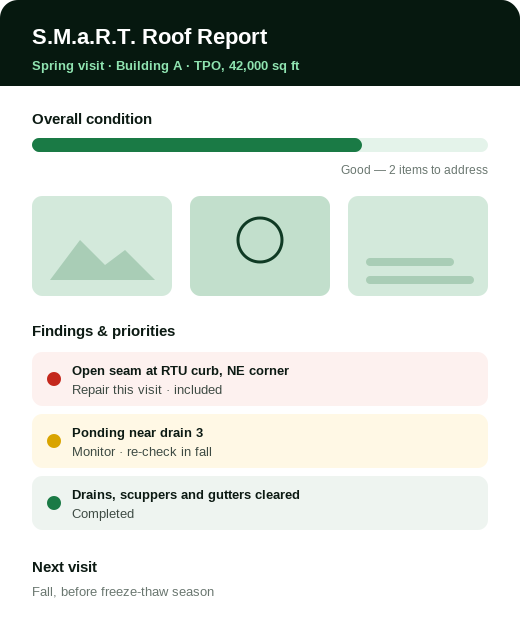
Keep the warranty document, registration, closeout photos and every maintenance report in one file. If the building changes managers or owners, hand that file over.
Questions to ask before you sign
Which warranties are included?
Workmanship, material, NDL system, or a combination, and who issues each one.
What's covered, and for how long?
Get the scope and term of each warranty in writing. Ask whether labor is covered and whether coverage is prorated.
What's excluded?
Read the hail, wind and ponding language, and ask what an upgrade would add.
What do you have to do?
Inspections, maintenance records, leak notice and who may make repairs.
What happens if you sell?
Ask whether the warranty can transfer to a new owner, and what that requires.
Longer terms and upgrades cost more, because they usually call for a fuller assembly. We price warranty options side by side so you can see what each adds; see commercial roof cost factors.
What about warranties on roofs you already have?
If your roof is still under a manufacturer warranty, an authorized contractor usually has to make repairs and report them to the manufacturer. Before we repair a roof another contractor installed, we check its warranty status and what it requires. That way a repair doesn't put your coverage at risk.
Don't know whether your roof is warranted? The building's closeout file or the manufacturer can usually tell you.
A warranty also isn't a lifespan. A long warranty on a neglected roof doesn't make it last; see how long commercial roofs last for what does. For how warranties differ by system, see types of commercial roofing systems and our commercial roofing section.
Comparing proposals, or not sure what your current warranty covers? Andrew Rickert leads our estimating team. He's a CPA with a Class-A general contractor license, and our credentials are on file.
We work across the Denver metro, including commercial roofing in Centennial and the Denver Tech Center. Request a consultation, and we'll walk you through what each warranty covers and excludes before you sign. We don't collect final payment until you sign off on the work.
Roof warranty FAQs
What is an NDL roof warranty?
A no-dollar-limit system warranty from the manufacturer. It covers leaks caused by material or workmanship defects across the whole roof system. Labor is included, up to the full cost of repair. You can only get one through an approved applicator, and it requires a manufacturer inspection and documented maintenance.
Does a manufacturer warranty cover hail?
Many exclude hail above a stated size unless you choose an enhanced assembly. You can often upgrade an NDL warranty with hail coverage to a stated size. Read the hail language before you sign.
Can our HVAC contractor work on a warranted roof?
They can service equipment. But the authorized roofer usually has to make or approve new penetrations, curbs and repairs to the roof itself. Call the warranty holder before anyone cuts into the roof.
Does maintenance affect our warranty?
Usually. Many manufacturer warranties require periodic inspections, clear drains, prompt notice of leaks and repairs by an authorized contractor. When you file a claim, they may ask for your records.
What warranty will Truman give us?
A workmanship warranty on replacements, and on qualifying commercial projects an extended manufacturer warranty as an approved applicator. Your proposal spells out which warranties apply, what they exclude and what maintenance they require.