
Home / Resources / Roofing scope of work
Writing a commercial roofing scope of work or RFP
A clear scope of work is the difference between bids you can compare and bids that each price a different roof. Here's what to put in a commercial roofing scope or RFP, section by section, and how to ask for prices back.
What a scope of work does
A scope of work describes the roof you want built and the conditions your contractor will work under. A request for proposal (RFP) wraps that scope in the bidding instructions. It says who's invited, when bids are due, how questions are handled and what format prices come back in. Together they make every bidder answer the same question.
Not every re-roof needs a full architect's specification. A new building, a public project or a complex roof often does. For many replacements on existing commercial and association buildings, you can write a clear scope yourself, built on good inspection data. If a roof consultant or architect is involved, the scope usually comes from their specification.
Before you write: gather existing conditions
A scope written without knowing what's on the roof leaves every bidder to guess, and they'll guess differently. Collect:
- A recent condition inspection with photos of each section and detail
- An infrared moisture survey and core-cut log showing layers, insulation, deck type and wet areas
- Roof plans or drawings, with roof areas by section
- Existing warranty documents and the leak and repair history
- Hazardous material test results for older built-up roofs and mastics, where testing is required
- A list of rooftop equipment, solar, telecom and lightning protection
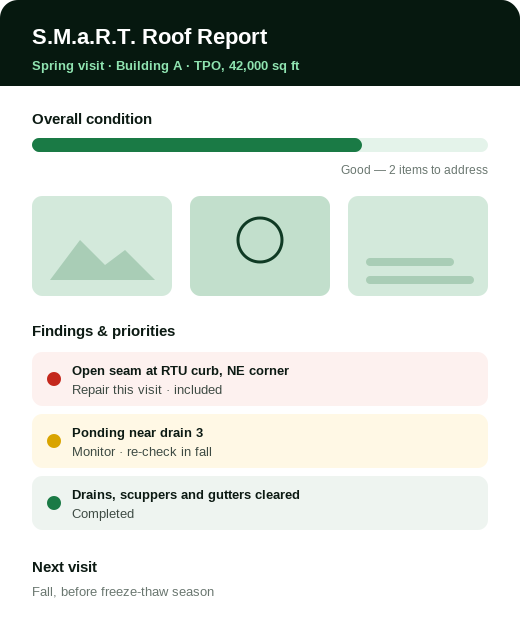
Some owners ask a roofer they trust to inspect the roof and supply this data. If you do, give every bidder the same documents. We write our inspection and IR survey reports for exactly this use.
The sections of a roofing scope of work
1. Project information
Give the property address, buildings and roof sections, approximate areas and occupancy. Name the owner's representative, and say how bidders get roof access.
2. Existing conditions
Describe what's on the roof now, from the inspection and cores. Include the system, number of layers, insulation, deck type and wet areas, plus known problem areas and any hazardous materials found. Say whether this information is for reference only and whether bidders should verify it.
3. Work included
- Removal: tear-off to the deck, or a recover with wet areas removed.
- Deck: inspection once exposed, and repair or replacement priced as a unit cost.
- Insulation: meet the current energy code on a tear-off. Include tapered insulation and crickets to the drains, and a cover board.
- Roof system: name the system, thickness and attachment, or describe the performance you need and how "or equal" products will be approved.
- Flashings and details: walls, curbs, penetrations, pitch pans, skylights and hatches.
- Sheet metal: edge metal, coping, counterflashing, gutters and downspouts, with edge metal tested for wind resistance.
- Drains: new drain rings or inserts, sumps, and any new or relocated drains and overflows.
- Rooftop equipment: who disconnects, lifts and resets units, raises curbs and supports piping and conduit.
- Walkway pads at equipment and service routes.
4. Code and performance requirements
Ask for a design that meets the local wind uplift, fire rating and energy code requirements. Say who is responsible for confirming them. In Denver, larger buildings may also fall under the Green Buildings Ordinance at roof replacement.
Along the Front Range, call out hail resistance too. Ask for a dense cover board, your membrane choice and any manufacturer hail coverage you want. Keep code language general and let the bidder confirm requirements with the building department. Our guides to wind uplift ratings and hail-resistant commercial roofing help here.
5. Warranty
State the warranty you expect. Include the installer's workmanship warranty, and say whether you want a manufacturer material warranty or a no-dollar-limit system warranty. Ask each bidder to state the term and the issuer. Have them list the exclusions, any hail limits and the maintenance the warranty requires.
6. Site logistics and occupants
List staging areas, crane locations, dumpster placement, work hours and quiet hours. Add parking, entrances that must stay open, air intakes near the work, and who sends tenant or resident notices. If a crane or dumpster needs the street, say who gets the right-of-way permit. See re-roofing an occupied building.
7. Safety and insurance
Require a written safety program and a fall-protection plan for the site. Ask for certificates of insurance with the additional insureds and endorsements your contracts need. Require workers' comp on every employee, and bonds if the project needs them.
8. Schedule and phasing
Give your preferred work window, the order of buildings or sections, and blackout dates for tenants. Require the roof to be watertight at the end of every day.
9. Submittals and quality control
Product data, the tapered insulation layout, sheet metal details and a sample of the warranty. The National Roofing Contractors Association recommends a pre-roofing conference before work starts, with the owner, contractor and often the manufacturer's representative. List the inspections you expect: permit inspections, manufacturer inspections and your own walk-throughs, plus daily photo updates.
10. Closeout
Ask for a final walk and punch list, the permit final and the manufacturer's inspection where required. Then you should get warranty documents and an updated roof plan for your records. Tie final payment to your sign-off.
The bid form: how you want prices back
The scope says what to build. The bid form decides whether you can compare the answers. Ask every bidder to fill in the same form:
| Bid form item | What to ask for |
|---|---|
| Base bid | Broken into line items: removal, insulation, system, flashings, sheet metal, equipment, permit |
| Unit prices | Deck replacement, extra wet insulation removal and other variable work, per area or per unit |
| Alternates | Options you want priced separately, such as an upgraded warranty or thicker membrane |
| Allowances | Fixed amounts you set for unknowns, so every bid carries the same number |
| Exclusions | Everything not included, in a list |
| Warranty | Type, term, issuer and exclusions |
| Schedule | Proposed start window and sequence |
| Qualifications | Licenses, insurance, bonding, approved-applicator status and references |
Once bids are in, our guide to comparing commercial roofing bids shows how to level them.
How do you run a roofing RFP?
- Send the same package to every bidder, with a bid due date.
- Hold a pre-bid site walk, or give each bidder the same access.
- Set a deadline for questions, and answer them in a written addendum to all bidders.
- Say how you'll evaluate bids: price, scope, warranty, schedule and qualifications, not price alone.
- Include or describe the contract form you intend to use.
Gaps that show up in most roofing scopes
These items fall between trades or between owner and contractor, and they're where change orders come from:
- Wood blocking and nailers at edges and curbs
- Curbs and equipment supports: who provides, sets and flashes them
- Drain bodies, which usually belong to plumbing, versus drain rings and flashing
- Where sheet metal ends and the wall system begins
- Temporary roofing, protection of the finished roof from other trades, and snow removal
General contractors will recognize these from new construction. Our guide to working with a roofing subcontractor covers them in more detail. For terms you meet in a specification, see our commercial roofing glossary.
What our own proposals include
When we answer a scope, we use the format we'd want to receive. That means a documented inspection with photos of every section and a line-item proposal with options side by side. The permit is included, and the warranty is spelled out, including whether the manufacturer warranty is material-only or no-dollar-limit and what it requires. Andrew Rickert, our operations manager, leads estimating. He's a CPA and Class-A licensed general contractor who has been with Truman since 2009.
General contractors can add us to a bid list or send plans and specs through our general contractor page. If you own or manage a building in Centennial, the Denver Tech Center or elsewhere in the metro, request an inspection. Then your scope starts with real data. See our commercial roof services, or commercial roofing in Denver and Centennial.
Scope of work FAQs
Do we need an architect or roof consultant to write the scope?
For new construction, public projects and complex roofs, often yes. For many replacements on existing buildings, a scope you write yourself is enough. Base it on a good inspection and moisture survey, and give every bidder the same document.
Should the scope name a specific membrane?
You can name a system, thickness and attachment, or describe the performance you need and allow equal products. Either works if you say how substitutions are approved and ask that they be priced separately.
What's the difference between a scope of work and an RFP?
The scope describes the work. The RFP adds the bidding rules: who's invited, the due date, the questions process, the bid form and how bids will be evaluated.
How detailed should our scope be?
Detailed enough that two bidders reading it would price the same roof. If a line could be read two ways, expect two different prices.
Can you inspect the roof before we write the scope?
Yes. A condition inspection gives you the existing-conditions data a scope starts from. Where the decision is expensive, we add an infrared survey and core cuts.