
Home / Resources / Comparing roofing bids
How to compare commercial roofing bids fairly
Three bids for the same roof can land far apart, and the lowest number on the page isn't always the lowest cost. Here's how to line commercial roofing bids up so you're comparing the same roof, the same warranty and the same risk.
Why do bids for the same roof come out so far apart?
Commercial roofing estimates for one building can differ widely. That's rarely because one contractor is honest and the others aren't. Usually each bidder priced a different roof.
One assumed a recover and another a full tear-off. One included tapered insulation and a cover board and another didn't. One priced deck repair and another left it out. One named a no-dollar-limit manufacturer warranty and another a material-only warranty.
A fair roofing cost comparison means making those differences visible, then deciding which roof you actually want. That takes a little work up front, and it's the most valuable work in the whole project.
Step 1: give every bidder the same starting point
Bids can only be compared if they answer the same question. Before you invite anyone:
- Share the same information. Roof plans, past reports, any infrared survey and core-cut log, warranty documents and known leak areas.
- Write down what you want. Tear-off or recover, the system if you have a preference, the warranty you expect, phasing and occupant constraints. Our guide to writing a roofing scope of work walks through it.
- Hold one site walk or give each bidder the same access.
- Answer questions in writing to everyone, so an answer you give one bidder doesn't become a private advantage.
- Set one due date and one proposal format if you can.
Step 2: check that each bid starts from a real inspection
A bid written from the parking lot or a satellite image is a guess. Look for evidence the bidder was on the roof and looked below the membrane:
- Photos of each section and of the details: curbs, penetrations, walls, edges and drains
- Core cuts showing how many roofs are on the building, the insulation and the deck
- Moisture data from an infrared survey or meter readings when the tear-off or recover decision is close
- Measurements taken from the roof or from reliable drawings, not estimated
If one bidder found wet insulation and priced its removal and another didn't look, those bids aren't comparable yet. Ask the second bidder to account for it.
Step 3: put the bids on one sheet
Lay every proposal out side by side, line by line. This side-by-side roofing bid comparison is called leveling the bids. Where a bidder is silent on an item, write "not stated" and ask. These are the lines that most often explain the gap:
| Line item | What to compare |
|---|---|
| Existing roof | Tear-off or recover, how many layers come off, and how wet insulation is handled |
| Deck repair | A unit price per area, an allowance, or nothing |
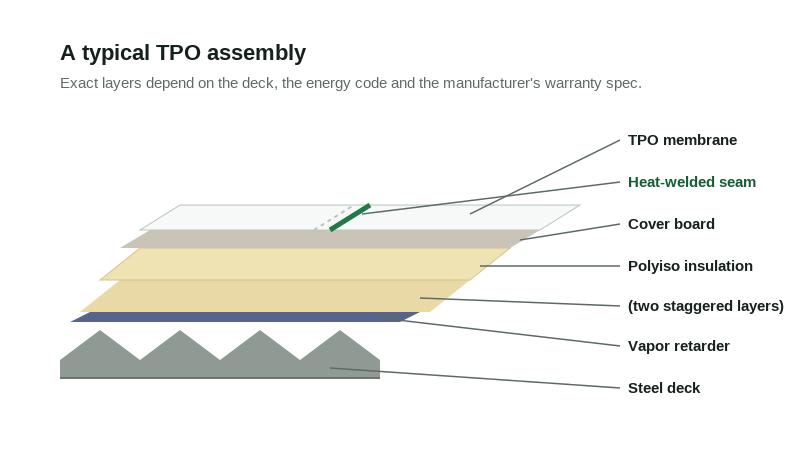
| Insulation | R-value and thickness per the energy code, tapered insulation, crickets and cover board |
| Membrane or system | System, thickness, attachment method and perimeter enhancements for wind |
| Flashings and details | Walls, curbs, penetrations, pitch pans and skylights |
| Sheet metal | Edge metal, coping, counterflashing, gutters and downspouts |
| Drains | Drain rings, sumps, new or relocated drains and overflows |
| Rooftop equipment | Who disconnects, lifts and resets units, and whether a crane is included |
| Permit and inspections | Included, and who pulls the permit and schedules inspections |
| Warranty | Workmanship warranty, plus the manufacturer warranty type and what it excludes |
| Schedule and phasing | Start window, sequencing and occupied-building measures |
| Exclusions | Everything the bidder says is not included |
| Payment terms | When payments are due, and when final payment is released |
For how each of these moves the total, see commercial roof cost factors.
Allowances, unit prices and alternates
- Allowances are placeholders for work nobody can measure yet. A low allowance makes a bid look cheaper and moves the risk to you.
- Unit prices set the rate you'll pay for variable work, such as deck replacement per area or extra insulation removal. Compare the rates, not just whether they exist.
- Alternates price options, such as a thicker membrane or an upgraded warranty. Make sure every bidder priced the same alternates.
Read the exclusions first
In many proposals, the exclusions list is the page that matters most. Common ones are deck repair, rooftop equipment work, permits, and asbestos testing and abatement. After-hours work, snow removal and sheet metal outside the roof area are often excluded too. An exclusion isn't wrong. It just has to be priced by someone before you can compare totals.
Step 4: compare the warranties, not the word "warranty"
"Warranty included" can mean three different things:
- Workmanship warranty from the installer, covering seams, flashings and details they built.
- Manufacturer material warranty, covering product defects but generally not the labor to find and fix a problem.
- Manufacturer system warranty, often called no-dollar-limit, covering materials and labor for covered leaks. You can only get it through approved applicators, and it usually requires a manufacturer inspection at completion.
For each one, ask the term and who issues it. Ask what it excludes, such as hail above a stated size, and what maintenance it requires of you.
Step 5: compare the contractors
The same scope built by two different crews is not the same roof. Ask each bidder for:
- The licenses required in your jurisdiction
- Certificates of insurance, with workers' comp on every employee
- Bonding, if your project requires bid or performance bonds
- Manufacturer approved-applicator status for the system they're proposing
- Their written safety program and fall-protection plan
- A local office, and who will manage the job day to day
- References on comparable buildings
For reference, Truman holds a Class-A general contractor license and is licensed for commercial roofing along the Front Range. We're an NRCA member. We carry $2M general liability, a $5M umbrella and workers' comp on every employee, with bonding capacity over $1M. See our credentials.
What are the red flags in a roofing bid?
- No sign anyone was on the roof
- A single lump sum with no line items
- "Per manufacturer specifications" without naming the system or thickness
- No mention of permits, insulation or sheet metal
- A warranty that isn't named or described
- Pressure to sign today, or an out-of-state crew that arrived after a storm. See storm chaser red flags.
- An offer to "take care of" your insurance deductible
Deductibles. Truman never pays, waives or rebates a deductible on any job. Colorado's roofing contractor law forbids it on residential property, and that can include condo and townhome buildings. See Colorado roofing law and deductibles.
What does a good bid look like?
We hold our own proposals to the standard we'd want to compare against:
A documented inspection
We walk the roof and photograph every section and detail. When the decision is expensive, we add core cuts or an infrared survey.
A line-item proposal
Options side by side, with each cost driver broken out, so you can see which decisions move the price.
Permit and warranty spelled out
The permit is included. The proposal says whether the manufacturer warranty is material-only or no-dollar-limit, what it excludes and what maintenance it requires. Our workmanship warranty is listed alongside it.
Estimating led by a CPA
Andrew Rickert, our operations manager, leads estimating. He's a CPA and Class-A licensed general contractor who has been with Truman since 2009. So the numbers are laid out the way your finance team or board reads them.
Payment tied to sign-off
You'll get a written contract, and we don't collect final payment until you sign off.
How should HOA boards compare bids?
Boards have to show owners the decision was fair. Use one bid package for every contractor, and keep the leveling sheet with the minutes. Disclose any conflicts of interest. Check whether your governing documents or management company set bidding rules. The lowest bid doesn't have to win, but the reason another one did should be written down. See our board guide.
We bid commercial and association roofs across the Denver metro. See commercial roofing in Centennial and our work in Aurora. For the full sequence from budget to closeout, see planning a commercial roof replacement. Request a line-item proposal and we'll start with the inspection.
Roofing bid FAQs
Should we just take the lowest bid?
Only after the bids are leveled. A low bid that leaves out deck repair, tapered insulation or equipment work often ends up costing more once change orders arrive.
How many bids should we get?
Enough to compare real options. More bids don't help if they aren't built on the same scope, so a clear scope matters more than the number of bidders.
Why did one bidder recommend an infrared survey and another didn't?
The tear-off or recover decision depends on how much insulation is wet. A visual inspection can't tell you that. When that decision is close, survey data makes the bids comparable.
What is a unit price, and why does it matter?
It's the rate for work that can't be measured until the old roof is off, such as deck replacement. Comparing unit prices tells you what a surprise will cost with each bidder.
Can a roofer cover our deductible to make the bid cheaper?
Truman never pays, waives or rebates a deductible on any job. Colorado's roofing contractor law forbids it on residential property, and that can include condo and townhome buildings.