
Home / Resources / Roof replacement timeline
Planning a commercial roof replacement in Denver
A commercial roof replacement goes smoothly when the decisions happen in the right order. Here are the phases, what you decide in each one, what your roofer should be doing, and what tends to move the schedule.
What are the phases of the roof replacement process?
Your replacement moves through the same eight phases anywhere in the Denver metro. That's true for a DTC office, a retail center, a warehouse or a group of condo buildings. Some phases overlap, and an insurance claim adds steps, but the order rarely changes.
Budget
Know the replacement is coming and get it into the capital plan or reserve study.
Assess
Inspect the roof and find out what's under the membrane before anyone picks a system.
Define the scope
Choose tear-off or recover, the system, insulation, drainage and warranty.
Bid and compare
Get line-item proposals built on the same scope.
Approve and contract
Owner or board approval, a written contract and a schedule.
Prepare
Permits, submittals, materials, staging, equipment coordination and occupant notices.
Build
Tear-off, deck repair, the new assembly and city inspections, watertight every night.
Close out
Final walk, manufacturer inspection where required, warranty documents and sign-off.
1. Budget: see it coming
The cheapest replacement is the one you planned for. If a re-roof surprises you, the warning signs were usually there. Look for leaks that keep coming back in the same areas and maintenance reports that flag the same aging details. A roof that's already on its second membrane is another sign.
- Use your maintenance reports. If you're on a maintenance program, the "plan for it" items are your early warning.
- Get condition data, not just an age. A roof surveyed by section tells you which areas need work first, and which have life left.
- Associations. Give that data to your reserve specialist so the reserve plan matches real conditions. If needed, phase buildings across budget years.
2. Assess: find out what's under the membrane
Before you can price a replacement, you need answers to three questions. How much of the insulation is wet? How many roofs are already on the building? What condition is the deck in? A visual inspection can't answer the first one.
- Condition inspection of every section, detail and drain, with photos.
- An infrared moisture survey to map wet insulation, verified with core cuts.
- Core cuts to show the layers, the insulation and the deck type.
- Hazardous material testing on older built-up roofs, mastics and flashing cements where required before demolition.
- A drone survey for large, tall or multi-building properties. See drone roof inspections.
The result decides the path: repair, restore, recover or replace. Our inspections and IR surveys are built for exactly this decision.
3. Define the scope
This is where most of the money gets decided. The main choices:
- Tear-off or recover. A recover only works over a dry roof and a deck that can carry the weight. It also has to stay within code limits on the number of roofs.
- System. TPO, EPDM, built-up, metal or spray foam, chosen for your slope, structure and use. Our guide to types of commercial roofing systems compares them.
- Insulation and energy code. A tear-off to the deck generally has to meet current insulation requirements. That can mean raising curbs, flashings and edge metal.
- Drainage. Tapered insulation and crickets to move water to the drains.
- Hail and wind. Cover board, membrane choice and perimeter attachment for Front Range hail and chinook winds. See hail-resistant commercial roofing.
- Warranty. Workmanship warranty, and whether you want a manufacturer material warranty or a no-dollar-limit system warranty.
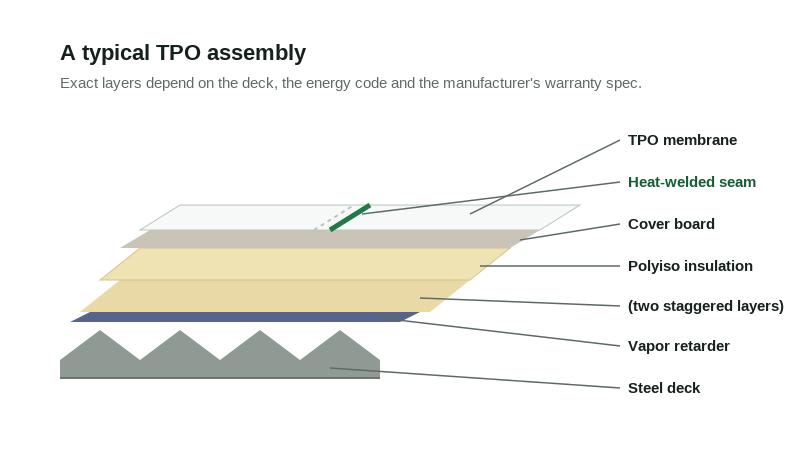
Each of these moves the price. Commercial roof cost factors explains how.
4. Bid and compare
Give every bidder the same information: the survey, the core-cut log, roof plans and your requirements, ideally in a written scope of work. Then compare proposals line by line, not by the total, as our guide to comparing commercial roofing bids explains. Bids most often differ on insulation thickness, tapered systems, deck repair pricing and sheet metal. Rooftop equipment lifts, permits and the included warranty differ too.
Our proposals put the options side by side, with line items, the schedule, the permit and the warranty spelled out. Andrew Rickert, our operations manager, leads estimating. He's a CPA and Class-A licensed general contractor, and he has been with Truman since 2009.
5. Approve and contract
- Approvals. You may need lender or asset-manager sign-off. An association needs a board decision under its governing documents. Build that meeting into your plan.
- A written contract. You'll get one from us, with the scope, schedule, warranty and payment terms.
- If it's an insurance claim. Settle the scope with the adjuster before construction starts, and ask your agent whether the policy covers code upgrades. See ordinance or law coverage.
6. Prepare: permits, materials and logistics
The work between signing and the first tear-off is invisible to most owners, and it's where well-run projects are won.
Permits in Denver and the suburbs
Re-roofs generally need a permit, and every jurisdiction runs its own process. For a commercial roof replacement, Denver permits come from Community Planning and Development. Larger Denver buildings may also need to meet the Green Buildings Ordinance when the roof is replaced.
In Centennial, the city's Building Division issues your permit and inspects the work. Some business parks with suburban mailing addresses sit outside city limits, where the county's building division handles permits. We confirm the jurisdiction, pull the permit and include it in your proposal.
Materials and submittals
Membranes, tapered insulation packages and custom sheet metal have lead times that change with the market. They can get longer after a major hailstorm. Before materials are released, we submit product data, the tapered layout and any manufacturer pre-job requirements for approval.
Staging and other trades
- Crane or hoist plans, dumpster locations, staging space and, where equipment sits in the street, a right-of-way permit.
- Mechanical contractors to disconnect and reset rooftop units, plus solar, lightning protection and telecom equipment.
- Notices for tenants or residents, and a plan for entrances, parking, noise and odors. See our guide to re-roofing an occupied building for the details.
How does the season affect timing?
Commercial roofs go on in every season along the Front Range, but each one changes the plan. Winter brings shorter days, snow clearing and cold-weather adhesives with temperature limits. Hail season, from mid-April to mid-August, brings afternoon storms. After a big one, demand spikes across the metro, and crews and materials can get tight. If you plan your replacement outside that post-storm rush, you keep more control over timing.
7. Build
- Mobilize and protect. Barricades, signage, protected entrances and a site-specific safety plan with fall protection.
- Tear off only what can be dried in. The roof is made watertight at the end of every day, not just at the end of each section.
- Deck repairs. Damaged deck is found once the old roof is off. A good proposal prices it as a unit cost, so the fix doesn't stop the job.
- New assembly. Insulation, cover board, membrane, flashings, edge metal and sheet metal.
- City inspections. Some cities, Centennial among them, inspect partway through as well as at the end.
- Communication. Daily photo updates and one point of contact who answers the phone.
For what the build phase looks like from the building's side, see what to expect during construction.
8. Close out
Closeout starts with a final walk with you and a punch list. Then come the manufacturer's inspection where the warranty requires it, the permit final, and warranty documents in your hands. We don't collect final payment until you sign off. Then your new roof goes onto a maintenance schedule. An infrared survey after installation gives you a dry baseline for the future.
What moves a roofing project timeline?
- Weather: rain, snow, wind and cold days for adhesives
- Deck damage or extra roof layers found during tear-off
- Material lead times and submittal approvals
- Permit review and inspection scheduling
- Crane dates and rooftop equipment coordination
- Occupant restrictions on hours, noise and access
- Board or owner decisions that arrive late
Your proposal should include a roof installation schedule, and your roofer should update it as the job moves.
We plan and build replacements across the metro. Learn about our commercial roofing in Denver and Centennial, or see all our commercial roofing services. When you're ready, request an assessment. We'll start with the inspection that shows what your replacement really needs.
Roof replacement planning FAQs
How long does a commercial roof replacement take?
It depends on roof size, how many layers come off, deck repairs, weather, access and material lead times. Your proposal includes a schedule, and we update it as the job moves.
When is the best time of year to replace a commercial roof in Denver?
Work can happen in any season with the right materials and planning. The bigger factor is planning ahead, so the project isn't competing with the demand that follows a major hailstorm.
Do we need a permit to replace our roof?
Re-roofs generally need one. It comes from Denver Community Planning and Development, the Centennial Building Division or whichever city or county your parcel is in. We confirm the jurisdiction, pull the permit and include it in the proposal.
Can our tenants or residents stay in the building?
Yes. Most commercial re-roofs happen on occupied buildings. We plan staging, noise, odors near air intakes and access around your occupants, and give you notices to send.
Can we replace roofs in phases?
On multi-building properties, yes. We rank roofs by condition and phase the work to match budgets or reserve funding, starting with the roofs in the worst shape.
What happens if the deck is damaged under the old roof?
It gets repaired once it's exposed. Our proposals include a unit price for deck replacement, so you know the cost of a surprise before the job starts.