
Home / Resources / Hail on built-up roofs
Hail damage on built-up and tar and gravel roofs
A built-up roof is built in layers, so hail rarely makes it leak right away. That's exactly what makes the damage easy to miss and hard to prove. Here's what hail does to gravel and smooth-surfaced built-up roofs, how inspectors separate it from age, and what your options are.
How a built-up roof takes a hailstone
A built-up roof (BUR) is several plies of reinforcing felt set in hot asphalt or cold adhesive, laid over insulation or the deck. On many older offices, schools, warehouses and condo buildings around the Denver metro, it's finished one of two ways:
- Gravel-surfaced, or tar and gravel: a heavy flood coat of bitumen with gravel embedded in it. The gravel shields the bitumen from sun and spreads the force of a hailstone.
- Smooth-surfaced: a bitumen glaze coat with a coating on top, often aluminum or reflective white. Some have a mineral-surfaced cap sheet instead. It's lighter and easier to inspect, but the surface takes hail directly.
Because the roof has several plies, a hailstone that fractures the top layer usually doesn't open a path all the way through. The roof keeps working, for a while. The fracture lets sun and water reach the layers below. Over a few seasons of UV at altitude and freeze-thaw, a crack in the surfacing becomes a crack in the plies. By the time the leak shows up inside, the storm may be a year old.
Older roofs may use coal tar pitch instead of asphalt. Coal tar isn't compatible with asphalt products. So any repair, hail or otherwise, starts with knowing which bitumen is on your roof. For more on the system, see our page on built-up roof repair and restoration.
Signs of hail on a gravel-surfaced roof
Gravel hides a lot. Hail damage on a tar and gravel roof often shows up as small changes to the surface rather than obvious marks:
- Displaced gravel in small, scattered spots across the field, leaving bare bitumen exposed.
- Gravel driven into the flood coat, sometimes with fractures in the bitumen beneath the stone.
- Fractured bitumen under impact points, which an inspector finds by brushing gravel away in test areas.
- Gravel washed into drains and scuppers, along with hail and debris, causing ponding after the storm.
- Damaged flashings: cracked or punctured base flashings at parapets and curbs, which take hail without any gravel protection.
- Dented gravel stops, edge metal, vents and pitch pans, which also show hail size and direction.
Signs of hail on smooth-surfaced and cap sheet roofs
Without gravel, hail strikes the surfacing directly. Look for:
- Fractured or spalled coating at impact points, often in a circular pattern, with bitumen showing through.
- Granule loss on cap sheets in round spots where the stone hit, sometimes with a fractured mat underneath.
- Broken blisters. Hail can rupture blisters that were intact and stable before the storm.
- Cracks through already-aged surfaces. Old, cracked or weathered bitumen is brittle. Hail can break through where a newer surface would have held.
Telling hail damage from age
This is the central question on almost every built-up roof claim. These roofs tend to be older, and many normal signs of age look a little like hail. Adjusters will ask what the storm did and what was already there, so a good inspection answers it honestly, section by section.
| Condition | Points toward hail | Points toward age or wear |
|---|---|---|
| Bare spots | Small, scattered spots across the field, with fractured bitumen beneath | Larger bare areas at corners, edges and drains, where wind and water scour gravel |
| Cracks | Round or star-shaped fractures at impact points | An alligator pattern of shrinkage cracks over a wide area of exposed bitumen |
| Blisters | Freshly ruptured blisters with impact marks | Intact blisters that have grown slowly between inspections |
| Granule loss | Round spots of loss with a bruised or fractured mat | General erosion, and wear along foot-traffic paths |
| Splits and ridges | Rarely hail by themselves | Long lines over insulation joints or deck joints, from movement and moisture |
| Soft metals | Fresh dents in edge metal, vents and gutters consistent with the storm's direction | Old dents, corrosion and paint wear |
Pre-storm records are the best tool here. Dated photos and reports from a spring inspection show what the roof looked like before hail season, which helps everyone agree on what changed. Our guide to documenting hail damage before the adjuster arrives covers what to collect.
Why a roof damage inspection has to go below the surface
The worst hail damage on a built-up roof is often under it. Think of fractured plies beneath intact-looking gravel, crushed insulation, or water that has worked into the insulation through a fracture. A visual walk can't find those.
- Test cuts through the plies show whether fractures go deeper than the surface, what the insulation is and whether it's wet. Each cut is photographed open and again after it's patched watertight.
- Moisture surveys. Infrared works best where a membrane sits directly on absorbent insulation, and heavy gravel can weaken the signal. On gravel roofs that aren't good infrared candidates, we rely on a grid of core cuts and moisture-meter readings instead. See our guide to infrared roof moisture surveys for how that decision is made.
- Flashings and penetrations. Base flashings, pitch pans, curbs and drains get a close look, since that's where most built-up roof leaks start.
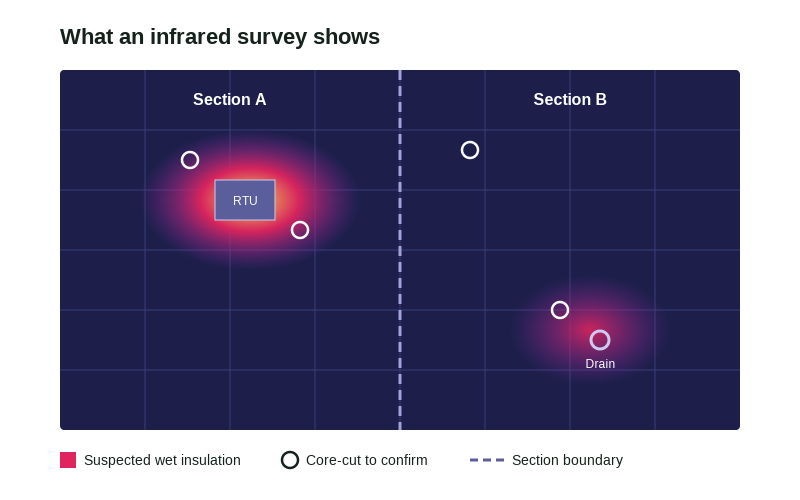
You should get a written report with photos for each building and roof section. It should include test cut results, moisture findings and an honest note of existing conditions.
Repair, restore or replace after hail
The answer depends on how deep the damage goes and how much of the insulation is still dry.
| Option | When it fits | What's involved |
|---|---|---|
| Targeted repair | Damage is limited to the surface or a few areas, and the insulation is dry | Re-ply fractured areas, rebuild damaged flashings, refill pitch pans, re-embed gravel in bare spots |
| Restoration | The plies are sound and the insulation is mostly dry, but the surfacing is broken or worn | Repair defects and small wet areas, then a new flood coat and gravel, or a compatible coating on a smooth roof |
| Recover | The roof is dry and code allows another layer | Remove loose gravel, prepare the surface and install a new system over it |
| Tear-off and replacement | Fractured plies across the roof, widespread wet insulation, or more than one existing roof | Remove to the deck, repair the deck, insulate to current code and install a new system |
Restoration can be a strong option on a gravel roof with good plies. What it can't do is fix wet insulation; coating or re-graveling over water traps it. On a replacement, owners can choose a new built-up roof or switch to TPO, EPDM or spray foam, depending on the structure and how the roof is used. Some older felts, flashing cements and mastics contain asbestos. Where Colorado rules require it, we test materials before scheduling a tear-off.
For what drives the price of each path, see commercial roof cost factors.
Colorado weather after the storm
Hail season along the Front Range runs from mid-April to mid-August. A built-up roof keeps paying for a storm long after it passes.
Exposed bitumen where gravel was knocked away oxidizes quickly at altitude. Freeze-thaw widens fractures in the surfacing every winter. Chinook winds move loose gravel and strip spots that hail has already thinned. Snow drifts against parapets and holds meltwater at base flashings, right where hail damage tends to concentrate. A roof that came through a June storm with no leaks can start leaking the following March.
Built-up roofs and the claim
Report the storm to your agent or carrier promptly. Most policies require timely notice. Built-up roofs are often older, so ask your agent how your policy values the roof. Is it replacement cost or actual cash value, and how does depreciation apply? To see how payments usually work, read our hail claim timeline.
We inspect and document the roof and, at your request, meet the adjuster on the roof. We open test cuts to show what's under the gravel, then prepare a detailed, line-item scope. If the carrier's estimate misses items, we document them for a supplement.
Coverage decisions are between you and your insurer. You negotiate the claim, with your agent or a licensed public adjuster. Policies vary, so read yours. Associations can find more in our guide to association hail claims.
Many built-up roofs sit next to newer sections and equipment, so check the rest of the roof too. See how hail affects EPDM rubber roofs, metal roofs and rooftop HVAC units, skylights and vents. We work on older built-up roofs across the metro, from commercial roofing in Denver to our home base in Centennial. Read about our inspections, or request a hail inspection and we'll reply within one business day. If water is already coming in, call (720) 296-0000 first.
Built-up roof hail damage FAQs
Can hail damage roofs with a gravel surface?
Yes. Gravel protects the bitumen and spreads the impact. But hail can still knock gravel loose and fracture the flood coat beneath it. It can also damage flashings, which have no gravel cover. The damage often doesn't leak right away.
How can you tell hail damage from an old roof's normal wear?
By the pattern and by what's underneath. Hail leaves scattered impact fractures; age leaves wide alligator cracking, scour at corners and drains, and slow-growing blisters. Test cuts and pre-storm records settle most questions.
Why do you need to cut into the roof?
Fractured plies and wet insulation are often hidden under gravel. A small test cut is the most direct way to see and photograph them. Each cut is patched watertight.
Will an infrared survey work on our gravel roof?
Sometimes. Heavy gravel can weaken the thermal signal. If your roof isn't a good candidate, we'll tell you before scheduling and use a grid of core cuts and moisture readings instead.
Can a hail-damaged built-up roof be restored instead of replaced?
Often, yes, if the plies are sound and the insulation is dry. That means repairs, then a new flood coat and gravel or a compatible coating. If much of your insulation is wet, restoration would trap the water. Then replacement is the honest answer.
Can you negotiate our claim?
No. We document the damage, meet your adjuster on the roof and prepare a detailed scope. You negotiate the claim, with your agent or a licensed public adjuster.