
Home / Resources / Hail on EPDM roofs
EPDM roof hail damage: how to spot it
EPDM rubber flexes under hail and usually bounces back. That's good for the roof and bad for anyone trying to see the damage. Here's where hail damage hides on an EPDM roof, how inspectors find it and how to tell it from ordinary aging.
Why hail damage hides on EPDM
EPDM is a synthetic rubber membrane, cured at the factory. It has covered warehouses, offices, churches and condo buildings around the Denver metro for decades. When it's newer and still elastic, a hailstone often dents it, and the rubber springs back. The surface can look untouched afterward.
The layers beneath don't spring back. When the membrane absorbs a hailstone, the insulation can crush. The insulation's facer or a cover board can fracture. On an adhered roof, the bond between the sheet and the board below can break. None of that shows from above. It shows months later. A soft spot flexes underfoot until the membrane cracks, or water finds its way into insulation that hail already damaged.
Age changes the picture. After years of high-altitude sun and Front Range freeze-thaw, EPDM gets stiffer, especially in cold weather. Older rubber is more likely to fracture under a hailstone instead of flexing. And on any EPDM roof, the field membrane usually outlasts the accessories: flashings and pipe boots crack and split before the sheet does.
What you can check without going on the roof
Leave the roof itself to a crew with fall protection. Wet rubber is slick, hail can hide edges and skylights, and extra foot traffic adds marks to the record. From the ground and inside, you can still gather useful evidence:
- Dented soft metals: gutters, downspouts, edge metal, vents, light fixtures and ground-mounted condensers. Photograph each with a wide shot and a close-up.
- Rooftop equipment visible from a distance, such as damaged condenser fins or cracked skylight domes.
- Interior water: ceiling stains, wet tiles and damp finishes on top floors, with the date each appeared.
- Debris and gravel at downspouts, which can show that ballast or debris moved during the storm.
Our checklist for the first 72 hours after a hailstorm covers safety, leaks and insurance notice.
What an inspector looks for on the membrane
Soft spots and crushed insulation
The most common hail damage on EPDM is underneath it. Inspectors press-test the field, walking in a pattern and feeling for areas that give or flex compared with the roof around them. Soft spots are marked, often with chalk, and photographed with a scale. A random scatter of soft spots across the exposed field, matching the storm's direction, points toward hail.
Fractures and punctures
On older or cold-stiffened EPDM, look for small circular, crescent or star-shaped cracks at impact points. Also look for pinholes where the rubber split. These can be hard to see on a dirty or chalky surface, so the inspector cleans small areas and examines suspect impacts up close.
Lost adhesion on adhered roofs
A fully adhered EPDM roof should feel solid. Where an impact broke the bond between the membrane and the board, the sheet can feel loose or hollow. That loose area can grow as wind and foot traffic work on it.
Seams and lap edges
Seams are where most EPDM roofs fail, hail or not. Older roofs spliced with liquid adhesive often have lap edges that were already drying out before the storm. Where impacts are heaviest, inspectors check seams for lifted edges and small openings called fishmouths. They note whether the problem is local to the storm or runs the length of the roof.
Flashings, pipe boots and penetrations
Flashings at walls and curbs, pipe boots and the seals around vents take hail without the support of insulation beneath them. Cracked boots and split flashings are some of the most common hail findings on EPDM roofs, and some of the most likely to leak. For the equipment itself, see our guide to hail damage to rooftop HVAC units, skylights and vents.
Ballasted roofs
On a ballasted roof, river rock or pavers sit loose over the membrane. Ballast shields EPDM well from hail and sun, but it also hides the surface. Water can travel under a loose-laid sheet before it shows up inside. Inspectors move ballast in test areas to examine the membrane. They pay close attention to corners and edges, where wind has scoured ballast away and left the rubber exposed.
Hail damage or age?
Adjusters will want to know which marks the storm made. A good inspection separates them honestly:
| What you see | Points toward hail | Points toward age or wear |
|---|---|---|
| Surface cracking | Isolated circular or star-shaped fractures at impact points | Fine crazing and chalking spread across the most sun-exposed areas |
| Soft spots | A scattered pattern across the field, in line with the storm | Larger soft areas around ponding, drains or old leaks, where insulation has been wet for a long time |
| Seam openings | Openings clustered where impacts are densest | Lifted lap edges and fishmouths along long runs of old adhesive seams |
| Flashing problems | Fresh splits and cracks at boots and flashings | Shrinkage that pulls the membrane away from walls and bridges the corner at curbs |
| Soft metals | Fresh dents on vents, edge metal and gutters consistent with the storm | Old dents, corrosion and paint wear |
Pre-storm records settle many of these questions. A spring inspection with dated photos shows what the roof looked like before hail season. See our guide to documenting hail damage before the adjuster arrives.
Why test cuts and moisture surveys matter on EPDM
So much EPDM hail damage sits below the membrane that a visual-only roof damage assessment can understate it. Small test cuts at suspect impacts show whether the insulation is crushed, the facer is fractured or the board is cracked. We photograph each cut open, then again after it's patched watertight. If water may have gotten in, an infrared moisture survey maps the wet insulation. Core cuts then confirm what the camera sees. On ballasted roofs, where infrared is less useful, a grid of cores and moisture readings does the same job.
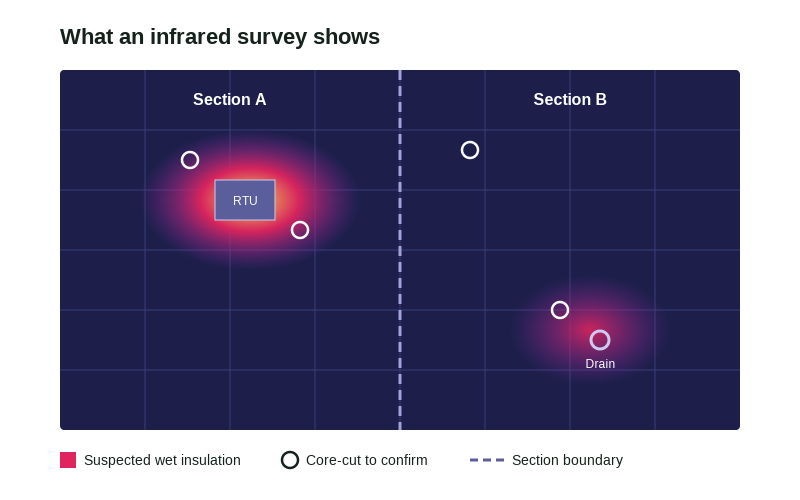
You should get a written report organized by building and roof section. It should include photos of marked impacts, test cut results, moisture findings and notes on existing conditions. To see how we put that report together, visit our roof inspections and infrared surveys page.
Don't wait for a leak
Hail season along the Front Range runs from mid-April to mid-August. EPDM damage from a summer storm often doesn't leak until winter. Freeze-thaw opens small fractures, snow drifts hold meltwater against flashings, and chinook winds work at loose edges and lifted laps. By the time you see a stain, the storm is months old and harder to tie to the damage. You may also be past your policy's notice deadline. A prompt inspection protects both the roof and the claim.
Hail damage repair: patch, recover or replace
- Repair: when damage is localized and the insulation is dry. We clean and prime punctures and fractures, then tape new EPDM over them. Split pipe boots and damaged flashings are replaced. Crushed insulation at isolated impacts is cut out and replaced.
- Recover: when the membrane is widely damaged or worn out but the insulation is mostly dry and there's only one roof. A cover board and a new TPO or EPDM membrane go over the old roof; ballast is removed first.
- Replace: when crushed or wet insulation is widespread, there are already two roofs, or the deck needs attention. A tear-off also brings insulation up to the current energy code.
A coating isn't a fix for hail damage. Over crushed or wet insulation, it hides the problem and traps the water. See our EPDM roof repair and replacement page for more on each option. If you're replacing, our TPO vs EPDM guide compares the two membranes.
The claim: your role and ours
Notify your agent or carrier promptly, since most policies require timely notice. Ask how your policy values the roof and how the wind and hail deductible works. Truman never pays, waives or rebates a deductible on any job. Colorado's roofing contractor law forbids it on residential property, and that can include condo and townhome buildings.
We inspect and document the roof and, at your request, meet the adjuster on the roof. We show the soft spots and test cuts, then prepare a detailed, line-item scope. If the carrier's estimate misses items, we document them for a supplement. Andrew Rickert, a CPA with a Class-A general contractor license, leads our estimating; meet him and the rest of our team.
Coverage decisions are between you and your insurer. You negotiate the claim, with your agent or a licensed public adjuster. Policies vary, so read yours. For the rest, see our hail claim timeline and our guide to association hail claims.
Other roofs on the same property may need a look too. See how hail affects built-up and gravel roofs and metal roofs. Whether you need commercial roofing in Centennial or Littleton, we can inspect your EPDM roof and handle the storm damage roofing work.
If water is coming in, call us first at (720) 296-0000 or report a leak. Otherwise, request an EPDM hail inspection and we'll reply within one business day.
EPDM hail damage FAQs
Can our EPDM roof have hail damage if there are no holes?
Yes. EPDM often rebounds after an impact while the insulation underneath is crushed or the facer is fractured. Those areas often leak months later. Press testing and test cuts find them.
Should our maintenance staff walk the roof to look for damage?
No. Leave the roof to a crew trained and equipped for fall protection. Staff can photograph damage from the ground and inside the building, which is very useful.
Does ballast protect an EPDM roof from hail?
Largely, yes, where the ballast is in place. Areas where wind has scoured ballast away are exposed, and flashings and penetrations aren't covered by ballast at all. The inspector moves ballast in test areas to check.
Why do you cut into the roof?
Because the damage is usually under the membrane. A small test cut shows crushed insulation or a fractured board directly, and it's patched watertight right away.
Can hail-damaged EPDM be patched?
If the damage is limited and the insulation is dry, yes: cleaned, primed and taped patches, new pipe boots and flashing repairs. If crushed or wet insulation is widespread, patches won't solve it.
Can you negotiate the claim for us?
No. We document the damage, meet your adjuster on the roof and prepare a detailed scope. You negotiate the claim, with your agent or a licensed public adjuster.