
Home / Resources / Hail reports and the date of loss
NOAA hail reports and your date of loss
Every hail claim starts with the same question: when did it happen? Public storm records from NOAA and the National Weather Service help you answer it with a date, a time and a place. Here's where to find them, how to read them and how they fit with what's on your roof.
General guidance, not legal or insurance advice. Your policy has its own rules on notice, deadlines and how storms are counted. Read it with your insurance agent.
What is the date of loss, and why does it matter?
The date of loss is the date of the storm that caused the damage you're claiming. It's one of the first things a carrier asks for, and a lot hangs on it:
- Which policy applies. Property policies generally cover losses during the policy period. The date ties the damage to a specific policy.
- Notice and deadlines. Your policy likely requires prompt notice and sets time limits for filing and completing repairs. Those clocks start at the loss.
- The deductible. Wind and hail deductibles often apply per occurrence. The number of storms involved can change what you pay.
- Separating this storm from others. The adjuster has to decide what this storm did, as opposed to age, wear or an earlier storm.
The date should be the one the evidence supports. Picking a date because it fits a policy, rather than because it's when the hail fell, can undermine the whole claim.
Why is the date often unclear on commercial roofs?
On a commercial or association roof, you may not notice hail the day it falls. Storms hit at night or over a weekend when nobody is in the building. Damage to a low-slope roof is hidden from the ground, and it may not leak until a winter of freeze-thaw opens what the hail cracked. Along the Front Range, a single season can bring several hail days to the same neighborhood. If you're a new property manager, you may not know what happened before you arrived.
That's where public weather records help. They don't prove your roof was damaged, but they show when and where hail was reported, and that narrows the search.
Where to find NOAA weather hail reports
Storm Prediction Center storm reports
NOAA's Storm Prediction Center publishes daily storm reports of hail, wind and tornadoes. The reports come from trained spotters, emergency managers, the public and other sources. Each day has a map and a list, and you can go back to earlier dates or download the reports as a spreadsheet file. Each hail report shows the time, the hail size, the county and coordinates. The location is described as a distance and direction from a town. The SPC labels all of these reports preliminary.
The National Weather Service office in Boulder
The National Weather Service Denver/Boulder office issues severe thunderstorm warnings for the Denver metro. It also collects local storm reports. For significant storms it writes event summaries, with maps and descriptions of where the worst hail fell.
NOAA's Storm Events Database
NOAA also compiles a reviewed record of severe weather, the Storm Events Database, searchable by county and date. It's published months after the storm, so it's more useful for an older loss than for last week's.
Commercial hail reports
Private weather-data companies sell address-specific hail reports estimated from radar. Many carriers and contractors use them. They fill gaps between spotter reports, but they're estimates. Treat them as one more piece of evidence, not the last word.
| Source | What it tells you | Limits |
|---|---|---|
| SPC storm reports | Date, time, hail size and location of individual reports | Preliminary; only where someone saw and reported hail |
| NWS Boulder warnings and local reports | Whether a severe storm was warned for your area, and local reports | A warning shows risk, not damage at your address |
| NWS event summaries | The path and impacts of major storms | Written only for significant events |
| Storm Events Database | A reviewed record by county and date | Published months later |
| Commercial radar hail reports | Estimated hail size at a specific address | Estimates; methods vary by vendor |
How to read an SPC hail report
Open the date and find your area
Use the map or list for the storm date and look for reports nearest your building. Note each report's distance and direction from your address.
Convert the time
Times are listed in UTC. During hail season, Mountain Daylight Time is six hours behind, so a report listed at 0130 happened at 7:30 p.m. local time. Because the SPC's report day runs from 6 a.m. to 6 a.m. Mountain Daylight Time, that evening storm still appears on the page for the date it happened.
Read the size
Hail size is listed in hundredths of an inch. Spotters often judge size by comparing hail to coins or balls, so treat it as an estimate. Look at the largest reports near you, not just the closest one.
Check the days around it
Look at the days before and after. If there were several hail days near the building, you'll want to know before anyone else asks.
Save what you found
Download the file or save a dated screenshot of the map and list for each candidate date. Note which reports are nearest your property.
Keep in mind what the reports can't show. Hail falls in narrow, uneven swaths, and a report exists only where someone saw hail and reported it. Office parks and industrial areas at night produce fewer reports than neighborhoods in the afternoon. No report near your building doesn't mean no hail, and a report a few miles away doesn't mean your roof was hit.
Building a date-of-loss record
Your strongest record combines public weather data with evidence from your own building and from the roof. Weather data gives you candidate dates. The rest shows which one hit your building.
Your own records
- Timestamped photos or video of hail, from staff, tenants or residents
- Security camera footage of the parking lot or roof during the storm
- Work orders and leak reports, with dates and locations
- Emails or calls from occupants about the storm or new leaks
- Local news coverage of the storm in your area
Evidence on the roof
A trained inspector looks at whether the damage fits the reported storm. Impact size and spacing should match the reported hail. Dents in soft metals such as vents, gutters and edge metal show size and direction.
Fresh hail often leaves bright spatter marks on weathered surfaces that fade over time, which helps separate a recent storm from an older one. Our guide to documenting hail damage on a commercial roof covers what the inspection should record.
Records from before the storm
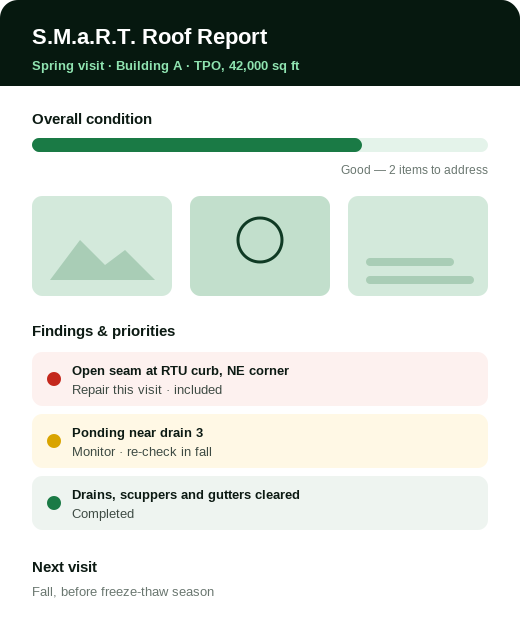
A dated inspection from before the season is one of the best tools you have. Say last spring's report shows a clean roof and today's shows impacts. Then the damage happened in between, and the weather records for that window do the rest. Our S.M.a.R.T. maintenance program leaves a written, photo-documented report after every visit for this reason.
When there were several storms
Hail season on the Front Range runs from roughly mid-April to mid-August. It's common for your property to sit near more than one hail report in a season. Don't default to the biggest storm on the list. Match each candidate date against your records and the roof evidence. Then let the inspector tell you whether the impacts look like one event or several. Sometimes size, density and freshness make that clear; sometimes they don't, and the report should say so.
Several dates can mean several claims and several deductibles, depending on your policy. Ask your agent how your policy treats more than one storm before you file.
Finding damage months later
It happens often on low-slope roofs: a leak in January turns out to be damage from a storm in June. Report it as soon as you know, since late notice invites questions. The public records are still there, because the SPC keeps years of daily reports. An inspection can still show whether the damage is consistent with a specific storm. For what happens next, see our hail claim timeline from storm to closeout.
How we help
When we inspect after a storm, we document impacts by building and roof section, with a scale in the photos. We note soft-metal damage and spatter. Our written report includes the relevant storm reports, so the weather and the roof evidence sit side by side. When you ask us to, we meet the adjuster on the roof and prepare a detailed scope.
You're the one who reports the date of loss to your insurer. We'll show you what the roof evidence supports. We don't negotiate the claim; that's your role, with your agent or a licensed public adjuster. If your community has many buildings, our guides to managing a hail claim across multiple buildings and association hail claims cover keeping dates and damage straight building by building. Our guide to public adjusters, appraisal and what a roofer can and cannot do explains who handles which part of the claim.
No deductible deals. Truman never pays, waives or rebates a deductible on any job. Colorado's roofing contractor law forbids it on residential property, which can include condo and townhome buildings.
Whether your building is in the Denver Tech Center or elsewhere in the metro, the first steps after a storm are the same. Our checklist for the first 72 hours after a hailstorm covers them. We're based near the Tech Center and inspect roofs across our service area, including commercial roofing in Centennial and Aurora. Request a hail damage inspection or call (720) 296-0000.
Hail report and date of loss FAQs
Can we look up hail storm reports by address?
The SPC and National Weather Service list reports by date and location, not by address. Find the reports nearest your building and note the distance. You can also buy address-specific reports, estimated from radar, from commercial weather-data companies.
There's no hail report near our building. Can we still file a claim?
Possibly. Reports exist only where someone saw and reported hail, so their absence doesn't prove there was none. Your own records and the roof evidence matter as much. Talk with your agent about how to proceed.
Why do the report times look wrong?
They're in UTC. Subtract six hours for Mountain Daylight Time during hail season, or seven in winter. An evening storm can show a time that looks like the early morning.
We found hail damage months after the storm. Is it too late?
Not necessarily, but report it promptly once you know. Policies set notice requirements and time limits, so ask your agent what applies. Then get the roof inspected so the damage can be tied to a specific storm.
Can you tell which storm damaged our roof?
Often, yes. An inspector can say whether the damage is consistent with a reported storm. Impact size, soft-metal dents, spatter and earlier inspection records all help. When the evidence can't separate two storms, our report says so.