
Home / Resources / Public adjusters and appraisal
Public adjusters, roof claim appraisal and what your roofer can do
A large roof claim can involve the carrier's adjuster, an engineer, a public adjuster, appraisers and your roofer. Knowing who does what keeps the claim moving and keeps everyone's work credible. Here's where a roofing contractor fits on a commercial or association claim, and where its role stops.
General guidance, not legal or insurance advice. Public adjuster contracts and appraisal rules vary from policy to policy. Read your policy. Before you hire a public adjuster or start appraisal, talk to your insurance agent or an attorney.
Who's who on a commercial roof claim
On a single building with a clear storm and an agreed scope, you may only deal with one adjuster. On a large loss, or a community with dozens of roofs, more people get involved. Each works for someone different:
| Role | Works for | What they do |
|---|---|---|
| Carrier's adjuster | The insurer | Investigates the loss, applies the policy and estimates the claim. Large losses often go to an independent adjuster the insurer hires. |
| Engineer or consultant | Usually the insurer | Gives opinions on cause and extent of damage on complex losses |
| Insurance agent or broker | Placed your policy | Explains your coverage, deductibles and deadlines, and helps with notice |
| Public adjuster | You | Prepares, presents and negotiates your claim with the insurer, for a fee |
| Attorney | You | Advises on coverage disputes, contracts, appraisal and litigation |
| Appraisers and umpire | Appointed under the policy's appraisal provision | Decide the amount of loss when you and the insurer disagree on it |
| Roofing contractor | You, under contract | Documents the roof, prepares the repair scope and does the work |
What does your roofing contractor do on a claim?
A roofer's value on a claim is technical: what's on the roof, what happened to it and what it takes to fix it. On commercial and association claims, that means:
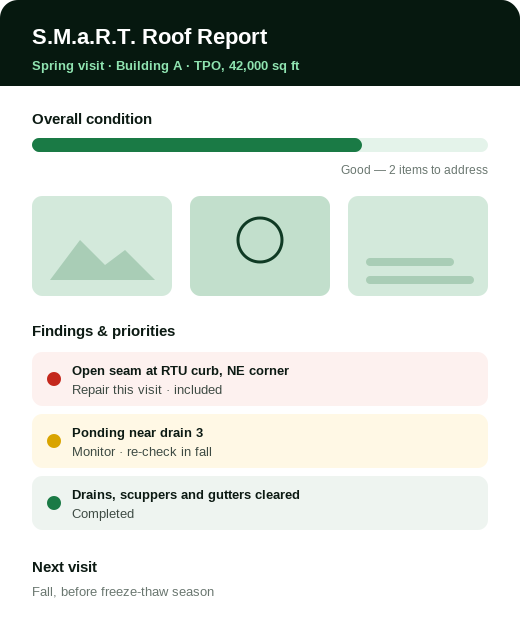
- Inspection and documentation. Photos tied to building numbers and roof sections, and test cuts to check insulation and cover board. Where water may have gotten in, an infrared moisture survey. Our guide to documenting hail damage covers what the record should include.
- A detailed scope. A line-item scope of the repair or replacement, with quantities, materials and code-required items listed separately.
- The adjuster meeting. When you ask us to, we meet the adjuster on the roof and walk the documented damage. We show the test cuts and explain how the roof is built.
- Supplements. When the carrier's estimate misses items, we document them with photos, measurements and the reason each is needed.
- Technical support for your team. We give our documentation and scope to whoever you choose: your manager, your public adjuster or your appraiser. We also answer their questions about the roof.
- The work itself. Under a written contract, with progress photos, hidden conditions documented and closeout records for the carrier.
What your roofing contractor doesn't do
- Negotiate your claim. That's your role, with your agent or a licensed public adjuster. In Colorado, negotiating a claim on someone else's behalf is a licensed role, and we don't act as your adjuster.
- Interpret your policy. Ask your agent or attorney whether something is covered, how a deductible applies or what an exclusion means.
- Promise an outcome. No contractor can promise that a claim will be approved or what it will pay.
- Shape the scope to the claim. The scope should describe what the roof needs, nothing more and nothing less.
- Touch the deductible. Truman never pays, waives or rebates a deductible on any job. Colorado's roofing contractor law forbids it on residential property, which can include condo and townhome buildings.
If a contractor offers to "handle the insurance" for you, ask exactly what that means. Documenting damage and meeting the adjuster is normal. Speaking for you on coverage or settlement isn't a roofer's job.
No deductible deals. An offer to "take care of the deductible" is a red flag.
When should you consider a public adjuster?
A public adjuster is a claims professional you hire to prepare, present and negotiate your claim. You might consider one when the loss is large or spread across many buildings. Owners and boards also hire one when the carrier's estimate and the documented damage are far apart, or when nobody on their side has the time or experience to manage the claim.
Before you hire one
- Check the license. Public adjusters in Colorado are licensed through the Colorado Division of Insurance. Ask for the license and confirm it.
- Ask about commercial experience. A multi-building association claim or a large low-slope roof is different from a smaller claim. Ask who will actually work on yours.
- Read the contract. You'll sign a written contract with a public adjuster, usually for a fee tied to the claim payment. Make sure you understand how the fee is calculated, what it applies to and how you can cancel the contract.
- Keep the roles independent. Be wary of arrangements that tie the public adjuster and the contractor together. Referral fees, or a contractor who comes as part of the package, are warning signs. Each should be working for you.
- For associations: follow your governing documents on who can sign, and have your attorney review the contract.
Working alongside a public adjuster
If you hire a public adjuster, the roles stay simple. The public adjuster represents you on the claim. We represent the roof. We share our documentation and scope, meet on the roof when asked and keep our scope tied to what we found.
Pick one point of contact on your side so the carrier, the public adjuster and the contractor all hear the same thing. Our guide to association hail claims covers how boards and managers keep a multi-building claim organized.
The insurance appraisal process, in general terms
Many property policies include an appraisal provision. It applies when you and the insurer agree there's a covered loss but disagree about the amount. In general terms, either side can ask for appraisal in writing, and each side selects an appraiser. The two appraisers select an umpire. The amount of loss is set when two of the three agree.
A few points hold for most policies, but check yours:
- It's usually about how much, not whether. Appraisal generally sets the amount of loss. Disputes over whether the policy covers the damage are generally handled differently.
- The policy sets the rules. Your policy language sets the deadlines, how appraisers are chosen, how costs are split and how binding the result is.
- It has costs. Each side typically pays its own appraiser, and the umpire's cost is often shared.
- It's a significant step. Read your policy and talk with your agent or an attorney before you demand appraisal or agree to one.
Where we fit: we can give your appraiser our documentation and scope. We can also explain how the roof is built and what the repair requires, and answer technical questions. Appraisers are generally expected to be independent of the outcome. So the contractor who would do the work isn't the right choice to serve as yours. The appraisal itself is between the appraisers and the umpire.
When the estimate and the roof don't match
Many disagreements on commercial roof claims are about scope, not coverage. Think edge metal, flashings, insulation, code items or rooftop equipment that has to be lifted. You can often resolve those with documentation before anyone talks about public adjusters or appraisal.
Compare line by line
Put the carrier's estimate next to the roofer's scope, building by building, and list the differences.
Document what's missing
Submit a supplement with photos, measurements and the reason for each item, including code-required work. See our guide to ordinance or law coverage and code upgrades.
Ask for a re-inspection
Request a second visit with your roofer on the roof, and ask the carrier to explain its position in writing.
Get advice on next steps
If the gap remains, talk with your agent or an attorney about your options. They may include hiring a public adjuster or using the policy's appraisal process.
Our hail claim timeline shows where these steps usually fall between the storm and closeout. If the date of the storm is in question, our guide to using NOAA hail reports to establish a date of loss explains how to support it. If your community has many buildings, also see our guide to managing a hail claim across multiple buildings.
Choosing a contractor for a claim
The contractor's documentation carries weight only if it's credible. Look for a local company with a track record, current licensing and insurance, and documentation the adjuster can follow.
Truman started as a general contractor in 2003 and has done roofing since 2009. We carry a Class-A general contractor license, NRCA membership, and general liability, workers' comp and umbrella coverage. See about Truman Roofing for our credentials. We're a local contractor, not a storm crew. You'll get a written contract from us, and we don't collect final payment until you sign off.
We document commercial and association roofs across the metro from our office near the Denver Tech Center. See our commercial roofing in Centennial page. Request an inspection and we'll document the roof for you, your agent and anyone else working on your claim, or call (720) 296-0000.
Public adjuster and appraisal FAQs
Can our roofer negotiate with the insurance company for us?
No. A roofer can document the damage, meet the adjuster on the roof and explain the scope. Negotiating the claim is your role, with your agent or a licensed public adjuster.
Do we need a public adjuster?
Not always. Many commercial roof claims settle with good documentation and a clear scope alone. The decision is yours; talk with your agent or attorney, especially on large, multi-building or disputed claims.
Will you work with our public adjuster?
Yes. We share our documentation and scope with whoever you choose and meet on the roof when asked. We also answer technical questions about the roof and the repair.
What is appraisal?
A process in many property policies for settling disagreements about the amount of a loss. In general terms, each side picks an appraiser, the appraisers pick an umpire and agreement by two of the three sets the amount. Your policy sets the details, so read it and talk with your agent or attorney first.
Can you serve as our appraiser?
No. Appraisers are generally expected to be independent of the outcome, and we'd be the contractor doing the work. We can give your appraiser our documentation and explain the roof.
Should our public adjuster pick our roofer?
Choose your contractor yourself. Be cautious of arrangements that tie the public adjuster and the contractor together, such as referral fees.