
Home / Resources / Wet roof insulation
Wet flat roof insulation: what to do about it
Fixing a leak stops new water from getting in. It doesn't remove the water already sitting in the insulation. Of all flat roof problems, wet insulation is the one that decides so many repair-or-replace calls on commercial and association roofs. Here's why it matters, how to find it and what to do about it.
How does water get into roof insulation, and why does it stay?
A low-slope roof is a sandwich. There's a deck at the bottom, rigid insulation and often a cover board in the middle, and a membrane on top. Water can get past the membrane at an open seam, a cracked pipe boot, a failed flashing or a hail fracture. When it does, it soaks into the boards below and gets trapped there. The membrane above won't let it evaporate, and the deck or vapor retarder below keeps it from draining out.
Trapped water also moves. It spreads sideways along board joints, through the cover board and along the flutes of a steel deck. So the wet area is usually much larger than the spot where water came in. The stain inside may show up rooms away from either.
Not all of it comes from above. Some buildings have a lot of indoor humidity, such as pools, commercial kitchens, laundries and some multifamily buildings. There, warm moist air can work up into the roof in winter and condense in the insulation where it meets the cold. That's a design problem. It's usually solved at replacement with an air and vapor retarder, not with a repair.
Why does wet insulation matter?
- It stops insulating. Wet boards lose much of their insulating value, so you pay more to heat and cool the floors below.
- It adds weight. Saturated insulation can hold a lot of water, and it never dries out on its own. That's weight the structure carries all year, on top of winter snow. See snow load on commercial roofs.
- It attacks the deck and fasteners. Moisture rusts steel decks and fastener plates and can rot wood decks.
- It weakens the roof's hold. Wet boards break down, facers come loose and adhesives lose their grip. A roof that's poorly attached at the perimeter is more exposed when chinook winds hit.
- It feeds blisters and ridges. On sunny afternoons the trapped water turns to vapor and pushes the membrane up. See our guide to roof blisters.
- It limits your options. A new roof generally can't go over wet insulation. A coating or new surfacing over it traps the water and shortens the life of the work.
How do different insulation types handle water?
Most commercial roofs in the Denver metro use rigid foam boards such as polyiso, often with a cover board on top. Older roofs may have fiberboard, perlite or lightweight insulating concrete. They don't all react to water the same way:
| Material | When it gets wet |
|---|---|
| Polyiso foam board | Absorbs water, loses insulating value and its facers can delaminate |
| Expanded or extruded polystyrene | More resistant to water, but can still hold moisture and lose some insulating value over time |
| Fiberboard and perlite | Soaks up water, softens and crumbles underfoot |
| Gypsum and other cover boards | Can soften and lose strength, which affects how well the membrane is held down |
| Lightweight insulating concrete | Holds moisture for a long time and needs a careful repair plan |
Core cuts show which materials are on your roof, how many layers there are and what the deck is. That's why they're part of every moisture survey we do.
What are the signs the insulation may be wet?
A membrane over saturated insulation often looks the same as one over dry insulation. These clues suggest it's time to look underneath:
- Leaks that keep coming back after repairs, or stains far from any obvious roof problem
- Soft, spongy or crunchy areas underfoot, noticed by a roofing crew
- Blisters, or ridges along insulation board joints
- Ponding where the roof surface has sunk over crushed or wet boards
- Rust stains or drips on the underside of a steel deck
- Damp or sagging ceiling tiles on the top floor, or a musty smell
- A hailstorm or a long-running leak in the roof's history
How do infrared surveys and core cuts find it?
You can't price a decision on a wet roof until you know how much of it is wet. Two methods do most of the work:
- Infrared moisture survey. After a sunny day, wet insulation holds heat longer than dry insulation. A thermal camera scanning the roof after sunset sees the wet areas as warm patches, often spreading out from a curb, drain or seam. Our guide to infrared roof moisture surveys explains how it works and the weather it needs.
- Core cuts. A warm spot isn't proof of water, so suspect areas are verified in daylight by cutting small samples down to the deck. Each core is logged and patched watertight the same visit. Cores in areas that read dry give a comparison.
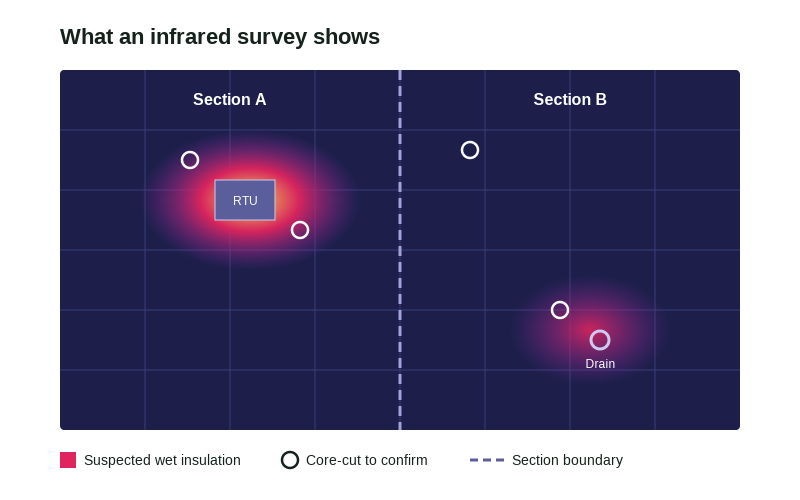
Infrared doesn't work well on some roofs, such as those with heavy ballast, gravel or certain reflective membranes. On those we rely on a grid of core cuts and moisture-meter readings instead. Either way, the result is a roof plan with each wet area marked and its approximate size, which turns a guess into a scope. See our roof inspections and infrared surveys.
What should you do about wet insulation?
Stop the water
Find the entry point and make a repair, temporary if needed, so the wet area stops growing. If water is coming inside now, call us first at (720) 296-0000 or report a leak.
Map the extent
An infrared survey and core cuts show where the insulation is wet and how far it reaches.
Decide on the scope
Limited wet areas can be cut out. If moisture is widespread, you're usually looking at replacement instead of repair.
Remove and replace wet sections
We open the membrane and remove the wet boards down to the deck. The deck is checked and repaired. New insulation and cover board go in, and the membrane is tied back in with matching materials.
Document and recheck
Photos, a marked roof plan and a follow-up check, so you know the repair held and the rest of the roof stayed dry.
Some fixes don't work. Patching the membrane and leaving the wet boards in place seals the water in. So does coating or re-surfacing over them, or recovering over them.
Repair or replace?
How much insulation is wet, and where, often decides it. Sometimes it's confined to a few areas around drains, curbs or one bad seam. Then cutting those out and repairing the cause can keep a roof with plenty of life in service.
When it's spread across most of the roof, replacing the wet sections piece by piece costs more than it saves. A full replacement down to the deck, with insulation brought up to the current energy code, is usually the honest answer. Our guide to when a commercial roof repair is enough walks through the rest of that decision. Recover vs tear-off explains why a recover is only an option over a dry roof.
If you're planning capital work for an association or a building, a survey also gives you a schedule. Fix the wet areas now, keep the dry sections in service, and plan replacement for the year it's actually due. Give the survey to your reserve specialist, and see HOA roof reserve planning.
Can hail cause hidden moisture?
Hail can crush insulation and fracture cover board under a membrane that still looks intact. Months later, after a winter of freeze-thaw, water gets in. By then the storm is harder to tie to the damage.
Did your building take hail between mid-April and mid-August? Get an inspection before winter, and a survey if there are signs of water. That keeps the record clean. Our guide to documenting hail damage explains what to record. Policies vary, so check yours with your agent.
How does flat roof maintenance keep insulation dry?
The cheapest wet insulation is the kind that never gets wet. Most of it starts at details that maintenance catches early: a dried-out pitch pan, a seam opened by freeze-thaw, a drain plugged with leaves. The NRCA recommends inspecting low-slope roofs at least twice a year and after severe weather. Our S.M.a.R.T. maintenance program follows that schedule, and you get a written report every visit. A survey right after a new roof is installed gives you a dry baseline to compare against later.
Your building might be an office in the Denver Tech Center or a condo community across the metro. Either way, the first step is the same: find out what's wet. Learn about our commercial roofing in Centennial and the systems in our commercial roofing section. Then request a moisture survey.
Wet roof insulation FAQs
Will wet insulation dry out on its own once the leak is fixed?
Generally not. The membrane above and the deck or vapor retarder below keep the water in. Saturated boards need to be removed and replaced.
Can we leave wet insulation in place if the roof isn't leaking anymore?
It keeps costing you. Wet boards don't insulate, they add weight, they rust the deck and fasteners, and the wet area can keep spreading. It also rules out a recover later.
How do you know how much of the roof is wet?
An infrared moisture survey maps the areas that look wet, and core cuts confirm them. Your report shows each wet area on a roof plan with its approximate size, so you can price the repair.
Can a new roof go over wet insulation?
No. Wet insulation has to come out before anything goes over it. Codes generally don't allow a recover over a wet roof. The rest of the roof also has to be dry and in good enough shape to support the new one.
Can you survey the roof in winter?
Infrared works best from late spring through early fall, on a clear, calm evening after a sunny day with a dry roof. Snow, frost and short winter days make it harder, so winter work usually relies more on core cuts.