
Home / Resources / Claim supplements
Roof insurance claim supplements: when they're legitimate
A roof insurance claim supplement asks the insurer to add work its first estimate missed. On commercial and association roofs it's a normal part of many claims, but it can be abused. Here's how to tell a documented supplement from a padded one.
General guidance, not legal or insurance advice. The insurer decides what your policy covers. Your insurance agent can explain your terms.
What is a roof claim supplement?
A supplement asks your carrier to add items its first estimate left out. These are the work, materials or quantities needed to repair the covered damage. It doesn't reopen the question of whether the storm caused damage. It works within an accepted claim to make the scope match the roof, and it applies to roof repair insurance claims as well as full replacements.
Supplements come at two points:
- Before the work, when the roofer's detailed scope shows items the first estimate missed, such as edge metal, flashings or insulation.
- During the work, when hidden conditions appear once the old roof is off, such as wet insulation or damaged decking.
Why do first estimates miss things on commercial roofs?
A commercial roof is an assembly of layers and details, and much of it can't be seen from the surface. A first estimate is often written from one visit, sometimes on a large or multi-building roof, before anyone has opened the roof up. Common reasons for gaps:
- Hidden layers: an extra roof underneath, wet insulation or fractured cover board
- Details that are easy to undercount: curbs, penetrations, drains and flashing heights
- Work around the roof: rooftop units that must be lifted, crane time, safety setup and disposal
- Code-required items that apply once a roof is replaced, such as insulation brought up to the current energy code
- Buildings or roof sections the adjuster didn't reach
None of that means the adjuster did a poor job. It means the first estimate is a starting point, and the record from the roof fills in the rest.
When is a supplement legitimate?
A legitimate supplement meets four tests. Each item is:
Tied to the covered damage
It's part of repairing what the storm damaged, not a separate problem.
Needed to do the work properly
Leaving it out would mean an incomplete repair, a code violation or a roof the manufacturer won't warrant.
Actually performed
It's work that will be done, or has been done, on your roof.
Documented
It comes with photos, measurements, its location and the reason it's needed.
| Usually legitimate | Not legitimate |
|---|---|
| Edge metal and flashings that have to be replaced to make the repair watertight | Upgrades the owner chose, such as a different system, beyond like kind and quality |
| Corrected quantities, measured on the roof | Quantities padded beyond what was measured |
| Wet insulation or damaged decking found and photographed during tear-off | Wear and aging that existed before the storm |
| Lifting rooftop units so the roof under them can be replaced | Items that won't actually be performed |
| Code-required work, where the policy's ordinance or law coverage applies | Extra scope added to make up for the deductible |
The last item deserves a word. Padding a claim so it absorbs the deductible is a deductible rebate by another name.
No deductible deals. Truman never pays, waives or rebates a deductible on any job. Colorado's roofing contractor law forbids it on residential property, and that can include condo and townhome buildings.
What should a well-documented supplement include?
- The line item, written the way your carrier's estimate writes it, with a quantity and unit.
- The location, by building and roof section, using the same numbering as the site map and the original report.
- The evidence: photos with a scale, measurements, test cut or core results, and infrared findings if you have them.
- The reason you need the item: the damage it repairs, or the code or manufacturer rule it meets. State it in terms the adjuster can check.
- For hidden conditions, photos taken as the condition was uncovered, before it was removed or covered up.
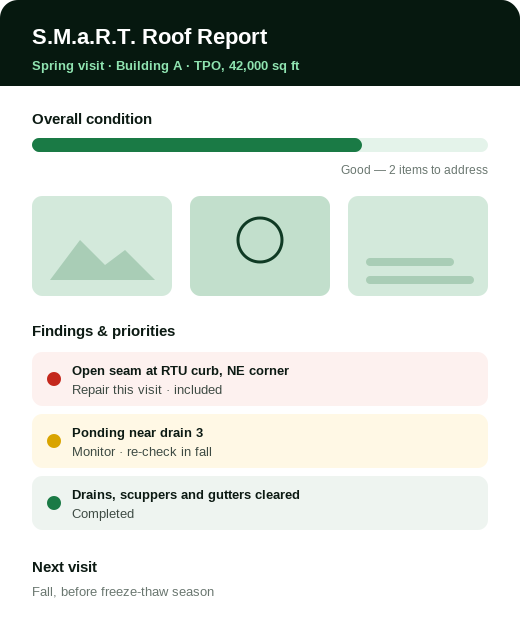
That's the same standard as the original documentation. For the details, see our guide to documenting hail damage before the adjuster arrives.
How does a supplement fit the insurance claim process?
Compare the estimate with the scope
Line by line and building by building. Our article on how to read a carrier's roof estimate shows what to look for.
Document each gap
Photos, measurements, location and reason for every missing item.
Send it with your knowledge
The supplement goes to the carrier as part of your claim file, and you see everything in it.
Re-inspection if needed
The adjuster may want to see the items. We'll meet them on the roof at your request.
A revised estimate
Your insurer decides what to add and sends you a revised estimate.
During the work
Hidden conditions are photographed as they're found, you're told, and they're documented before being covered up. Your contract should carry unit prices for hidden conditions so there's no surprise on price.
Watch your policy's deadlines. Some apply to finishing the work and recovering depreciation. Our hail claim timeline shows where supplements fall from storm to closeout. The association hail claims guide covers supplements on multi-building claims.
Supplements on association and multi-building claims
Community and campus claims add a layer. The same detail, such as a parapet coping or a curb flashing, may repeat on dozens of buildings. Miss it once and you may miss it many times over. A few practices keep it straight:
- Use one numbering system. Tie every supplement item to a building and roof section. Use the same site map as the original report and the carrier's estimate.
- Keep totals by building. Each building's supplement is then easy to check against that building's estimate, and easier to invoice when buildings finish in phases.
- Keep the board informed. Your manager can give the board a short summary: what was added, why, and how it changes the funding plan.
- Document hidden conditions by building. Wet insulation found on one building doesn't mean every building has it. Each is documented on its own.
If you manage several properties, our page for property managers shows how we report across a portfolio.
Red flags in a contractor's approach to supplements
- Promises about the payout, such as "we'll get you a new roof," before anyone has inspected it.
- Offers to handle the insurance company for you. Negotiating a claim is your role, with your agent or a licensed public adjuster, not a roofer's.
- Supplements you never see, or items you can't match to anything on your roof.
- A contract priced as "whatever insurance pays" with no written scope.
- Any mention of covering the deductible.
A local contractor with a history in the area and a reputation to keep is your best protection. Learn more about Truman Roofing: a local general contractor that has been roofing since 2009, not a storm crew.
How we handle supplements
Andrew Rickert leads our estimating. He's a CPA and holds a Class-A general contractor license; meet him on our team page. Every supplement item we document carries photos, measurements, a location and a reason. You see each one. Our invoice matches the approved scope and supplements, broken out by building for associations. We don't collect final payment until you sign off. We document damage, meet the adjuster on the roof and prepare a detailed scope; we don't negotiate your claim.
We're based in Centennial, near the Denver Tech Center. We work on commercial and association roofs across the metro, including commercial roofing in Littleton. If your carrier's estimate doesn't match your roof, request a scope review and we'll reply within one business day, or call (720) 296-0000.
Claim supplement FAQs
Are supplements normal on commercial roofing insurance claims?
Yes. Commercial roofs have hidden layers and many details. The first estimate is often written before anyone opens the roof. A documented supplement is a routine way to fix the scope.
Who approves a supplement?
The insurer. It reviews the photos and notes, may re-inspect your roof and decides what your policy adds to the estimate.
Can a supplement be submitted after work starts?
Yes, for hidden conditions found during the work, as long as they're documented when they're uncovered. Check your policy's deadlines with your agent.
Do supplements slow a claim down?
They add a review step, and the insurer may want to re-inspect. Clear documentation, tied to locations on the site map, keeps that step short. Items found before work starts are easier to resolve than items found late.
Does a supplement change our deductible?
No. Your policy sets the deductible, not the size of the estimate.
Will we see the supplement before it goes to the insurer?
Yes, when you work with us. You see every item, its photos and the reason it's needed. Nothing goes into your claim file without your knowledge.