
Home / Resources / The adjuster meeting
What your roofer does at the insurance adjuster meeting
The adjuster's visit is where the insurer sees your roof, and the estimate is written from what the adjuster sees. Here's what a commercial roofing contractor should do before, during and after that meeting. You'll also see what stays your call as the owner, manager or board.
General guidance, not legal or insurance advice. Every policy is different. Read yours with your insurance agent.
Why the meeting matters
On a commercial or association building, the roof insurance adjuster may have one visit to understand a large, complicated roof. Hail damage on low-slope roofs often hides under a membrane that looks fine. A community claim can cover dozens of buildings. Whatever the adjuster doesn't see, or doesn't understand, is unlikely to make it into the first estimate.
Having your roofer there doesn't change who decides coverage. It makes sure the person deciding has seen the whole roof, the hidden damage and how the roof is built. If your loss is large, the insurer may send a field adjuster, an independent adjuster, an engineer or all three. The meeting works the same way with each.
Who does what
| Role | At the meeting | Afterward |
|---|---|---|
| The adjuster | Inspects for the insurer, measures and photographs the damage, asks questions | Writes the estimate; the insurer makes the coverage decision under the policy |
| Your roofer | Shows the documented damage, explains the assembly and repair methods, measures alongside the adjuster | Compares the estimate with a line-item scope and documents missed items for a supplement |
| You (owner, manager or board) | Provides access, records and one point of contact | Decides how to proceed and handles coverage questions, with your agent or a licensed public adjuster |
| Your HVAC contractor | Documents damage to rooftop units, if you ask them to | Prices equipment repairs for the same claim |
Before the meeting
Most of the work happens before the adjuster arrives. When you ask us to attend, we prepare:
- A full inspection of every roof. We mark impacts and photograph them with a scale, by roof section. Our guide to documenting hail damage before the adjuster arrives lists what belongs in the record.
- A site map with a numbering system. Every building and roof section gets a number that goes on every photo and note. That way the adjuster, the manager and the board all see the same labels.
- Evidence of what's under the membrane. We make test cuts at typical impacts, then photograph them open and patch them watertight. Where water may have gotten in, we add an infrared moisture survey. Cut locations are marked so we can show them, or make a new cut together if the adjuster wants to see the layers firsthand.
- Pre-storm records. Your recent maintenance and inspection reports, repair history, installation date and any warranty. These answer the question every adjuster asks: is this damage new?
- Access and safety. Roof hatches, ladders, keys and gate codes arranged, and fall protection set up for everyone on the roof. A wet or snow-covered roof can't be inspected well, so we'll suggest rescheduling rather than rushing it.
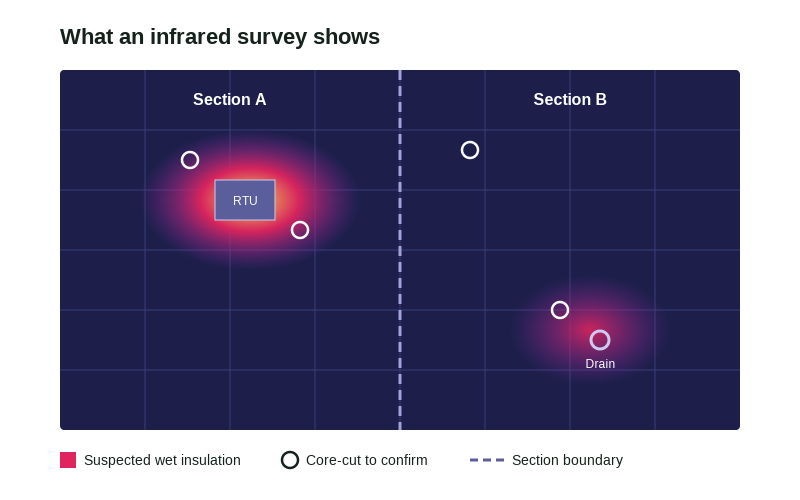
On your side, name one point of contact, usually the property or community manager. Then ask your HVAC contractor to document the rooftop units. Hail bends condenser fins and dents housings, and that damage belongs in the same claim.
On the roof with the adjuster
At the meeting, our job is to make the roof easy to understand. We:
- Walk every section in order, following the site map, so nothing gets skipped on a large or multi-building roof.
- Show the marked impacts and the soft metals. Dented edge metal, vents and gutters help show hail size and direction.
- Explain the assembly. Deck, insulation layers, cover board and surface, and why that matters for the repair. Crushed insulation can't be fixed with a patch on top. Codes also generally limit how many roofs can be stacked on a building, which can rule out a recover.
- Measure together. Roof areas, perimeter, flashing heights and counts of drains, curbs and penetrations. When we agree on quantities with the adjuster up there, you avoid arguments later.
- Point out existing conditions honestly. Old patches, ponding and worn seams belong in the conversation. When we separate old wear from storm damage, your whole file is easier to trust.
- Note disagreements calmly. If the adjuster sees something differently, we note it and ask how the insurer will resolve it, rather than arguing on the roof.
Before the adjuster leaves, ask when you'll get the estimate. Ask for it in writing, by building, with line items. That format makes the comparison in the next step possible.
What a roofer shouldn't do
- Negotiate your claim. We discuss the roof, the damage and the repair scope. You handle coverage questions and negotiation, with your agent or a licensed public adjuster. We aren't public adjusters and don't act as one.
- Promise what the insurer will pay. The insurer makes its own determination under your policy.
- Pressure the adjuster. A clear record and a calm walk-through do more than an argument.
- Touch your deductible. See the note below.
No deductible deals. Truman never pays, waives or rebates an insurance deductible on any job. Colorado's roofing contractor law forbids it on residential property, which can include condo and townhome buildings. A contractor who offers to "take care of the deductible" is a red flag.
After the meeting
The adjuster's estimate usually arrives some time after the visit. When it does, we compare it line by line with our own detailed scope. Our article on how to read a carrier's roof estimate explains what's on each page.
- Missed items. Commercial roof estimates often miss edge metal, flashings, insulation, permits and code-required work. Rooftop equipment that has to be lifted is another common gap. We document each one with photos, measurements and the reason it's needed. See supplements on commercial roof claims for how that works.
- Coverage disagreements. What if the insurer and your documentation still don't match? You may be able to ask for a re-inspection or use the policy's dispute process, such as appraisal. Your agent or attorney can explain the options.
- Next steps. Once you agree on the scope, we can sign the contract, pull permits and set the schedule. Our hail claim timeline walks through the rest of the insurance claim process.
Why the estimator matters
The adjuster meeting is an estimating conversation. Andrew Rickert, our Operations Manager, leads our estimating. He's a CPA with a Class-A general contractor license and has been with Truman since 2009. Our proposals are line-itemed, which makes them easy to compare with a carrier's estimate. Learn more about our team and about Truman Roofing. We're a local general contractor roofing company and an NRCA member, not a storm crew.
If you're on an association board, our association hail claims guide covers master policies, percentage deductibles and how payments flow across many buildings.
A checklist for managers and boards
Get the roof documented first
A full inspection and photo report before the adjuster's visit, organized by building and roof section.
Confirm the date and attendees
Your manager, your roofer, your HVAC contractor if possible, and the adjuster or engineer.
Arrange access
Hatches, ladders, keys, gate codes and any interior spaces where leaks were reported.
Bring the records
Site map, photo report, leak log, maintenance reports, policy and claim numbers.
Ask for the estimate in writing
By building, with line items, and a date to expect it.
Keep one voice
One point of contact with the carrier, so communication doesn't fork.
We're based in Centennial. We meet adjusters on commercial and association roofs across the Denver metro, from DTC office parks to HOA communities. See our commercial roofing in Greenwood Village. If an adjuster's visit is coming up, request an inspection and we'll reply within one business day, or call (720) 296-0000.
Adjuster meeting FAQs
Do we need our roofer at the adjuster meeting?
It isn't required, but it helps. If your roofer has already documented the roof, they can show hidden damage, explain the assembly and measure with the adjuster. That makes a complete first estimate more likely.
Can our roofer talk to the adjuster about the claim?
We talk about the roof: the damage, how it's built and what the repair involves. Coverage decisions and negotiating the claim stay with you, your agent or a licensed public adjuster.
What if the adjuster disagrees with what we found?
Write down the disagreement and ask how the insurer will resolve it. Then send any added documentation you have. You may be able to ask for a re-inspection or use the policy's dispute process. Your agent or attorney can explain your options.
Should the inspection happen before the adjuster's visit?
Yes. When you document the roof first, the damage is marked and the test cuts are ready to show. The site map is also done before the adjuster arrives.
Should our HVAC contractor be there?
If possible. Hail often damages rooftop units. When your equipment contractor documents that damage, you can put it in the same claim.