
Home / Resources / Roof insulation and R-values
Commercial roof insulation and R-values in Denver
When your commercial roof is replaced, the insulation under it usually has to meet today's energy code. That may not be the code your building was built to. Here's what R-values mean and what codes along the Front Range generally require. You'll also see how added insulation changes the rest of the roof.
What does roof insulation R-value mean?
R-value measures how well a material resists heat flow. The higher the number, the less heat moves through it. On a low-slope commercial roof, the R-value that counts is the total of the insulation layers above the deck. Codes call this continuous insulation. It runs unbroken across the whole roof rather than sitting between framing.
The number on the label isn't always what you get. Real-world performance drops when:
- Insulation gets wet. Wet insulation loses much of its value, adds weight and can corrode a steel deck. It's one of the most common hidden problems on older roofs.
- Joints line up. Gaps between boards that run straight through the assembly let heat escape. Two or more layers with staggered joints close those paths.
- Fasteners pass through. Every metal fastener through the insulation is a small heat path. Adhering the top layer instead of fastening through it cuts those paths.
- It's cold outside. Polyiso, the most common roof insulation, performs below its rated value in very cold weather. That matters on a Colorado winter night.
What goes into a commercial roof assembly?
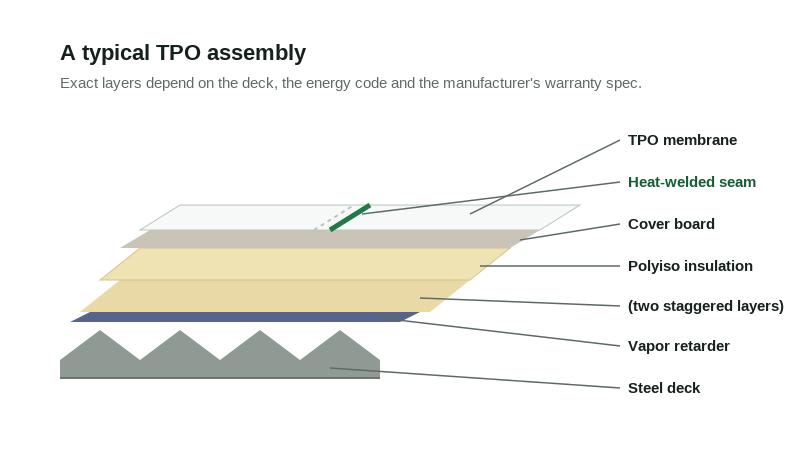
- Polyiso (polyisocyanurate) boards are the standard on most low-slope roofs. They're light, high in R-value for their thickness and compatible with most membranes.
- Expanded and extruded polystyrene show up in some assemblies and some recovers. Not every membrane can sit directly on them.
- Mineral wool is used where fire performance or sound control matters.
- Tapered insulation is cut to build slope toward drains, so the roof drains instead of ponding. See tapered insulation and roof slope.
- Cover boards sit on top to protect the insulation from hail and foot traffic. They add little R-value, but they protect the insulation that provides it.
- Spray polyurethane foam is insulation and roof in one, sprayed in place and coated. See spray foam roofing.
What does the energy code generally require?
The Denver metro is in IECC climate zone 5B. When your roof is replaced rather than recovered, the energy code generally requires current insulation levels. This is the rule for insulation that sits entirely above the deck. Under recent IECC editions, that's roughly R-30 of continuous insulation, which means several inches of polyiso. Many older buildings have far less.
A few things make the answer project-specific:
- Each city and county adopts its own code. Centennial, Denver, Aurora and the rest of the Front Range each pick a code edition. Each also adds its own amendments, on its own schedule.
- Replacement and recover can be treated differently. Energy codes often treat a recover over existing insulation differently from a tear-off to the deck. Your building department decides how your project is classified.
- Denver adds green building rules. Larger buildings in Denver can face added requirements at roof replacement, such as a cool roof or other options.
- Re-roofs generally need a permit. Check with your city's building division, or let us confirm what applies before we price the work.
We check your jurisdiction's current requirements on every project. The insulation requirement often moves your budget more than the membrane does.
How does tapered insulation count?
A tapered system is thin at the drains and thicker at the high points, so its R-value varies across the roof. How that counts toward the code depends on the code edition and the jurisdiction. It's worked out during design, not on the roof. Getting it right affects how much flat insulation goes under the taper.
What does more insulation change on the roof?
Bringing an older roof up to current levels can raise your roof surface by several inches. Everything that meets the roof has to rise with it:
| Item | Why it changes | What's usually involved |
|---|---|---|
| Curbs and rooftop units | Flashings need enough height above the new roof surface | Raising curbs, which can mean disconnecting and lifting units |
| Walls and parapets | Base flashings have to extend above the thicker roof | New flashing heights; sometimes raising coping or adding blocking |
| Door thresholds | Roof access doors can end up below the roof surface | Stepping insulation down at the door, or raising the threshold |
| Roof edges | Edge metal has to cap the new, thicker assembly | New wood blocking and tested edge metal |
| Drains and scuppers | Openings have to stay at the low point of the new surface | Drain extensions, reset scuppers and tapered sumps |
None of this is a surprise if it's scoped from the start. It's one of the main reasons two replacement bids for the same roof can differ widely. See commercial roof cost factors for the rest.
How do you get the R-value you pay for?
- Two or more layers with staggered joints, so no gap runs straight through.
- An adhered top layer and cover board where the design allows, to cut fastener heat paths.
- A vapor retarder where it's needed, such as over pools and commercial kitchens. It keeps warm, humid indoor air from condensing inside the roof in winter.
- Dry insulation, every day. We only open as much roof as we can make watertight by the end of the day. That way, new insulation never sits out in a storm.
- A cover board to keep hail and foot traffic from crushing the insulation, which also protects its R-value.
Energy-efficient roofing: insulation and a reflective surface together
Two things make a commercial roof energy-efficient, and they do different jobs. Insulation slows heat flow in both directions and does most of the work on winter heating. A reflective white surface, such as TPO, cuts summer heat gain from the strong sun at altitude.
Most air-conditioned offices, medical buildings and apartments along the Front Range benefit from both. We look at them together when we recommend an assembly. See energy efficiency from a roof replacement and white vs black roofs in Colorado.
Is your existing insulation still working?
On an older roof, the bigger question is often not how much insulation is there but whether it's dry. Leaks that have been patched for years may have soaked large areas.
An infrared moisture survey, confirmed with core cuts, maps the wet areas. It shows you what's actually under the membrane. Those findings decide whether you can recover, and how much insulation a tear-off has to replace. Our guide to roof recover vs tear-off walks through the choice.
What Colorado details matter?
- Snow and ice. A well-insulated roof loses less heat, so less snow melts from below and refreezes at cold edges and drains.
- Freeze-thaw and condensation. Cold nights and humid interiors can drive condensation into a roof without the right vapor control.
- Chinook winds. Thicker assemblies still have to meet the wind uplift design, with fasteners or adhesive placed for the building's exposure.
- Hail, mid-April to mid-August. Hail crushes insulation under an intact-looking membrane. A dense cover board protects the insulation you just paid for.
Planning a replacement, or want to cut energy costs on an existing building? We assess roofs across our service area, including commercial roofing in Centennial and Denver. We install TPO, EPDM, built-up, metal and spray foam systems to the insulation level your jurisdiction requires. Request an assessment. We'll confirm the code requirement and show you how it affects your scope.
Roof insulation FAQs
Do we have to add insulation when we replace our roof?
Usually, when the roof is removed down to the deck. Along the Front Range, your city or county generally requires current energy code insulation levels on a replacement. Recovers can be treated differently, and your building department decides.
What R-value does a Denver-area commercial roof need?
In climate zone 5B, recent IECC editions generally call for roughly R-30 of continuous insulation. That applies to a replaced roof with insulation entirely above the deck. Your city's adopted code and amendments set the exact requirement.
Can we reuse the existing insulation?
Sometimes, if it's dry and sound. Wet insulation has to come out. An infrared survey and core cuts show which boards can stay.
Will more insulation lower our energy bills?
Usually, especially on heating. How much depends on what you have now, the building's use and its heating and cooling systems. A reflective roof surface helps separately with summer cooling.
Why does added insulation raise the cost so much?
Beyond the boards themselves, a thicker roof can mean raising curbs and rooftop units, new flashing heights, new edge metal and drain adjustments. We scope those from the start so they're in the price.