
Home / Resources / Cover boards and hail
Roof cover boards and why they matter for hail
The cover board is a thin layer you never see, between the insulation and the membrane. On a single-ply roof in Colorado, it often decides whether a hailstorm leaves you with a few repairs or a crushed roof. Here's what it does, the common types and when it's worth adding.
What is a roof cover board?
A cover board is a thin, dense board. It goes over the rigid insulation and under the membrane of a low-slope roof. From the deck up, these are the roofing system components on a typical Front Range single-ply roof:
- Deck: steel, wood, concrete or, on older buildings, gypsum.
- Vapor retarder, where humid interior air could condense inside the roof in winter.
- Insulation: usually polyiso, in two or more layers with staggered joints, sometimes tapered to build slope.
- Cover board: the dense layer that protects the insulation.
- Membrane, flashings and edge metal: TPO or EPDM, with flashings at walls and curbs and tested edge metal at the perimeter.
The insulation keeps heat in and out, but it's fairly soft. The cover board's job is to protect it.
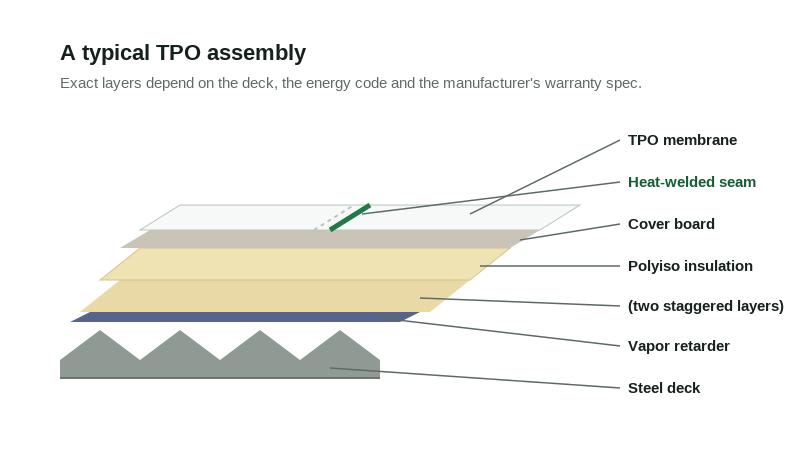
How hail damages a single-ply roof
Hail rarely punches straight through a single-ply membrane. More often it crushes the insulation or fractures its facer underneath, leaving a soft spot that flexes underfoot. The membrane over it looks fine at first. Then foot traffic, thermal movement and freeze-thaw work that spot until the membrane cracks. That's often months after the storm, when the date of loss is harder to tie to it.
A dense cover board spreads the impact over a wider area, so the insulation underneath isn't crushed. It also gives the membrane a firm surface to bear against. That's why, on single-ply roofs, the cover board is one of the most important hail choices you'll make. It matters as much as the membrane label, and sometimes more: a thick membrane over soft insulation is not the answer on its own.
Front Range hail season runs from mid-April to mid-August, and a building can be hit more than once in a season. Low-slope roofs are common in DTC office parks and across the Denver metro. On your roof, that hidden damage is what turns into leaks the following spring.
What else a cover board does
- Takes foot traffic. HVAC techs, dropped tools and snow shovels all crush unprotected insulation.
- Gives adhesives a better surface. A fully adhered membrane bonds to a firm, smooth board better than to soft insulation.
- Separates a recover from the old roof. When a new membrane goes over an existing one, a cover board or separator between them gives the new roof a clean, even substrate.
- Can be part of a tested assembly. Wind uplift and fire ratings belong to complete assemblies. The cover board is often one of the listed layers.
Common cover board types
Several commercial roofing materials are used as cover boards. They differ in density, weight, moisture tolerance and how they fit the assembly:
| Type | What it is | Things to know |
|---|---|---|
| Glass-mat gypsum | A dense gypsum core with glass-mat facers | Hard and noncombustible; heavier than foam boards; widely used under adhered single-ply |
| High-density polyiso | A much denser version of polyiso insulation | Lighter and easier to handle; adds a little insulation; often used under single-ply |
| Wood fiber and perlite | Older, traditional boards | Common under existing built-up roofs; they absorb water and lose strength when wet |
The right board depends on your membrane and attachment method. It also depends on the manufacturer's specification for the warranty you want, and the weight and height the roof can take. We match it to the assembly rather than picking one board for every roof.
Cover boards and attachment
A cover board works with how the roof is held down. The strongest hail assembly is a dense cover board with an adhered or fleece-backed membrane bonded to it. The sheet stays tight to a firm surface. The weakest setup is a mechanically fastened sheet laid directly over soft insulation. Our guide to single-ply attachment methods compares the options. For the whole assembly, including membrane thickness, see hail-resistant commercial roofing.
Membrane thickness and the cover board are best chosen together. On hail-exposed Front Range roofs, 60 mil TPO with a cover board and good attachment is a sound baseline. Where hail exposure is heavy, a thicker or fleece-backed sheet adds resistance. See TPO roof installation and repair.
Hail ratings and warranties
Some owners and insurers ask for roof assemblies with FM Approvals hail ratings. Those are tested on a complete assembly, not on a single product, and the cover board is part of what gets tested. If your carrier or lender has requirements, get them in writing before the roof is designed.
Manufacturer warranties often treat hail the same way. Many exclude hail above a stated size unless you choose an enhanced assembly. Those assemblies often specify the cover board. We're an approved applicator, so we can offer extended manufacturer warranties on commercial projects. See commercial roof warranties explained for how the coverage works.
When to add a cover board
You generally can't slide a cover board under an existing membrane. So the time to add one is when your membrane is being replaced or recovered:
- At a tear-off. With the roof open to the deck, a cover board goes in over the new, code-required insulation. This is the easiest time to get the assembly right.
- At a recover. If your existing roof is dry and code allows another layer, a cover board over it gives the new membrane a firm, even base. A moisture survey confirms the roof qualifies first.
- After a hail claim. If hail damage leads to a replacement, ask what assembly is being specified. A roof rebuilt the same way may take the next storm the same way.
A cover board adds material, labor and a little height at curbs and edges. We price it as an option, so you can see what it adds. Our guide to commercial roof cost factors explains the rest of the price. A roof that also needs drainage fixes should be designed with its tapered layout; see tapered insulation and roof slope.
Finding damage under the membrane
Because hail damage often sits in the cover board and insulation, a surface look isn't enough after a big storm. A trained inspector press-tests the field for soft spots. Where damage is suspected, they take small test cuts to see the layers below. Where water may have reached the insulation, they use an infrared moisture survey. Our guides to hail damage on TPO roofs and the first 72 hours after a hailstorm walk through what to do.
Planning a replacement, or wondering how your current roof would take the next storm? We assess commercial and association roofs across the metro, including commercial roofing in Centennial. See our commercial roofing systems. Or request an assessment, and we'll lay out hail-ready assemblies side by side, with the cost drivers for each.
Cover board FAQs
Do all commercial roofs have a cover board?
No. Some single-ply roofs, especially older ones, have the membrane directly over the insulation. Older built-up roofs often have wood fiber or perlite boards. Spray foam and metal roofs don't use one. A core cut shows what's in your roof.
Is a cover board worth it on a Colorado roof?
On a single-ply roof exposed to Front Range hail, usually yes. It protects your insulation from hail and foot traffic. Enhanced hail coverage in manufacturer warranties often requires one, too. We price it as an option so you can decide.
Can a cover board be added without replacing the roof?
Not under the existing membrane. It can go over a dry existing roof as part of a recover, with a new membrane on top, or into a full replacement.
Does a cover board make a roof hail-proof?
No roof is hail-proof. A cover board helps your roof take ordinary storms without functional damage. It also limits the damage from severe ones.
How do we know if hail crushed our insulation?
You often can't tell from the surface of the roof. Press-testing for soft spots, test cuts and an infrared moisture survey show what's happening under the membrane.