
Home / Resources / Energy-efficient roofing
Energy-efficient roofing in a commercial roof replacement
A roof replacement is the one time you can change what's between your building and the sky. Energy-efficient roofing comes from three things: insulation, a reflective surface and tight details. A well-planned re-roof can improve all three. This guide shows where your gains come from, and where they don't.
How does the roof affect commercial energy efficiency?
On a low-rise commercial building, much of the envelope is roof. Think of offices in the Denver Tech Center, single-story retail and warehouses. Their roofs are large compared with their walls, so your roof has an outsized effect on heating and cooling. It works through four things:
- Insulation, which slows heat moving through the roof in both directions, summer and winter.
- The surface, which decides how much summer sun the roof absorbs.
- Air leakage at roof-to-wall transitions, curbs and penetrations.
- Moisture, because wet insulation loses much of its insulating value.
How much this saves depends on your building: what's there now, how it's used and how it's heated and cooled. An honest contractor won't promise a number. If you need one, an energy consultant or engineer can model it for your building.
Why is insulation the biggest lever?
Many older Front Range buildings have far less roof insulation than today's energy code calls for. Say you replace the roof down to the deck instead of recovering it. Jurisdictions across the metro then generally require the new roof to meet current insulation levels. The Denver metro sits in a cold climate zone, so those levels are substantial; our TPO roofing page covers the detail.
That rule is also the main energy gain you get from a tear-off. A few details make the most of it:
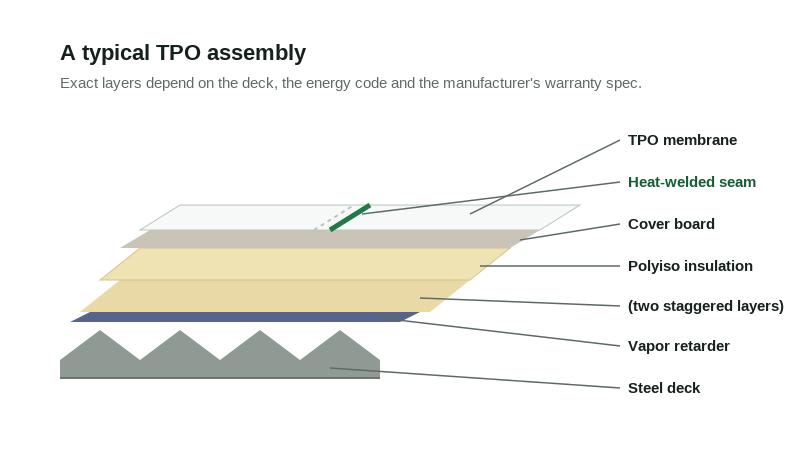
- Continuous insulation above the deck avoids gaps where heat escapes. It goes down in staggered layers, so board joints don't line up.
- Fewer fasteners through the insulation, or adhered upper layers, cut the heat lost through metal fasteners, known as thermal bridging.
- Tapered insulation slopes the roof to its drains and adds insulation at the same time, so you fix ponding and heat loss together.
- A cover board protects the insulation from hail and foot traffic, so it stays dry and keeps performing.
More insulation raises the roof surface. That can mean taller curbs, raised wall flashings, new edge metal and adjusted drains. Put those in your budget from the start; see commercial roof cost factors.
How do reflective roofs help in summer?
A dark roof absorbs summer sun and passes heat into the building. A white or light-colored roof reflects much of it. If you run an air-conditioned office, medical building, retail center or multifamily building, a reflective membrane cuts your summer heat gain. It also protects the membrane at Denver's elevation, where UV exposure is stronger than at sea level.
A reflective surface helps most with cooling. Insulation does more for winter heating, which is why we look at both together. In Denver, larger buildings may also face green building rules when the roof is replaced, such as a cool roof or other options. Check the current rules for your building before you choose a surface.
Which systems are reflective?
- TPO is usually white and is the most common reflective single-ply for re-roofs.
- EPDM is usually black and absorbs heat, though it stays flexible in deep cold. See TPO vs EPDM.
- Spray foam is finished with a flexible protective coating, often a reflective white.
- Built-up roofs can be finished with gravel, a cap sheet or a smooth coating, with different reflectance.
- Metal reflectance depends on the finish and color.
Compare all five in types of commercial roofing systems.
Can spray foam be insulation and roof in one?
Yes. Spray foam (SPF) forms a seamless roof and a continuous layer of insulation at the same time. There are no board joints and no fastener holes. If your existing roof is dry and qualifies, foam can go over it and add insulation without a full tear-off. Its reflective coating handles the surface side. The trade-off is upkeep. The coating has to be renewed on schedule, because UV at altitude wears it down and hail can crack it. See spray foam roofing and spray foam pros and cons.
Why do air leaks and details matter?
Insulation can't do its job if air moves around it. A re-roof is your chance to seal roof-to-wall transitions and close abandoned penetrations and curbs. Where the design calls for a vapor retarder and air barrier, make sure they're continuous. If your building has a humid interior, such as a pool or kitchen, the vapor retarder also keeps moisture from condensing inside the new insulation.
Rooftop equipment matters too. Are your HVAC units near the end of their life? Then plan their replacement with the roof. New, efficient units can go on properly flashed curbs at the right height, instead of cutting through a new roof a year later.
How does wet insulation waste energy?
Water that gets past a membrane soaks the insulation below it and stays there. Wet insulation loses much of its insulating value, adds weight and corrodes fasteners and decks. A roof can look fine and still be losing heat through wet areas.
An infrared moisture survey finds those areas. That matters for energy, and for deciding whether to repair, recover or replace. A recover over wet insulation traps the problem instead of fixing it.
What about green roofing systems and solar?
Owners sometimes ask about green roofing systems: vegetated roofs and rooftop solar. Both are specialty systems that we don't install, and both depend on a sound roof underneath. If you want a vegetated roof, it needs a membrane, drainage and structure designed for it.
Solar works best on a roof that won't need replacing while the array is on it; see replacing the roof before solar. For most commercial buildings, your most reliable energy gains from a re-roof still come from three things: insulation, a reflective surface and dry, well-sealed details.
How do you judge the results?
Energy savings from a roof are real but hard to see month to month, because weather, occupancy and equipment change too. A few habits make the effect easier to judge:
- Keep a baseline. Save a year or two of utility bills from before the replacement, so you can compare like seasons afterward.
- Note other changes. New HVAC equipment, lighting or a change in occupancy during the same period will affect your bills too.
- Watch comfort, not just bills. Fewer hot top-floor complaints in summer and fewer cold spots in winter are often the first signs.
- Ask for modeling when it matters. Is it a large building or a capital decision? An energy consultant can estimate the effect before you choose a scope.
How do you keep the gains?
An efficient roof stays efficient only while it stays dry. NRCA recommends inspecting low-slope roofs at least twice a year and after severe weather. Clear drains, sound seams and intact flashings keep water out of the new insulation.
Our S.M.a.R.T. maintenance program puts those visits on a schedule, and you get a written report after each one. Planning a replacement over several years? See roof capital planning.
For HOA and multifamily buildings
Top-floor units feel the roof first: hot in summer, cold in winter, and the first to see a leak. Current insulation and a reflective low-slope membrane can make those units more comfortable. A white membrane is rarely visible from the ground. If any roof areas are visible, check your design guidelines before you choose a color.
We replace commercial and association roofs across the Denver metro, including Denver and commercial roofing in Centennial. We price insulation, code items and surface options side by side, so you can see what each choice adds. Request an assessment and we'll show you where your roof stands and what a replacement would change.
Energy-efficient roofing FAQs
Will a new roof lower our energy bills?
Often, yes. The biggest gains come when a tear-off brings insulation up to the current energy code and the new surface is reflective. How much depends on what's there now and how the building is heated and cooled, so we don't promise a number.
Is a white roof worth it in Colorado's cold winters?
For most air-conditioned commercial and multifamily buildings, yes. A reflective roof cuts summer heat gain, and insulation does more for winter heating, which is why we look at both together.
Does a recover improve energy efficiency?
It can, if insulation or spray foam is added and the existing roof is dry. A recover over wet insulation traps water and loses much of the benefit.
Does the energy code apply to our re-roof?
Generally, yes. If you replace the roof down to the deck, the new roof has to meet current insulation levels. Requirements vary by jurisdiction, so we check with your building department before we price the job.
Do you install green roofs or solar?
No. We install TPO, EPDM, built-up, metal and spray foam roofs. If you're adding solar, we work alongside your solar contractor on the roof underneath.