
Home / Resources / Roof capital planning
Capital planning for commercial roof replacement
A roof replacement is one of the largest checks a building owner writes, and one of the few you can see coming years ahead. Here's how to turn roof condition into a plan you can fund and defend. And when a Colorado storm rewrites the schedule, you can adjust it.
Why do roofs belong in the capital plan?
Roofs wear out on a fairly predictable path. First come small leaks at details, then wider wet insulation. Then the roof costs more to keep patching than to replace. Because you can see that coming, you can plan for it.
When you plan, you replace roofs on your own schedule, in the season you choose, with bids you've had time to compare. Owners who don't plan replace them after the ceiling tiles come down.
Front Range buildings add two complications. Hail season runs roughly mid-April to mid-August, and a single storm can damage every roof on a campus at once.
And UV at altitude, freeze-thaw cycles, chinook winds and snow loads age each building's roof differently. That's true even for roofs installed the same year. A good capital plan is built from condition, not just age.
Step 1: what goes in a roof inventory?
Start with what you own. For each building and each roof section, record:
- System and area: TPO, EPDM, built-up, metal, spray foam or steep-slope, and the approximate size of each section.
- Age and history: install year or best estimate, the installer, past recovers and major repairs.
- Warranty: who covers it (manufacturer, workmanship or both), when it expires and what maintenance it requires.
- Leak log: where and when leaks have appeared inside. A pattern of repeat leaks in different places is a sign of a roof moving toward replacement.
- What's on the roof: rooftop units, skylights, solar, antennas and anything that will need to be lifted or reset when the roof is replaced.
If records are thin, a roofer can fill in much of it from the roof itself, including how many layers are there.
Step 2: what should a commercial roof assessment tell you?
An inventory says what you have. An assessment says what shape it's in. The most useful assessments for capital planning include:
- Condition by section, with photos for every finding.
- Moisture data. On a low-slope roof, wet insulation decides whether you can repair or recover the roof, or must tear it off. An infrared moisture survey verified with core cuts maps it.
- Remaining life as a range, with reasons. "Replacement likely within the plan window if the north-section seams keep opening" tells you what to watch. A single number doesn't.
- Options and their cost drivers: repair, recover or replace, for each section.
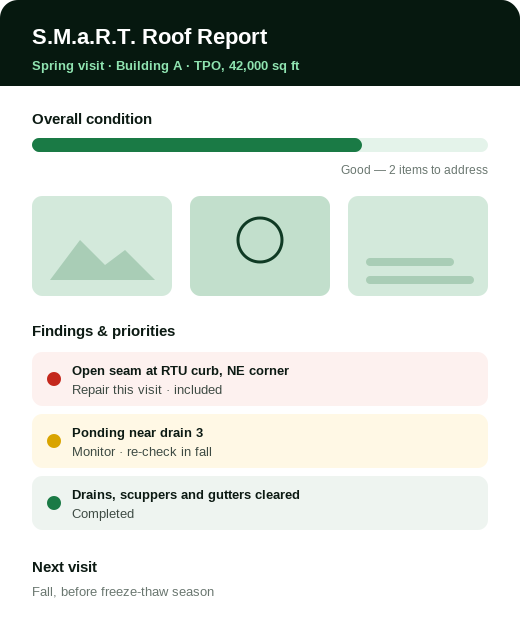
We write our inspections and IR surveys for the people who sign off on the money. That means owners, asset managers, boards and lenders.
Step 3: which path fits each roof?
| Path | When it fits | What it means for the plan |
|---|---|---|
| Maintain and repair | Dry insulation, sound membrane, problems limited to details | Operating budget; reassess each year |
| Repair and extend | Localized wet areas that can be cut out and replaced | A smaller project now pushes replacement later |
| Recover | A dry roof, structure that can carry another layer, and code room for it | Lower cost than a tear-off; plan it only after a moisture survey |
| Replace | Widespread wet insulation, two existing roofs or a failing deck | A capital project, with code upgrades priced in |
For spray foam roofs, recoating on schedule belongs in the plan as its own line. See spray foam roofing.
Step 4: how do you put budget ranges on the plan?
A capital plan needs numbers, but a generic price per square foot from someone else's building will mislead you. Budget ranges should come from your roofs, accounting for the factors that move the price on each one:
- Tear-off versus recover, and how many layers come off
- Insulation the current energy code will require at replacement, and the curb, flashing and edge changes that follow
- Likely deck repairs on older buildings, carried as a contingency
- Drainage work: tapered insulation, crickets, added drains
- Rooftop equipment that must be disconnected, lifted or reset
- Access, height, staging and work around occupants
- The warranty level you want
Material and labor costs move, so refresh ranges whenever the plan is updated. More in commercial roof cost factors. Our estimating is led by a CPA, so the numbers come laid out the way finance teams read them.
Step 5: when should the work happen?
Your roofing project timeline starts long before the crew shows up. Work backward from the season you want the crew on the roof:
Assessment
Inspection, moisture survey and a written report. Infrared surveys need clear, calm evenings, so late spring through early fall is easiest.
Budget approval
Board, owner or lender sign-off, plus any tenant notice your leases require.
Scope and bids
A defined scope every bidder prices the same way, and time to compare.
Permits and materials
Permit reviews and lead times vary by city and product.
Construction
Building by building or section by section, with weather setting the pace.
Closeout
Walkthrough, punch list, warranties and final payment after sign-off.
Decisions made in winter usually get better scheduling. After a major hailstorm, demand jumps across the metro, and labor and materials get hard to find. If the work needs to be spread over several years, see phasing a roof replacement.
Step 6: how do you leave room for hail?
Insurance pays for sudden damage, not wear, but in Colorado the two meet often. Plan for it:
- A claim can move replacement forward. If hail replaces roofs early, update the plan so you aren't still saving for roofs that are now new.
- Older roofs may be paid at less than replacement cost. Depending on the policy, depreciation may be deducted. See ACV vs replacement cost.
- Deductibles can be large. Many Colorado commercial and association policies have percentage-based wind and hail deductibles. Yours may too. Ask your agent how yours works and plan for it.
- Current condition data helps a claim. A recent assessment shows what the roof looked like before the storm. That makes storm damage easier to show.
Truman never pays, waives or rebates a deductible on any job. Colorado's roofing contractor law forbids it on residential property, which can include condo and townhome buildings.
What else can a replacement fix?
A replacement is a chance to fix what the old roof did badly. Tear off the old roof and you'll generally have to meet current insulation levels. The upside is lower heating and cooling loads. See energy efficiency from a roof replacement.
If you're planning rooftop solar, schedule the roof work first. See replacing the roof before solar. And coordinate with HVAC replacements, so new units go onto new curbs on a new roof rather than through it a year later.
How do HOA boards plan for roofs?
Associations do this through the reserve study. The roof inputs are the same: inventory, condition, moisture data, remaining-life ranges and budget ranges by building. For more, read our guide to HOA roof reserve planning, or see our reserve planning services.
How does maintenance stretch the plan?
The cheapest capital strategy is keeping small problems small. NRCA recommends inspecting low-slope roofs at least twice a year and after severe weather. Our S.M.a.R.T. maintenance program puts those visits on a schedule. And each written report adds to the condition history your plan depends on.
You'll find us assessing commercial and association roofs all over the Denver metro, including office parks near the DTC. See our work in Aurora and commercial roofing in Centennial. Request an assessment. We'll walk your roofs and give you condition, options and budget ranges for each building.
Roof capital planning FAQs
How far ahead should we plan roof replacements?
Far enough ahead to cover every roof you expect to replace or recover while you own the building. Refresh the plan with new condition data every year or two, and after significant hail.
Why not just plan replacements by roof age?
Because roofs of the same age can be in very different condition. Drainage, sun exposure, foot traffic, storms and maintenance all change remaining life. Condition data, including moisture, is more reliable.
Can you give us budget numbers for the plan?
Yes. After an assessment, we'll give you budget ranges by building or section. They're based on scope, system and the cost drivers we see on site.
Is a recover a good way to defer capital spending?
It can be, if the roof is dry, the structure can carry the extra layer and code allows it. Put a recover over wet insulation and it fails early, so get a moisture survey first.
Does a hail claim replace the need for a capital plan?
No. A claim may replace some roofs early, but those roofs will need replacing again someday. And your budget may still have to cover deductibles and depreciation.