
Home / Resources / Repair or replace
Commercial roof repair or replacement: how to decide
Age alone doesn't decide it. Whether your roof needs a repair, a restoration or a replacement comes down to a few facts you can measure. How much of it is wet? What shape is the membrane in? What keeps failing? Here's how owners, managers and HOA boards can make the call.
What's the right question to start with?
Most commercial roof repair decisions get framed as "how old is the roof?" A better question is "what is this roof still capable of?" A well-built, maintained roof can be worth repairing well past the age printed in a reserve study. A roof that took a bad hailstorm or ran for years with a slow leak may need replacing early.
Three facts decide most cases:
- Is the insulation dry? Wet insulation is the main reason a roof that looks fine from above has to come off.
- Is the membrane or surface still sound? A membrane that still bonds, welds and flexes can be repaired. One that has shrunk, cracked or worn through can't be patched back to health.
- Are the problems local or everywhere? One failed flashing is a repair. The same failure at every curb and wall is a pattern.
Two more shape the answer: how long you plan to own or manage the building, and when the money is available.
When is commercial roof repair enough?
A repair is usually the right call when most of these are true:
- The leak has a clear, local cause. Think of a punctured membrane near a rooftop unit, a cracked pipe boot, an open seam or a loose piece of edge metal.
- The insulation around it is dry, or the wet area is small enough to cut out and replace.
- The membrane still takes a repair. TPO still accepts a reliable weld, and EPDM is still flexible and lying flat. Built-up plies are intact under the surfacing, and spray foam is still bonded under its coating.
- The problem is new, not the third patch in the same spot.
- The rest of the roof is in fair shape, with drainage that works and flashings that are holding.
- A warranty may still apply. If your roof is under a manufacturer warranty, repairs by an authorized contractor keep it in force. Check before anyone patches it.
A good repair fixes the cause and the damage it did, not just the spot above the stain. Our guide to why commercial roofs leak explains how a leak is traced to its source.
When is commercial roof replacement the better call?
- Widespread wet insulation. When a survey shows moisture across much of the roof, replacing it piece by piece costs more than it saves. See wet insulation under a flat roof.
- Leaks in many places, or the same leaks returning. Repair spending that rises year after year is a signal. It's a stronger one when each repair fixes one spot and another opens.
- A worn-out surface. TPO won't take a weld, or EPDM has shrunk and is pulling at every wall and curb. Built-up roofs are cracked through to the felts, or spray foam has lost its coating and the foam is exposed.
- Deck damage. Rusted or deflected steel deck, or soft wood deck, can only be fixed with the roof off.
- Repeated hail damage across the roof, not just in one area.
- Drainage that needs redesign. Chronic ponding from slope or drain placement is best corrected with tapered insulation during a replacement.
- Two roofs already on the building. Codes generally prohibit a third, so the next step is a tear-off.
What options sit between a patch and a new roof?
The choice isn't only repair or replace. Several middle options can add useful life to a roof that's mostly sound:
| Option | When it fits | What it involves | What it can't fix |
|---|---|---|---|
| Targeted repair | Isolated leaks or damage on a sound roof | Rebuild the failed detail, replace small wet areas | Widespread wear or moisture |
| Re-flashing | The field is sound, but flashings everywhere are aging | Rebuild base flashings, counterflashing, pipe boots and pitch pans as one project | A membrane near the end of its life |
| Restoration | The surface is worn but the roof underneath is dry | On built-up roofs, a new flood coat and gravel; on spray foam, a recoat | Wet insulation, which it would trap |
| Section replacement | One area is wet or failed and the rest is sound | Replace that section down to the deck and tie it into the existing roof | A roof failing everywhere |
| Recover | The roof is dry and code allows another layer | A new roof system over the prepared existing roof | Wet insulation, deck damage, a second existing roof |
| Tear-off and replacement | Widespread moisture, failed membrane, deck damage | Remove to the deck, repair the deck, insulate to current code, new system | Nothing; it starts over |
Each system has its own page in our commercial roofing section, and our guide to recover vs tear-off covers that choice in detail.
How does Colorado weather tip the decision?
Front Range roofs age faster than average, and the weather shapes the timing as much as the condition. Hail season runs from mid-April to mid-August, and a roof already at the margin may not get through another storm without leaking.
UV at altitude dries out sealants and surfaces. Freeze-thaw opens every small crack over the winter, chinook winds pull at loose edges and seams, and spring snow drifts against walls and units. A roof that's borderline in October is usually worse in April. Our guide to how Colorado's climate wears out commercial roofs goes deeper.
Timing works the other way too. Replacement is easiest to schedule outside the coldest months. After a major hailstorm, crews and materials are in demand across the metro. If you decide early, you have more room to plan.
What data do you need before you decide?
A repair-or-replace decision is only as good as what you know about the roof. Before an expensive choice, gather:
- A condition inspection covering the field, seams, flashings, drains, penetrations, walls and edges, with photos and a priority list.
- An infrared moisture survey confirmed with core cuts, to show where the roof is wet and how many layers are on it.
- The repair history: invoices, dates and locations of past leaks.
- Your warranty documents, so you know what's covered and what the manufacturer requires.
- Drawings or past reports, if you have them, for the deck, insulation and drainage design.
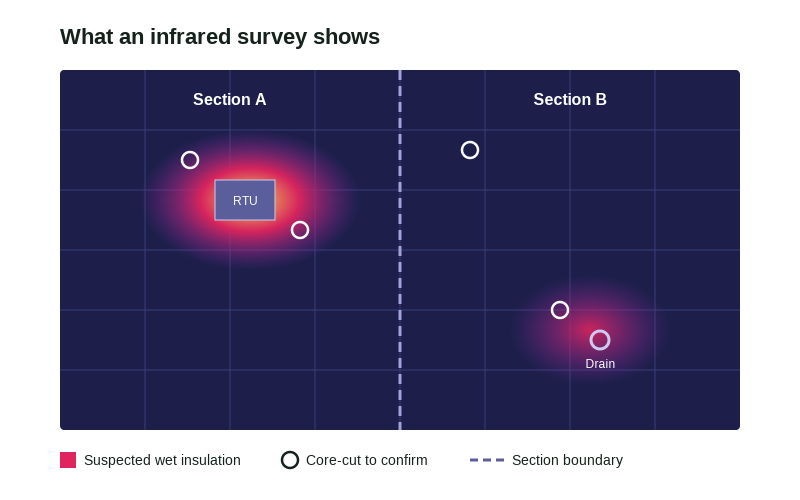
Our roof inspections and infrared surveys give you a roof plan with conditions and wet areas marked by section. Each section gets a recommended action, so you can see where a repair makes sense and where it doesn't.
How do repair and roof replacement costs compare over time?
A repair almost always costs less this year. The useful comparison is what each path costs over the time you'll hold the building. Weigh:
- The repair now, plus the repairs you can reasonably expect over the next few years
- The risk of interior damage, tenant disruption and downtime from the next leak
- Energy costs if the insulation is wet or below current levels
- Code-required work at replacement, such as added insulation, raised curbs and new edge metal
- Whether a phased approach, repairing now and replacing in a planned year, fits your budget or reserve schedule
Our guide to commercial roof cost factors explains what drives the price of each option. If you manage an association, the survey data feeds your reserve study. See HOA reserve planning.
What does a simple decision process look like?
Review the history
Past leaks, repairs, inspection reports, storms and warranty status.
Inspect and survey
Get a section-by-section inspection, plus an infrared survey and core cuts if moisture is in question.
Sort the findings
Local problems on a sound roof, patterns across the roof, and conditions that only a replacement fixes.
Lay out the options
Repair, re-flash, restore, replace a section, recover or tear off, with the cost drivers for each.
Plan the timing
Fix what's urgent now and schedule larger work for the season and budget year that make sense.
What if a hail claim is involved?
After a storm, repair versus replacement becomes part of the claim. The insurer decides coverage.
We'll document the damage, meet your adjuster on the roof and prepare a detailed scope of what the damage requires. You negotiate the claim, with your agent or a licensed public adjuster. See our hail claim timeline for how the steps fit together.
If water is coming in now, call us first at (720) 296-0000 or report a leak. Our commercial roof services cover the metro, including commercial roofing in Denver and Centennial, near the Denver Tech Center. Request an assessment and we'll lay out the options side by side.
Repair or replace FAQs
How old is too old to repair a commercial roof?
There's no single age. Condition decides it. Is the insulation dry? Does the membrane still take a repair? Are the problems local? A maintained roof can be worth repairing for years; a neglected or storm-damaged one may not be.
How much wet insulation is too much to repair?
There's no fixed cutoff. If the wet areas are limited, they can be cut out and replaced. When moisture is spread across much of the roof, replacing it piece by piece stops making sense. A survey shows where your roof falls.
Can we repair now and replace later?
Often you can. A common approach is to fix urgent problems now and schedule replacement for a planned year. That works as long as the roof stays watertight in the meantime and the wet areas aren't spreading.
Will repairs affect our manufacturer warranty?
They can. Many warranties require you to use an authorized contractor for repairs and to report leaks promptly. Before we work on a warranted roof, we check what your warranty requires.
Is a recover cheaper than a tear-off?
A recover usually involves less tear-off and disposal. But it's only an option over a dry roof, when code allows another layer. A survey and core cuts tell you whether it's possible.
Will you tell us if a repair is enough?
Yes. The same estimating team handles a pitch pan repair and a full replacement, so the recommendation doesn't change with the size of the job.