
Home / Resources / Colorado climate and commercial roofs
How the Colorado climate wears out commercial roofing
A commercial roof on the Front Range takes a beating. Hail comes every summer, the sun is strong all year, and winter brings dozens of freeze-thaw cycles. Downslope windstorms and heavy spring snow add to it. Here's what each one does to a roof, and what slows the damage down.
Why do roofs age faster on the Front Range?
Five forces do most of the damage to commercial roofs here: hail, UV at altitude, freeze-thaw cycles, chinook winds and snow loads. A low-slope roof that would last a long time in a mild climate has a harder life in the Denver metro. The city sits about a mile above sea level, near the heart of Hail Alley. The weather can move from a warm afternoon to snow overnight. Each force attacks a different part of the roof, and they make each other worse.
Knowing which force is working on your building helps you spend maintenance money where it counts. It also helps you plan a replacement built for this climate. That goes for DTC office parks, warehouses and association buildings across the south metro.
Hail, mid-April to mid-August
Colorado's hail season runs from roughly mid-April to mid-August. Storms usually build over the foothills in the afternoon and move east across the plains. A single cell can hit one office park hard and miss the next one entirely. Your neighbor's damage, or lack of it, doesn't tell you much about your own roof.
What hail does depends on the roof:
- TPO and EPDM membranes: punctures, cracks and bruising, and crushed cover board and insulation under a membrane that can look intact from above.
- Built-up and granule-surfaced roofs: cracked plies, loose gravel and granule loss that leaves asphalt open to the sun.
- Metal: dented panels, edge metal and coping, and cracked sealant at seams and laps.
- Spray foam: cracked coating that lets UV and water reach the foam underneath.
- Everything sitting on the roof: skylights, condenser fins, vent caps and rooftop unit panels.
The real problem with hail is timing. A bruised membrane or cracked cover board often leaks months later. By then, freeze-thaw has opened what the hail cracked, and the storm date is harder to pin down for a claim. A post-storm inspection matters even when nothing is dripping. Our guides to the first 72 hours after a hailstorm and hail damage to rooftop equipment cover what to check. If you're planning a replacement, start with our guide to hail-resistant commercial roofing options. It explains why the whole assembly, not just the membrane, decides how a roof comes through a storm.
UV at altitude
At a mile up there's less atmosphere between your roof and the sun. That makes ultraviolet exposure stronger than in sea-level cities, and the Front Range gets a lot of clear days. UV doesn't punch holes. It works slowly, drying out and hardening the materials that hold a roof together:
- Sealant at pitch pans, termination bars and counterflashings dries, shrinks and pulls away. Sealant-dependent details are usually the first thing to fail.
- EPDM seam tape and older adhesive seams lose their grip, and lap edges start to lift.
- Smooth-surfaced built-up roofs and asphalt flashings crack in a pattern like alligator skin once their surface coating wears.
- Spray foam coatings wear thin and have to be renewed on schedule, before the foam beneath them starts to break down.
- Weathered TPO gets harder to weld, which makes later repairs more involved.
Reflective white membranes and coatings run cooler and slow some of this wear, and a good gravel surface shields a built-up roof. On any system, you find UV damage by looking closely. Each spot is a small fix on a maintenance visit, or a leak if it's left alone.
What causes freeze-thaw roof damage?
Water gets into a small opening, freezes and widens it, and the cycle repeats night after night. Front Range winters don't stay frozen. A cold night is often followed by a sunny afternoon that melts snow on the roof. The meltwater runs into every small opening, then freezes again after dark. Water expands when it freezes. Each cycle widens a seam opening, a crack in a flashing or a gap at a coping joint a little more. Over a winter, a hairline opening becomes a leak.
Freeze-thaw does the most damage where water sits:
- Ponding areas, where meltwater collects and refreezes against seams and flashings. See ponding water on a flat roof.
- Drains, scuppers and gutters, where ice blocks the outlet and sends water back across the roof or over the edge. Our guide to drains, scuppers and crickets covers the fixes.
- Parapets and masonry, where water gets into mortar joints and coping seams and works its way down behind the flashing. See parapet wall and coping leaks.
- Hail-damaged areas, where freeze-thaw turns a bruise into an opening.
Good drainage and well-made seams matter more here than the name on the membrane. A roof that drains completely gives freeze-thaw much less to work with.
What do chinook winds do to a roof?
Chinooks are warm, dry winds that melt snow fast and bring gusts that test every edge on a roof. They come down the east side of the mountains, most often in winter. The quick melt helps with snow loads but floods drains that are still full of ice. The strongest downslope windstorms bring the hardest gusts. Buildings closest to the foothills take the brunt. That's why we pay extra attention to perimeter details on our work in Boulder, Golden, Lakewood and Arvada. High winds reach the rest of the metro too, including the gust fronts ahead of summer thunderstorms.
Wind pulls hardest at corners and perimeters, and the damage usually starts small:
- Loose or under-fastened edge metal and coping that lifts and lets wind get under the membrane
- Perimeter sheets that peel back once the edge lets go
- Ballast pushed off the corners of ballasted EPDM roofs, and gravel blown off built-up roofs
- Rooftop unit panels, vent caps and loose flashing that blow off and puncture the roof where they land
- Metal panels with fasteners that have backed out
On a replacement, wind is a design question. That means more attachment at corners and perimeters, tested edge metal, and an assembly suited to the building's height and exposure. Our guides to wind damage on commercial roofs and wind uplift ratings go further.
How do snow loads affect a commercial roof?
Snow loads put the most weight in a few spots. Denver-area snow is often heavy and wet, especially in spring storms, and it rarely sits evenly on a flat roof. Wind drifts it against parapets, rooftop units and the walls where a lower roof meets a taller one. Those drifts weigh far more than the snow on the open field.
- Weight. Every structure is designed for a snow load set by the local building code. Drifts, ice and ponded meltwater put extra weight in a few places. Call a structural engineer if you see a sagging deck, new ponding after a storm, cracking sounds or interior doors that start to stick.
- Meltwater. Snow melts from the top and refreezes at cold drains and edges. Water then backs up behind the ice and finds seams and flashings.
- Snow removal. Shovels, snow blowers and ice chippers puncture membranes. If a roof has to be cleared, leave a protective layer of snow and keep tools off the membrane.
- Sliding snow. Metal and other sloped roofs shed snow onto lower roofs, entries, walkways and parked cars. Snow guards keep it in place.
Heavier systems and recovers add weight. If a replacement adds layers, have a structural check done. See snow load on commercial roofs for what to watch after a big storm.
Temperature swings and thermal movement
Dry air at altitude lets roof temperatures swing hard between day and night. Roof materials expand and contract with every swing. That works fasteners loose on metal roofs, stresses the joints where membranes meet walls and curbs, and pulls aging EPDM away from edges. It's a big part of why flashings fail before the field of the roof does. See roof flashing failures.
How the forces stack up
None of these works alone. Hail cracks a cover board in July, and leaves clog the drain in October. In December, meltwater ponds against the damaged spot, freezes and opens it further. By March there's a ceiling stain and wet insulation under the membrane. Each problem is cheap early and expensive once they combine.
| Climate force | When | What it attacks | What helps |
|---|---|---|---|
| Hail | Mid-April to mid-August | Membranes, cover board, metal, skylights, rooftop equipment | Dense cover board, a tougher surface, a post-storm inspection |
| UV at altitude | Year-round, strongest in summer | Sealants, seam tape, coatings, smooth asphalt surfaces | Reflective surfaces, scheduled recoats, sealant checks |
| Freeze-thaw | Late fall through spring | Seams, flashings, coping joints, drains, damaged areas | Complete drainage, sound seams, early repairs |
| Chinook and high winds | Mostly winter, plus summer storms | Edge metal, perimeter sheets, ballast, loose equipment parts | Perimeter attachment, tested edge metal, secured equipment |
| Snow loads | Fall through spring, heaviest in wet spring storms | Structure at drifts, drains, membranes during removal | Drift-aware design, clear drains, careful removal, snow guards |
How do you build and maintain a roof for this climate?
Build the roof for hail, water and wind at replacement, then inspect it twice a year and after severe weather.
At replacement
- A dense cover board over the insulation, to protect against hail and foot traffic
- A membrane or surface chosen for the building's exposure, with a reflective surface where cooling loads matter
- Tapered insulation and crickets that move water to the drains, plus overflow drains or scuppers
- Extra attachment at corners and perimeters, and edge metal tested for wind
- Insulation brought up to the current energy code. Re-roofs generally need a permit, so check with your city's building division.
- Snow guards where sliding snow threatens entries, walkways or lower roofs
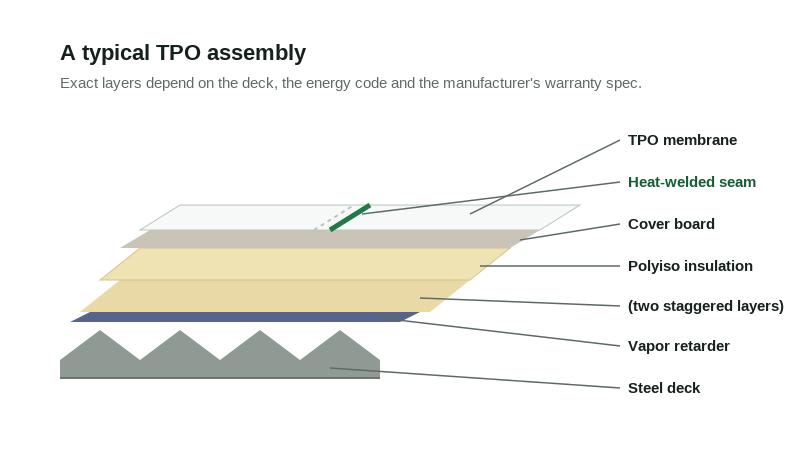
Our overview of commercial roofing systems compares how TPO, EPDM, built-up, metal and spray foam handle these conditions. The commercial roofing section covers each system in detail.
Every year
NRCA recommends inspecting low-slope roofs at least twice a year and after severe weather, and the Front Range calendar fits that schedule well. A spring visit clears what winter left in the drains. It finds seams and flashings opened by freeze-thaw and fixes weak spots before hail season. A fall visit looks for summer hail and wind damage and reseals details dried out by UV. It also clears leaves before they freeze into the drains.
A check after hail, high wind or heavy snow documents any damage while the date is fresh. That's the schedule our S.M.a.R.T. maintenance program follows, with a written report after every visit.
Where water may already be under the membrane, an infrared moisture survey finds wet insulation before it forces a replacement.
Across the metro
We inspect, maintain and replace commercial and association roofs across the Denver metro and about 30 miles around it. That runs from commercial roofing in Centennial, our home base near the Denver Tech Center, to Denver, Aurora and the foothill cities above. See all of our service areas. Andrew Rickert, our Operations Manager, leads estimating. He is a CPA, holds a Class-A GC license and has been with Truman since 2009. If you'd like to know how the climate has treated your roof, request an inspection. If water is coming in now, report a leak or call (720) 296-0000.
Colorado climate and roof FAQs
When is hail season in Colorado?
Roughly mid-April to mid-August, with most storms in the afternoon and evening. Have your roof inspected in spring, before the season starts, and again in fall. Add an inspection after any storm that dropped hail you could see.
Why does our roof leak in winter when it was fine all summer?
Often the cause is summer damage. Hail bruises, sealant dried out by UV and small seam openings may not leak until freeze-thaw opens them and meltwater ponds against them. A fall inspection catches most of these before winter.
Should we shovel snow off our flat roof?
Usually not, unless an engineer or roofer says the load is a concern. Shovels and ice tools puncture membranes. If snow has to come off, use a crew that leaves a protective layer, keeps tools off the membrane and clears drains. Watch for signs of structural stress.
Which roof system handles the Colorado climate best?
No single system wins everywhere. Performance comes from the assembly: cover board, attachment, drainage, flashings and a surface suited to the building. An inspection tells you what fits your structure, your budget and how the roof is used.
Does the climate affect our roof warranty?
It can. Many manufacturer warranties limit coverage for hail and wind. Some cover hail only up to a stated size when the roof is built to their specification. Most also expect documented maintenance, so keep every inspection report.