
Home / Resources / Roof due diligence
Roof due diligence before you buy or lease
The roof is one of the largest capital items on a commercial building, and one of the easiest to misjudge from the parking lot. Here's how you can find out what you're taking on before you sign, whether you're buying or leasing. It covers the documents to request, the inspections worth ordering and what the findings mean for the deal.
Why does the roof need its own place in the due diligence process?
General property condition reports cover the whole building, and the roof often gets a walk-over at most. That can miss the things that decide what the roof will cost you. Examples are wet insulation under a membrane that looks fine, a second roof already on the building, or a damaged deck. Hail damage from a storm years ago that was never repaired is another.
Along the Front Range, the stakes are higher. Hail season runs from mid-April to mid-August, UV at altitude ages membranes and sealants, and freeze-thaw opens whatever hail cracked. A roof that looks fine in a listing photo may need far more than the seller's disclosure suggests. A focused commercial roof assessment tells you the remaining life, the near-term repairs and a budget range before you settle on a price.
Start with the documents
Ask the seller or landlord for everything they have on the roof. What's missing tells you something too.
- Installation records: when the roof went on, who installed it, the system and the contract.
- Warranties: the manufacturer warranty, the installer's workmanship warranty, and whether either can transfer to a new owner. Transfers often have conditions, such as a manufacturer inspection or paperwork. Read the terms or ask the manufacturer.
- Maintenance reports and the repair history, including invoices.
- Leak logs and tenant complaints about water.
- Previous inspections and any infrared moisture survey.
- Insurance claim history for the roof, including whether a paid claim was actually used to repair the roof.
- Permits for past re-roofs, which the city or county building division may also have on file.
- Roof plans or drawings.
- Rooftop agreements for telecom antennas, solar arrays or other equipment owned by third parties. They put other people on your roof and complicate a future replacement.
Order the right inspection
The level of inspection should match the size of the decision. You can order anything from a condition walk to a full survey with core cuts. See our roof inspections.
| Inspection | What it answers | Worth it when |
|---|---|---|
| Condition inspection | Section-by-section condition of the field, seams, flashings, drains, penetrations, walls and edges, with photos and a priority list | Every purchase or lease |
| Infrared moisture survey | Where the insulation is wet, mapped on a roof plan and verified with cores | Older roofs, a history of leaks, or a close repair-or-replace call |
| Core cuts | How many roofs are on the building, the insulation type and thickness, the deck and whether it's wet | Whenever a recover or replacement is on the table |
| Drone roof report | Overhead imagery of large, tall or multi-building roofs | Portfolios, large footprints and hard-to-reach roofs |
Don't skip the inside. Look for water stains on top-floor ceilings, replaced ceiling tiles and buckets in a storage room. They're some of the most honest evidence a building offers.
Why moisture data matters most
Wet insulation is the single finding most likely to change the price of a roof. It loses insulating value, adds weight, rusts fasteners and decks, and rules out a recover in the wet areas. A membrane over soaked insulation often looks exactly like one over dry insulation. A visual inspection can't tell the difference. An infrared roof moisture survey, verified with core cuts, can.
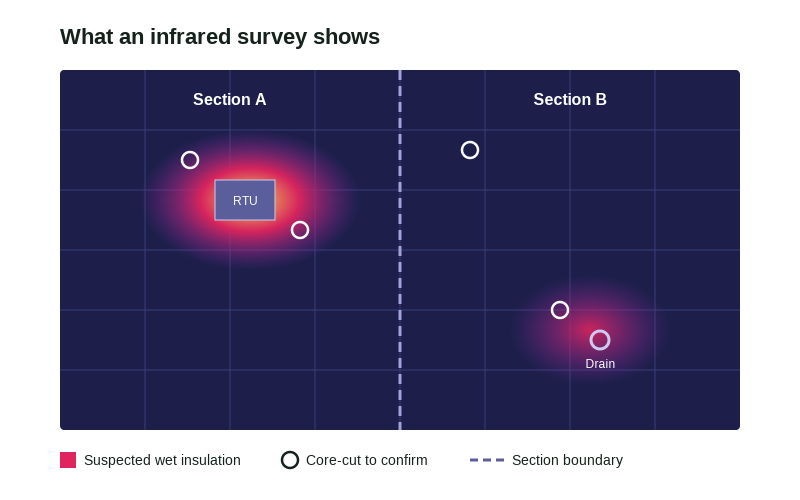
Infrared surveys need the right conditions: a sunny day, a dry roof surface and a clear, calm evening. So tell your inspector your closing and due-diligence dates on the first call. Then the survey can be booked for the first good evening.
What the findings mean for the deal
- Number of roofs. Codes generally don't allow a recover when there are already two roofs. On a building like that, the next project is a full tear-off.
- Extent of wet insulation. A few wet areas can be cut out and replaced. Widespread wet insulation points to replacement.
- Deck condition. Rusted steel or damaged deck adds cost once the roof is opened.
- Drainage. Ponding and poorly placed drains shorten roof life and may need tapered insulation or new drains at replacement.
- Details. Failed flashings, curbs and coping are repair items, and they're where most leaks start.
- Rooftop equipment. Aging units, crowded curbs and abandoned equipment all affect the next roof.
- Code at replacement. A tear-off generally has to meet current energy code insulation. In Denver, larger buildings may also face Green Buildings Ordinance requirements. Both affect the replacement budget.
A good report turns these into remaining-life estimates by section, a repair list in priority order and budget ranges for larger work. It should be written so your lender, partner or investment committee can follow it. For what drives those budgets, see commercial roof cost factors.
Check the hail history
Many Front Range roofs have a hail history, and damage isn't always repaired after a claim is paid. Ask whether the roof has had hail claims and whether the money went into the roof.
Check storm records for the address in the NOAA Storm Prediction Center's storm reports. See also our guide to NOAA hail reports and the date of loss. Damage from before you owned the building may not be something you can claim. Ask your insurance agent how existing damage affects your new policy before you close.
Using what you learn
Roof findings give you options: a price adjustment, a seller repair before closing, a credit, or a line in your first-year capital budget. Your broker and attorney can advise on how to structure any of them. What matters is that the roof's condition is a known number when you negotiate, not a surprise in your first winter. After closing, a roof maintenance plan keeps the roof you just evaluated from sliding backward.
If you're leasing
Tenants inherit roof problems too. Before you sign:
- Read who's responsible. Leases split roof repair and replacement between landlord and tenant in different ways. Some put more on you, the tenant, than you might expect. Have your attorney review those clauses.
- Document the condition at move-in. A baseline inspection protects you if you later disagree with the landlord about what was already wrong.
- Ask about the warranty and who is allowed to authorize roof repairs, so a leak call doesn't void coverage.
- Plan your own rooftop equipment. New units, exhaust or antennas need curbs and flashing done right, and the lease may say who can do the work.
Roof due diligence checklist
Request documents
Installation records, warranties and transfer terms, maintenance and repair history, leak logs, claim history, permits, plans and rooftop agreements.
Share your dates
Give the inspector your due-diligence and closing dates up front.
Inspect
Order a condition inspection. Add an infrared survey and core cuts when the roof is older or the decision is close.
Check the history
Hail reports, past claims and whether repairs were made.
Price the findings
Remaining life, near-term repairs and budget ranges, then decide how to handle them in the deal.
We inspect commercial and association roofs for buyers, owners and tenants across the Denver metro. That includes office and flex buildings around the Denver Tech Center. See commercial roofing in Centennial and Englewood. Request a pre-purchase roof inspection and tell us your dates.
Roof due diligence FAQs
Isn't the general property inspection enough?
For a small, newer roof it may be a start. For most commercial roofs it isn't. A general report rarely includes core cuts or moisture data, and those decide whether your roof needs repairs or replacement.
Can you take core cuts on a building we don't own yet?
With the owner's permission, yes. We patch each core watertight with compatible materials. If the roof is under a manufacturer warranty, we check its requirements first.
Will the roof warranty transfer to us?
It depends on the warranty. Some transfer with conditions, such as a manufacturer inspection or paperwork, and some don't transfer at all. Read the terms or ask the manufacturer before closing.
How can we tell if the roof has old hail damage?
An inspection with test cuts shows the damage, and storm reports show when hail hit the area. The seller's claim history shows whether a claim was paid. Together they tell you whether the roof was repaired.
Can our lender use the report?
Yes. We write our reports for the people who approve the money. They include roof plans, photos, condition by section, remaining-life estimates and budget ranges.